

Why Beginners Get Curious About Vedic Numerology
Many people first discover numerology in a very casual way. Someone tells them their number is lucky. A friend says their Birth Number explains their personality. A numerologist mentions Moolank, Bhagyank, favorable dates, or name vibration. Then at some point they hear the phrase Vedic Numerology and wonder whether it is different from ordinary numerology, different from Indian numerology, or simply a spiritual-sounding version of the same thing.
This confusion is extremely common. The word “Vedic” immediately gives the impression that the system must be very ancient, very sacred, and perhaps very difficult. On the other hand, modern online numerology often presents number readings in a very simplified way, almost like personality entertainment. So beginners are left between two extremes. One side makes numerology sound mystical but vague. The other makes it sound easy but shallow.
The truth is more balanced. Vedic Numerology is a meaningful and structured way of reading number vibration through an Indian spiritual lens. It is not merely random superstition, and it is not just a collection of lucky-number tricks. At the same time, a beginner does not need to be a Sanskrit scholar or a full astrologer to understand its foundations. Once the core ideas are explained properly, the system becomes surprisingly approachable.
This guide is written for readers who want a clear beginning. It explains what Vedic Numerology is, why it matters, how it is commonly practiced, what the key core numbers are, how planetary symbolism is connected with numbers, and how beginners can start using the system wisely without getting lost in jargon.
The goal is not to overwhelm you. The goal is to help you understand the basic framework so that later number interpretations, compatibility readings, yearly cycles, name corrections, or business number suggestions make more sense.
What Vedic Numerology Actually Means
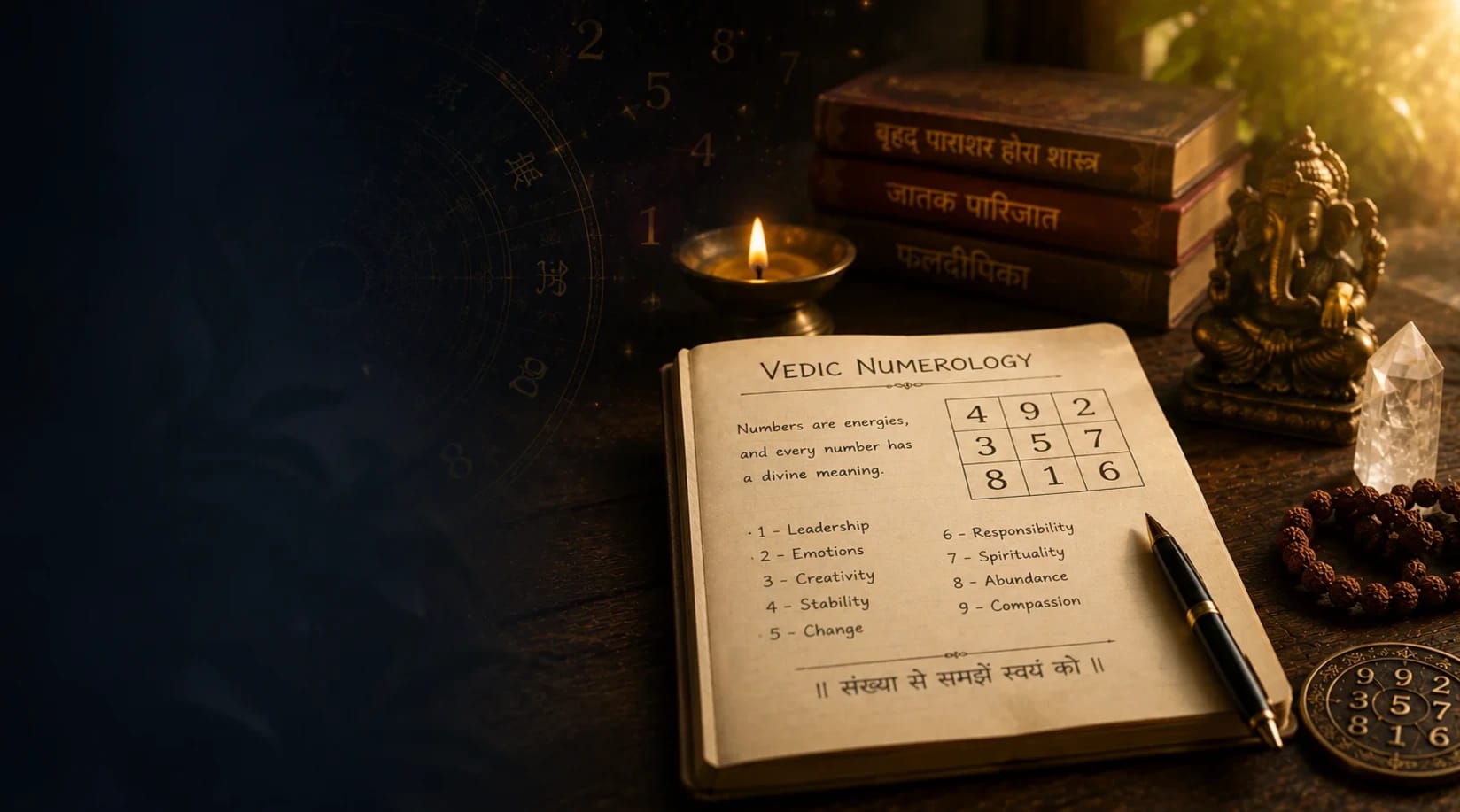
Vedic Numerology is an Indian style of numerological interpretation that treats numbers as carriers of subtle meaning, life vibration, karmic indication, and symbolic force. In practical terms, it is used to understand a person’s temperament, strengths, weaknesses, patterns, life direction, and sometimes compatibility, timing, and remedial guidance.
The reason it is called “Vedic” is that it is usually framed within the broader spiritual atmosphere of Indian knowledge traditions. It feels naturally connected to ideas such as karma, destiny, graha influence, spiritual growth, and dharmic life direction. For many readers, this makes it feel closer to Jyotish than to Western pop-style numerology.
However, it is important to be precise here. In modern usage, “Vedic Numerology” does not always mean one rigidly standardized system with zero variation. Different numerologists may teach it with slightly different emphasis. Some focus heavily on Birth Number and Destiny Number. Some integrate name vibration. Some add stronger links with planetary remedies or timing. Some combine older Indian interpretations with modern practical methods.
So the best beginner definition is this: Vedic Numerology is an Indian number-reading system that interprets numbers through a spiritual, karmic, and planetary framework. It looks at numbers not just as mathematical values, but as symbolic keys to human nature and life patterns.
How Vedic Numerology Is Different from Casual Number Reading
One reason serious readers are drawn to Vedic Numerology is that it goes deeper than casual number superstition. In casual number culture, people often ask questions such as:
- Which number is lucky for me?
- What color matches my number?
- Which date should I choose?
These questions are not wrong, but by themselves they can make numerology look shallow. Vedic Numerology begins at a deeper level. It asks:
- What is the vibration of your birth?
- What kind of karmic pattern are you carrying?
- What is your natural mental style?
- What kind of life lessons repeat around you?
- What energies support your growth, and where do you feel resistance?
In other words, Vedic Numerology is not only about luck. It is about meaning. It attempts to understand how number patterns reflect personality, destiny tendencies, strengths of expression, and life movement.
This does not mean every numerologist explains it with the same depth. But the system itself is most useful when it is treated as a tool for self-understanding and alignment, not merely as a source of random lucky-number advice.
The Two Core Numbers Most Beginners Start With
For beginners, the easiest way into Vedic Numerology is through two very important numbers:
- Birth Number, often called Moolank
- Destiny Number, often called Bhagyank
These two numbers are the usual foundation of basic Vedic Numerology reading.
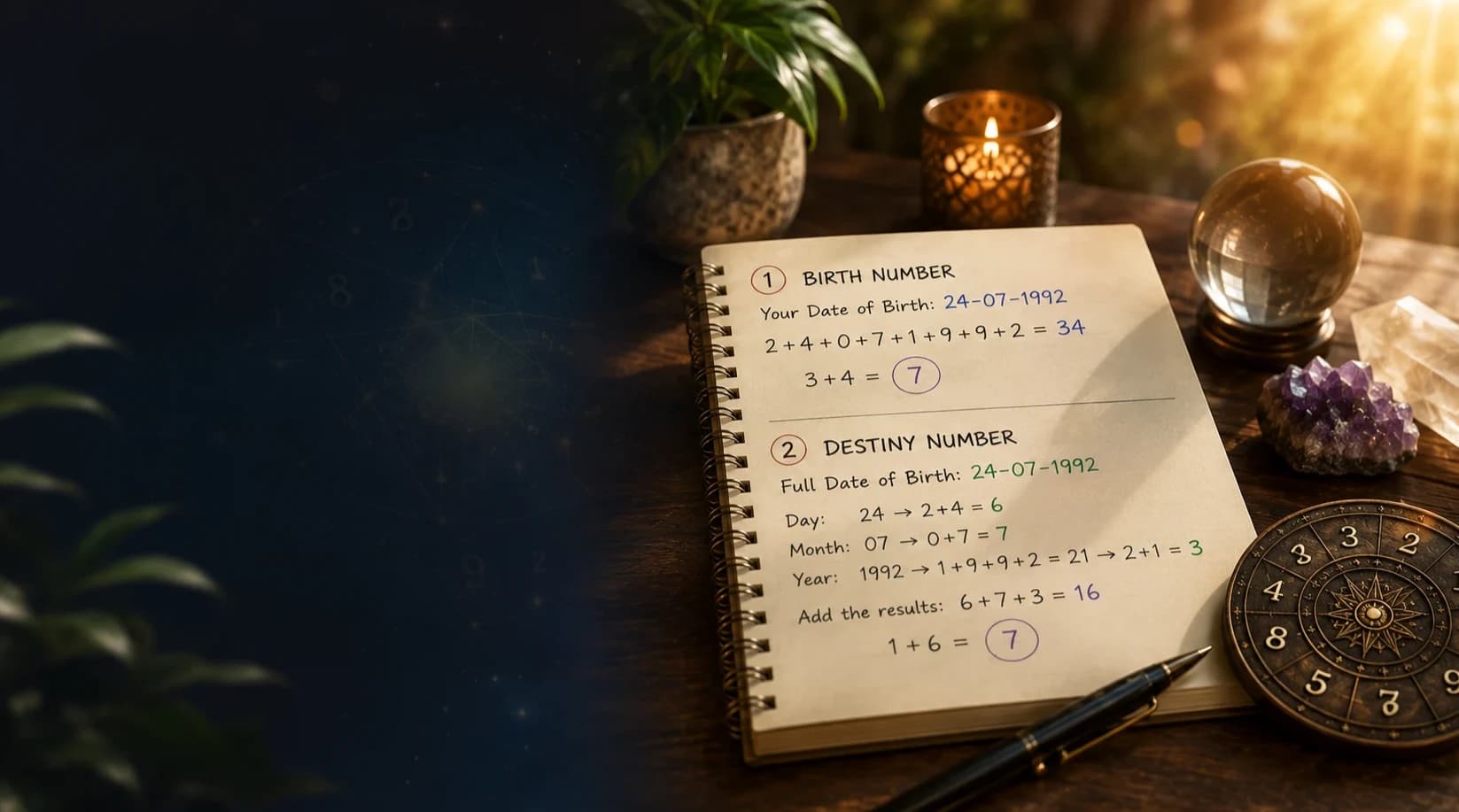
The Birth Number is usually taken from the day of the month on which you were born. If someone is born on the 5th, the Birth Number is 5. If someone is born on the 24th, the digits are reduced, so 2 + 4 = 6, and the Birth Number becomes 6.
The Destiny Number is usually calculated from the full date of birth. All the digits are added together and then reduced until a single digit is reached, depending on the method being followed.
These two numbers are not treated as duplicates. They are read differently.
- The Birth Number is often understood as your immediate personal vibration, basic nature, instinctive style, and outer personality tendency.
- The Destiny Number is often understood as the broader life-path vibration, the direction of fate, deeper life lessons, and the larger current through which your journey unfolds.
This distinction is one of the first things a beginner must understand. Many readers make the mistake of thinking one number explains everything. In practice, Vedic Numerology becomes richer the moment you see that more than one number is speaking at once.
What the Birth Number Reveals
The Birth Number, or Moolank, is usually the easiest number for a beginner to connect with personally. It often describes how a person acts, reacts, expresses themselves, and naturally operates in daily life.
For example, some Birth Numbers may suggest initiative and leadership, while others may indicate sensitivity, diplomacy, analysis, creativity, discipline, intensity, or idealism. The exact interpretation varies by number, but the broad idea remains the same: the Birth Number often feels close to the person’s visible and immediate personality pattern.
That is why many people say, “My Birth Number description feels very much like me.” It is often the number that shows how you move through life on a day-to-day level, how you make quick decisions, what kind of social energy you carry, and what your immediate strengths and challenges look like.
This does not mean the Birth Number tells the whole story. But for beginners, it is often the easiest entry point because it is concrete, personal, and directly connected to the self.
What the Destiny Number Reveals
If the Birth Number describes the visible personal vibration, the Destiny Number usually points toward the larger movement of life. It can be thought of as a deeper current running beneath daily personality.
The Destiny Number is often used to understand:
- long-term life direction
- the broader path of opportunity and challenge
- what kind of growth life seems to push you toward
- how your journey unfolds over time
This is why some readers feel that their Destiny Number describes what their life is gradually becoming, even if their day-to-day temperament feels more accurately described by the Birth Number.
For example, a person may have a Birth Number that feels social, expressive, and spontaneous, while their Destiny Number may indicate discipline, responsibility, structure, or spiritual maturity. In real life, such a person may feel both energies at work: one in their personality, another in the larger arc of their life journey.
This is an important beginner lesson. Vedic Numerology is not usually about reducing you to one label. It is about understanding how multiple number vibrations interact.
How Numbers Are Linked with Planets
One of the defining features that makes Vedic Numerology feel distinctly Indian is its connection with planetary symbolism. In many interpretations, numbers from 1 to 9 are associated with grahas or planetary energies. This does not mean numbers are simply planets in disguise. It means numerologists often read them through a planetary language.
This planetary connection is one reason Vedic Numerology feels so natural to readers of astrology. If someone already understands that planets symbolize different energies— such as authority, emotion, discipline, expansion, beauty, struggle, intellect, or karma— then number symbolism becomes easier to understand through that lens.
For beginners, the most important thing is not to memorize every mapping immediately. The important thing is to understand the principle: numbers are often interpreted as symbolic energy streams, and those streams are frequently understood through graha-like qualities.
This is also why Vedic Numerology often feels more spiritual and karmic than casual modern number culture. It is not merely counting. It is symbolic reading.
Why Vedic Numerology Feels Spiritual to Many Readers
Many readers say Vedic Numerology feels more meaningful than surface-level number reading because it naturally fits into an Indian spiritual worldview. It does not usually treat life as random luck. It tends to assume that patterns have meaning, that karmic tendencies exist, and that self-awareness can help a person live more consciously.
This spiritual tone appears in several ways:
- numbers are treated as vibrational rather than merely quantitative
- life challenges are often read as lessons, not only misfortunes
- timing and correction are often linked with alignment, not superstition alone
- guidance may include remedies, discipline, awareness, or self-refinement
This is one reason Vedic Numerology resonates strongly with readers who do not want numerology to feel like entertainment alone. They want a system that helps them reflect, make decisions, and understand patterns in a deeper way.
At the same time, being spiritual does not mean becoming vague. A good Vedic Numerology reading should still be practical. It should help the reader understand themselves in a grounded way, not simply surround numbers with mystical language.
What Vedic Numerology Is Commonly Used For
Once beginners understand the basics, they usually want to know how the system is actually used in real life. In practice, Vedic Numerology is commonly applied to questions such as:
- understanding personality and temperament
- identifying life direction and repeating patterns
- relationship compatibility
- favorable dates and timing
- career tendency and natural strengths
- business naming or brand vibration
- mobile number, vehicle number, and house number guidance
- self-awareness and karmic pattern reflection
Not every practitioner uses every application in the same way. Some are more spiritual and psychological. Some are more practical and remedial. Some focus heavily on personal numbers, while others go deeper into name correction and number alignment.
But for the beginner, the most useful understanding is this: Vedic Numerology is not just about labeling your personality. It is also used to guide choices, reflect on timing, and support a more aligned relationship with your own life pattern.
Does Vedic Numerology Use Name Numbers Too?
Yes, many practitioners do include name numerology within a Vedic or Indian numerology framework, although the exact method may vary. This is another place where beginners often get confused.
Some numerologists focus primarily on Birth Number and Destiny Number. Others place significant importance on the Name Number, especially for public expression, social vibration, branding, professional identity, or correction of repeated imbalance.
The basic idea is that your birth numbers reflect your original pattern, while your name can influence how you express yourself in the world. In some traditions, if birth-number patterns seem difficult or imbalanced, a numerologist may suggest adjusting the spelling of a name to create more supportive vibration.
This is one reason Vedic Numerology sometimes overlaps with broader Indian Numerology. In modern practice, many numerologists combine birth-based reading with name-based correction. For a beginner, the key thing to remember is that birth numbers are usually the foundation, while name numbers may add another applied layer.
How to Calculate Your Core Numbers as a Beginner
A beginner does not need to master every advanced rule to start exploring Vedic Numerology. The simplest beginning is to calculate the Birth Number and Destiny Number carefully.
Birth Number:
- If you were born on the 1st to 9th, that date is already your Birth Number.
- If you were born on a double-digit date, reduce it. For example, 14 becomes 1 + 4 = 5. The 23rd becomes 2 + 3 = 5. The 29th becomes 2 + 9 = 11, then 1 + 1 = 2, depending on the reduction style being used.
Destiny Number:
- Add all digits of the complete date of birth.
- Then reduce the sum until you reach the final working number according to the numerology method being used.
For example, if someone is born on 24-08-1992:
- Birth Number = 2 + 4 = 6
- Destiny Number = 2 + 4 + 0 + 8 + 1 + 9 + 9 + 2 = 35, then 3 + 5 = 8
So this person would begin with Birth Number 6 and Destiny Number 8.
This basic calculation is often the beginner’s first proper entry into the system.
Common Beginner Mistakes in Vedic Numerology
There are several mistakes that beginners make again and again when trying to understand Vedic Numerology:
- thinking one number explains everything
- mixing different numerology systems without realizing it
- jumping to name correction before understanding birth numbers
- assuming “lucky” and “unlucky” are the only meaningful outcomes
- treating every negative reading as fear-based prediction
- memorizing number keywords without understanding vibration
Another common mistake is trying to learn numerology through fragmented social media content alone. Short videos and quote cards may be entertaining, but they often remove the structure that makes the system meaningful.
A better beginner approach is to learn slowly and in order: first understand what the system is, then learn Birth Number, then Destiny Number, then planetary symbolism, then name vibration, and only after that move into more advanced applications like timing, correction, and compatibility.
How to Start Learning Vedic Numerology Properly
If you want to begin in a grounded and effective way, follow a simple sequence:
- Understand what Vedic Numerology is and what it is not.
- Calculate your Birth Number correctly.
- Calculate your Destiny Number correctly.
- Study the broad meaning of numbers 1 to 9.
- Observe how your Birth Number and Destiny Number differ.
- Learn the basic planetary symbolism connected with numbers.
- Only later explore name numerology, compatibility, yearly cycles, and remedies.
This sequence prevents confusion. It helps you build a real foundation instead of collecting disconnected facts.
The best learners in numerology are usually not the ones who memorize the most keywords. They are the ones who understand the logic of the system and then watch how it plays out in real life.
Is Vedic Numerology Scientific or Symbolic?
This is a question thoughtful readers often ask. The honest answer is that Vedic Numerology is best understood as a symbolic and interpretive spiritual system, not as laboratory science in the modern experimental sense.
It works through meaning, correspondence, pattern recognition, and traditional symbolism. Its purpose is not to replace logic or evidence-based decision making. Its purpose is to offer another layer of insight into temperament, timing, tendency, and self-reflection.
Used wisely, it can help a person think more consciously about their nature and choices. Used blindly, it can become superstition. That is true of many spiritual systems.
The mature approach is not to treat Vedic Numerology as magical control over fate. Nor is it necessary to dismiss it as nonsense simply because it uses symbolism. A balanced reader uses it as a reflective guidance system— one that can be meaningful when handled with intelligence and proportion.
Why Beginners Often Feel Seen by Vedic Numerology
Many beginners feel an immediate connection with Vedic Numerology because it offers language for things they already sense in themselves but have never organized clearly. A person may always feel internally serious yet socially warm. Another may feel outwardly expressive but inwardly burdened by responsibility. Another may repeatedly attract certain life themes and not know why.
When the Birth Number and Destiny Number are read properly, people often feel that their patterns are being named in a meaningful way. This does not happen because numerology is “proving” them with cold measurement. It happens because symbolic systems can sometimes articulate inner structure in a way that feels deeply resonant.
This is also why numerology should be read with maturity. Its value lies not in reducing a person to one label, but in giving language to pattern, timing, and self-observation.
Final Thoughts on What Vedic Numerology Is
Vedic Numerology is best understood as an Indian spiritual number-reading system that connects numbers with personality, destiny, karma, planetary vibration, and life pattern. It is not merely a game of lucky numbers, and it is not useful only for name correction or favorable dates. At its best, it is a reflective framework for understanding how number symbolism may relate to human life.
For beginners, the right starting point is simple: learn what the system is, calculate your Birth Number and Destiny Number properly, and begin observing the difference between your immediate personality vibration and your deeper life-path current.
From there, everything else becomes easier. Name numerology, compatibility, yearly cycles, and practical applications all make more sense once the foundation is clear. Without the foundation, numerology feels scattered. With the foundation, it becomes structured and insightful.
So if you have been wondering what Vedic Numerology really is, the simplest answer is this: it is a meaningful way of reading numbers through an Indian spiritual lens to better understand self, direction, and life pattern.
Editorial insight
Vedic Numerology becomes clear the moment a beginner stops asking only which number is lucky and starts asking what number vibration is trying to reveal about nature, karma, and direction. That is where the system begins to deepen from curiosity into real insight.
- My Destiny Path Editorial Team
Real-Life Case Study
A beginner once came to learn numerology after reading conflicting number descriptions online. One source said her number made her creative and affectionate. Another said the same number meant discipline and karmic struggle. She assumed one of the sources had to be wrong. But once her Birth Number and Destiny Number were calculated separately, the confusion disappeared. One number was describing her immediate personality and emotional style, while the other was describing the larger pressure and direction of her life path. The contradiction was not in numerology itself. The contradiction was in trying to read multiple layers of life through only one number. As soon as the framework became clear, the system stopped feeling random and started feeling precise. That is often how beginners first begin to trust the logic of Vedic Numerology.
Key terms in this article
- House
- A life area in the birth chart, such as marriage, career, wealth, home, or health.