

Why So Many Beginners Want to Build Their Own Lo Shu Grid
Once people discover the Lo Shu Grid, the next natural question is not only what it means, but how to actually make it. They may already know that it belongs to a Chinese numerology tradition, that it uses a 3×3 structure, and that missing or repeated numbers can reveal useful insights about personality and balance. But without knowing how to build the grid correctly, the whole system remains abstract.
This is exactly where many beginners get stuck. They understand the idea in theory, but when they sit down with their own date of birth, they are unsure what to do next. Should they reduce the whole birth date first? Should they place the full year inside the grid as one block? What happens to zero? Do repeated numbers matter more than single ones? And how do they know whether the grid they made is correct?
These are not silly questions. In fact, they are the right questions. Lo Shu Grid reading becomes useful only after the structure is built properly. If the grid is made incorrectly, the interpretation will also become unreliable. That is why the first real lesson in Lo Shu practice is not mystical at all. It is procedural. You must know how to construct the chart from the birth date clearly and accurately.
The good news is that once you learn the process, the Lo Shu Grid is not difficult to make. The steps are simple, but they must be followed carefully. And once you create your own grid with confidence, the system becomes much more engaging. You are no longer reading about a concept. You are looking at your own symbolic pattern.
This guide will walk you through the exact beginner method for making a Lo Shu Grid from your date of birth. It will explain the fixed 3×3 arrangement, show you how to place numbers correctly, clarify what to do with zero, help you understand repeated and missing digits, and highlight the most common beginner mistakes so you can avoid them from the start.
What You Need Before You Start
The Lo Shu Grid is built from one very basic piece of information: your date of birth. That means before you do anything else, you need to have your birth date written correctly in numerical form.
For example:
- 24-08-1992
- 15-11-2001
- 03-04-1988
The exact separator does not matter. You can write it with dashes, slashes, or spaces. What matters is that you clearly know which part is the day, which part is the month, and which part is the year.
This is important because many mistakes begin with wrong date formatting. If you confuse day and month, your grid will be wrong from the very beginning. So before moving ahead, make sure the actual birth date is correctly understood.
Once that is ready, you do not need advanced math, astrology software, or complicated numerology formulas. For a basic Lo Shu Grid, you only need:
- your correct date of birth
- a blank 3×3 grid or a notebook page
- an understanding of where numbers 1 to 9 are placed
That is all. The rest is a matter of method.
The Fixed Lo Shu Grid Layout You Must Know
The Lo Shu Grid is not created by placing numbers randomly. It uses a fixed arrangement of the numbers 1 to 9 inside a 3×3 square. This arrangement is the heart of the method, so you must learn it first.
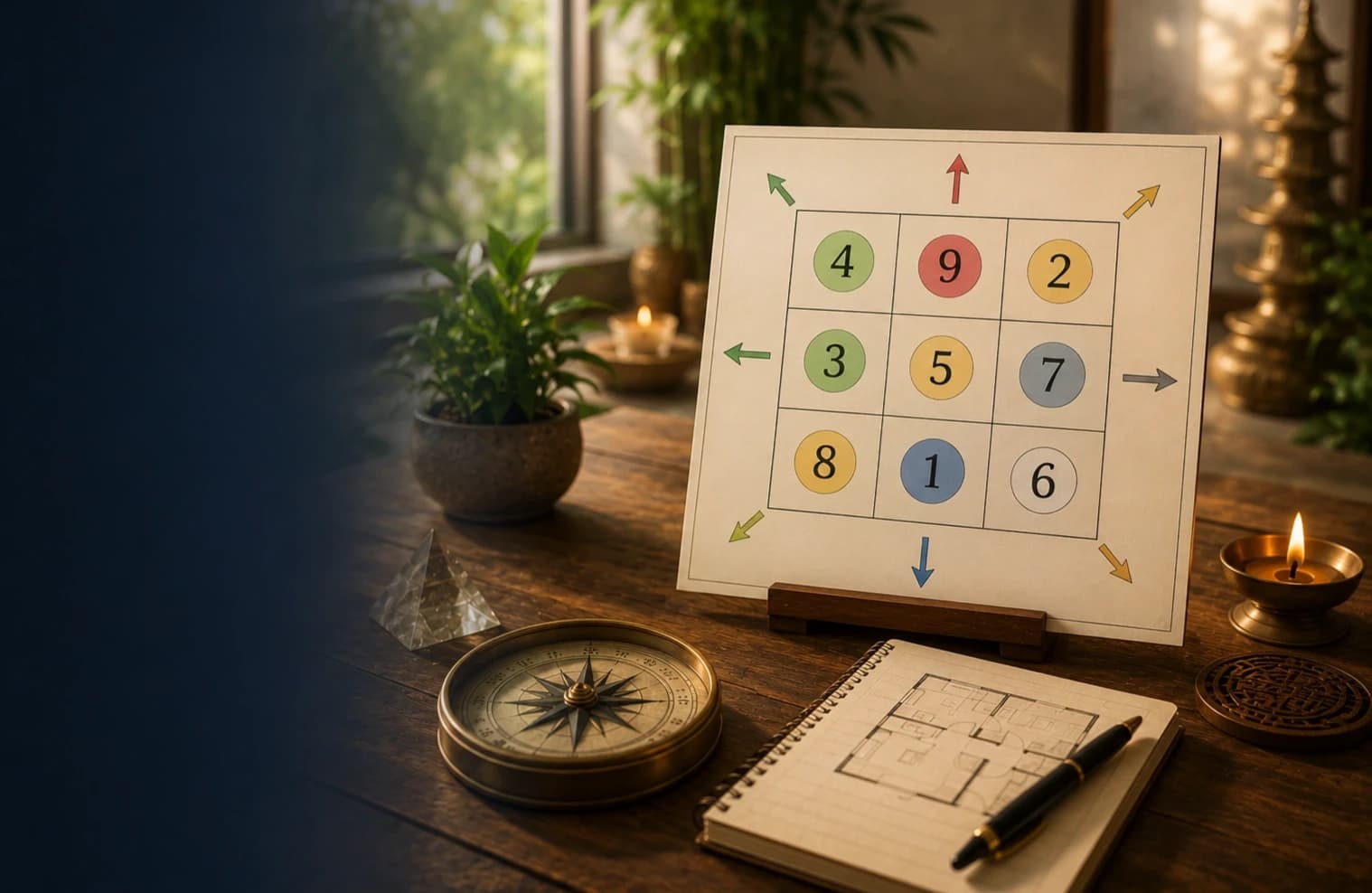
The standard Lo Shu layout is:
- 4 - 9 - 2
- 3 - 5 - 7
- 8 - 1 - 6
This means each number has a specific place in the grid. Number 4 is always in the top-left position. Number 9 is always in the top-middle. Number 2 is always in the top-right, and so on.
You do not create a new arrangement for each person. The arrangement stays the same for everyone. What changes from person to person is which numbers from the birth date appear in those positions, how many times they appear, and which positions remain empty.
This is why the Lo Shu Grid feels more like a map than a list. The positions matter. The gaps matter. The repetitions matter. If the layout is wrong, the entire reading will shift incorrectly. So before doing anything else, memorize or write down the correct grid format.
Step 1: Write Your Full Date of Birth as Digits
The first working step is to write your full date of birth using digits only.
For example, if your birth date is:
- 24-08-1992
then your digits are:
- 2, 4, 0, 8, 1, 9, 9, 2
If another birth date is:
- 15-11-2001
then your digits are:
- 1, 5, 1, 1, 2, 0, 0, 1
At this stage, do not reduce the whole date into one number. Do not calculate Birth Number or Destiny Number. Do not compress the year. The Lo Shu Grid works with the actual digits of the birth date, not with a reduced total.
This is one of the most common beginner mistakes. People sometimes think, “I already know my Birth Number and Destiny Number, so I should use those.” That is not how the Lo Shu Grid is built. It uses the birth-date digits directly.
Step 2: Ignore Zero When Placing Numbers in the Grid
This is another place where beginners often hesitate: what should be done with zero?
In the common beginner Lo Shu method, the grid works with numbers 1 to 9. That means zero is not placed into any box. You do not create a tenth space for it, and you do not force it into another number’s place.
So if your birth date includes 0, simply acknowledge that it is part of the birth date, but do not place it into the 3×3 Lo Shu chart.
For example:
- 24-08-1992 gives the digits 2, 4, 0, 8, 1, 9, 9, 2
When creating the grid, the working digits become:
- 2, 4, 8, 1, 9, 9, 2
The zero is ignored for placement.
This does not mean the date is incomplete. It only means the Lo Shu Grid is based on the active placement of digits 1 through 9.
Step 3: Count How Many Times Each Number Appears
Now that you have your working digits, the next step is to count how many times each number from 1 to 9 appears.
Let us take the example:
- 24-08-1992
Ignoring zero, the digits are:
- 2, 4, 8, 1, 9, 9, 2
Now count them:
- 1 appears once
- 2 appears twice
- 3 appears zero times
- 4 appears once
- 5 appears zero times
- 6 appears zero times
- 7 appears zero times
- 8 appears once
- 9 appears twice
This counting step is extremely helpful because it prepares you to fill the grid correctly. It also helps you notice repeated numbers and missing numbers immediately.
Some people skip this counting step and jump straight into filling the boxes. That can work if you are already experienced, but for beginners it often leads to mistakes. It is much better to count first and then place the numbers with confidence.
Step 4: Place Each Number in Its Fixed Grid Position
Now comes the main construction step. Take the counted digits and place each number into its correct position in the fixed Lo Shu layout.
Remember the layout:
- 4 - 9 - 2
- 3 - 5 - 7
- 8 - 1 - 6
Using the example birth date 24-08-1992, the placements will be:
- 4 appears once, so the 4-box gets one 4
- 9 appears twice, so the 9-box gets 99
- 2 appears twice, so the 2-box gets 22
- 3 is missing, so the 3-box stays empty
- 5 is missing, so the 5-box stays empty
- 7 is missing, so the 7-box stays empty
- 8 appears once, so the 8-box gets one 8
- 1 appears once, so the 1-box gets one 1
- 6 is missing, so the 6-box stays empty
Your grid would now look like this in practical form:
- 4 - 99 - 22
- [empty] - [empty] - [empty]
- 8 - 1 - [empty]
Some people prefer writing the repeated number multiple times inside the same box, such as 9 9 and 2 2. Others write the count separately. Either style is acceptable as long as the repetition is clear.
Step 5: Notice Which Numbers Are Missing
Once the grid is filled, the next thing to observe is which number positions are empty. These are your missing numbers.
In the example above, the missing numbers are:
- 3
- 5
- 6
- 7
Beginners often become anxious at this point, especially if many numbers are missing. But a missing number is not a failure. It is not a punishment. It is usually interpreted as an area where the corresponding energy is less naturally available, less instinctive, or more dependent on conscious growth and life learning.
So the first step is simply observation. Do not panic. Do not jump into dramatic conclusions. Just note which positions are empty. These gaps will matter later during interpretation.
For now, your task is only to build the grid correctly and see the structure honestly.
Step 6: Notice Which Numbers Are Repeated
Just as missing numbers matter, repeated numbers matter too. If a digit appears more than once in the birth date, that number receives extra emphasis in the grid.
In the same example, these repeated numbers are:
- 2 appears twice
- 9 appears twice
Repeated numbers usually indicate that the associated energy is stronger, more intense, or more emphasized than average. But beginners must be careful here. Repetition does not automatically mean “better.” Sometimes it can suggest talent, strength, or ease. At other times it may suggest excess, overdrive, rigidity, or over-identification with that energy.
So once again, the first task is observation, not overreaction. The grid is showing you where emphasis exists. Meaning comes later, and always in context.
A Full Example from Start to Finish
Let us go through one complete example clearly.
Date of birth: 15-11-2001
Step 1: Write the digits
- 1, 5, 1, 1, 2, 0, 0, 1
Step 2: Ignore zero for placement
- 1, 5, 1, 1, 2, 1
Step 3: Count appearances
- 1 appears four times
- 2 appears once
- 5 appears once
- 3, 4, 6, 7, 8, 9 are missing
Step 4: Place them into the Lo Shu layout
- 4 - [empty] - 2
- [empty] - 5 - [empty]
- [empty] - 1111 - [empty]
This grid immediately tells you something important even before advanced interpretation begins. It shows a heavy emphasis on 1, a present 2 and 5, and many missing positions. That does not yet tell the whole story, but it does create a visible structural pattern that can be explored further.
That is the beauty of the Lo Shu Grid. Once it is built, the pattern becomes visible in a way that simple one-number methods do not always provide.
How to Check If Your Grid Is Correct
After creating your first Lo Shu Grid, it is wise to double-check it before moving into interpretation. Beginners often wonder whether they made a mistake. A simple checklist helps.
Ask yourself:
- Did I write the birth date correctly?
- Did I use the correct day-month-year format?
- Did I keep the fixed Lo Shu layout unchanged?
- Did I ignore zero for placement?
- Did I count repeated numbers properly?
- Did I place each digit into its correct box?
If the answer to all of these is yes, then your grid is most likely correct.
A very good beginner habit is to make the grid once, then remake it from scratch after a few minutes without looking at the first version. If both versions match, you can feel much more confident in your accuracy.
Common Beginner Mistakes When Making a Lo Shu Grid
There are several mistakes beginners make again and again when trying to build their first grid:
- reducing the full birth date into one total before making the grid
- using Birth Number and Destiny Number instead of actual birth-date digits
- placing zero into the grid
- forgetting repeated numbers
- using the wrong fixed number arrangement
- mixing up day and month format
- treating empty boxes as errors instead of valid missing-number positions
Another common mistake is rushing straight into interpretation without confirming the structure first. That leads to a lot of confusion and fear-based misunderstanding. The grid must be built correctly before any symbolic meaning is taken seriously.
The good news is that once you know these mistakes, they are very easy to avoid.
What Your First Lo Shu Grid Can Tell You Right Away
Even before advanced interpretation, your first completed grid can already tell you a few useful things:
- which numbers are present
- which numbers are missing
- which numbers are repeated
- whether the grid looks sparse, balanced, or highly concentrated
This alone can create a powerful moment of self-observation. Some people immediately notice that their grid has many empty spaces. Others notice strong repetition. Others see clusters in certain areas. None of this should be interpreted as “good” or “bad” in a simplistic way. But it does begin to show structure.
For a beginner, that first structural awareness is extremely valuable. It shifts numerology from vague idea to visible pattern.
What to Do After Making Your Grid
Once your grid is built correctly, the next step is not to panic about missing numbers or become overexcited about repeated ones. The next step is to begin calm interpretation.
A healthy beginner sequence is:
- Build the grid accurately.
- Mark present, missing, and repeated numbers.
- Learn the broad meaning of each number one by one.
- Then study how those numbers behave in the grid pattern.
- Only later move into rows, columns, arrows, and advanced interpretations.
This order matters. Without it, many people jump into advanced grid reading too early and end up memorizing fear-based content rather than understanding structure.
The Lo Shu Grid is best learned like a language: first the letters, then the words, then the pattern of sentences. Not the other way around.
Final Thoughts on Making Your Lo Shu Grid
Making a Lo Shu Grid from your date of birth is not difficult, but it does require precision. You need the correct fixed layout, the correct birth-date digits, and a clear understanding that zero is not placed in the grid. Once those basics are understood, the rest becomes surprisingly simple.
The real power of the Lo Shu Grid begins the moment the structure becomes visible. You are no longer dealing with one reduced number alone. You are looking at a pattern of emphasis, absence, and arrangement. That is what makes the Lo Shu method so compelling for self-awareness.
For beginners, the most important thing is not to rush into dramatic interpretation. First build the grid correctly. Then observe it honestly. Then begin learning its meanings gradually.
If you want the shortest possible takeaway, remember this: write your full birth date, ignore zero for placement, count how many times each number from 1 to 9 appears, and place those numbers into the fixed 3×3 Lo Shu layout. That is how your personal Lo Shu Grid begins.
Once that step is done, the real reading can begin.
Editorial insight
The first breakthrough in Lo Shu practice is not interpretation. It is construction. The moment a person builds the grid correctly from their own birth date, the system stops feeling mysterious and starts feeling usable.
- My Destiny Path Editorial Team
Real-Life Case Study
A beginner once came to Lo Shu Grid reading after watching several short videos online, but every tutorial seemed to use slightly different explanations. She knew the idea of missing numbers and repeated numbers, yet whenever she tried to make her own chart, she became unsure whether to reduce the date first, whether zero counted, or whether she should place her Birth Number into the grid instead of the birth-date digits. Once the process was shown step by step, the confusion disappeared. She wrote the full date, removed zero from placement, counted the digits from 1 to 9, and placed them into the fixed 3×3 arrangement. For the first time, the grid made sense visually. What had seemed mysterious became practical. That is often the moment beginners stop feeling intimidated by the Lo Shu Grid and start seeing it as a real working tool.