

Why Reading the Grid Feels Harder Than Making It
For many beginners, making a Lo Shu Grid is exciting. The steps are concrete. You write your date of birth, ignore zero for placement, count the digits, and put them into the fixed 3×3 layout. Once that is done, the chart looks meaningful. It has empty spaces, repeated numbers, and clear visual structure. But then a new question appears almost immediately: Now that I have made the grid, how do I actually read it?
This is where many people feel unsure. Building the chart is procedural. Reading the chart is interpretive. A beginner may stare at the grid and see numbers, but not know which detail matters first. Should you start with missing numbers? Should you start with repeated numbers? Does an empty box mean something negative? Does a repeated number mean a blessing? What if the grid looks unbalanced? And how much meaning should you draw from one pattern before checking the rest?
These questions are important because Lo Shu Grid reading is not about panic, superstition, or dramatic conclusions. It is about learning to observe structure properly. A good reading does not begin with fear. It begins with pattern awareness. The purpose of the grid is not to declare that a person is “good,” “bad,” “lucky,” or “doomed.” Its purpose is to show where energy seems present, absent, emphasized, or underdeveloped so that personality and life tendencies can be understood more clearly.
That is why a beginner needs a reading method, not just random meanings. If you try to memorize isolated interpretations without knowing what order to read the grid in, confusion will grow quickly. But if you learn a calm step-by-step approach, the Lo Shu Grid becomes far more practical.
This guide is designed for exactly that stage. It assumes you have already made your Lo Shu Grid and now want to read it properly. We will go through the beginner reading sequence in a simple and structured way: what to notice first, how to read present numbers, how to interpret missing numbers, how repeated digits change the reading, how to observe balance, and how to avoid the most common beginner mistakes. The goal is not to make you an instant expert. The goal is to help you read your first grid intelligently and responsibly.
What It Means to Read a Lo Shu Grid
Before jumping into detailed interpretation, it is useful to understand what “reading” the Lo Shu Grid actually means. Many people imagine that reading a grid means looking at one number and then attaching one fixed meaning to it. But that is not how this system really works.
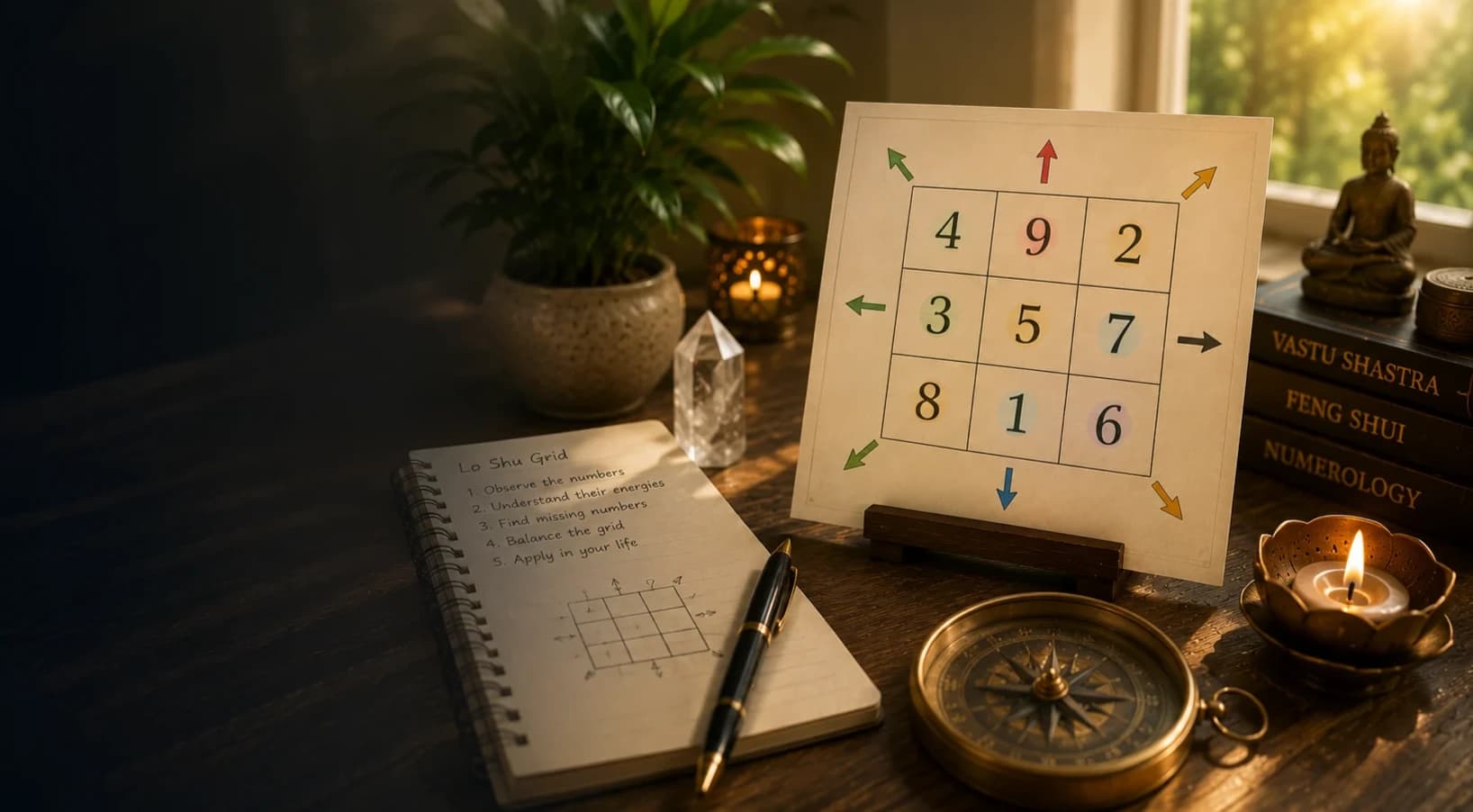
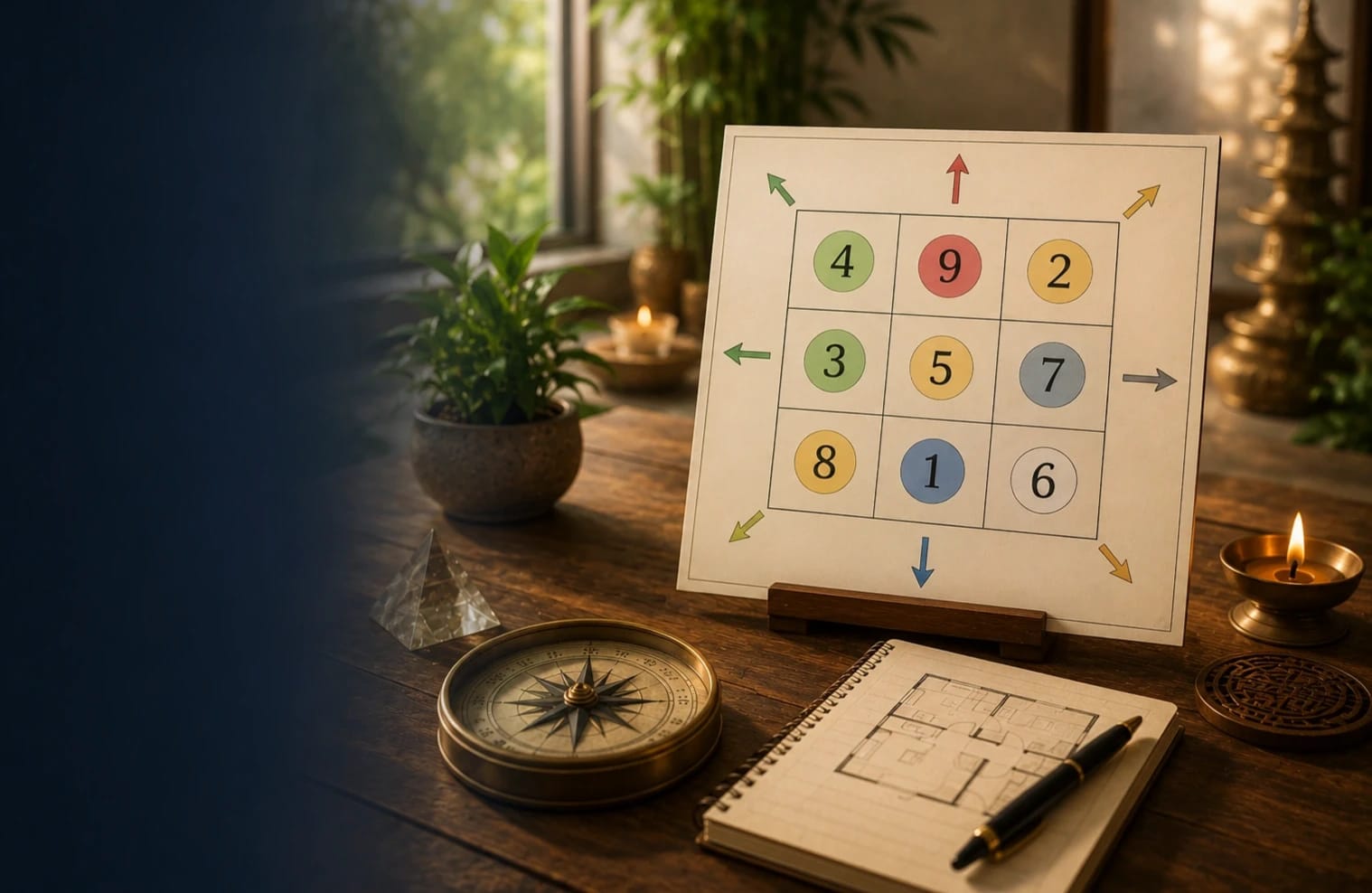
A Lo Shu Grid is not only about individual numbers. It is about structure. It shows:
- which numbers are present
- which numbers are absent
- which numbers repeat strongly
- where concentration appears
- where emptiness appears
- how the overall pattern feels in balance or imbalance
So when you read a Lo Shu Grid, you are not asking only, “What does number 4 mean?” You are also asking:
- Why is 4 present but 5 missing?
- Why is 1 repeated so strongly?
- Why is the center empty?
- Why does one part of the grid feel concentrated while another is blank?
This is why the Lo Shu Grid is often more revealing than simple one-number numerology. It allows the reader to see a pattern of emphasis and absence instead of a single label. In that sense, reading the grid means learning to see a symbolic arrangement rather than a flat identity statement.
Step 1: Start by Looking at the Whole Grid
The first mistake many beginners make is zooming in too fast. They immediately pick one missing number or one repeated number and build the entire reading around it. That usually leads to distortion.
The correct first step is simpler: look at the whole grid first.
Ask broad visual questions such as:
- Does the grid look sparse or dense?
- Are many boxes empty?
- Are a few boxes heavily crowded?
- Does the pattern look balanced, or highly concentrated in one area?
This first visual impression matters because it gives you the emotional tone of the chart before you start interpreting details. Some grids look light and open. Some look highly loaded in a few positions. Some feel balanced. Some feel like they are missing many natural supports.
You should not make dramatic conclusions from this first impression alone. But you should notice it. It gives you a structural starting point and helps prevent tunnel vision later.
In beginner reading, the whole grid always comes before the parts.
Step 2: Identify Which Numbers Are Present
After looking at the whole chart, the next step is to identify which numbers are actually present. A present number suggests that the corresponding energy exists in some natural form within the person’s pattern.
This does not automatically mean mastery, balance, or perfection. Presence simply means that the energy is there and available in some way.
For example, if a person has 1, 2, 5, and 8 present, the first reading question is not whether those numbers are “good.” The first question is: What kind of qualities do these present numbers usually represent, and how might they be active in this person’s life?
For beginners, this is a good place to slow down. You do not need to attach complicated psychological meaning immediately. Just recognize that present numbers are often the easiest energy for a person to access. They may describe natural tendencies, visible patterns, or available strengths.
So the second step is simple: mark the numbers that exist in the grid and begin treating them as active parts of the person’s symbolic structure.
Step 3: Identify Which Numbers Are Missing
Once present numbers are clear, the next step is to notice which numbers are missing. Missing numbers are often the first thing people focus on because they stand out visually. But they must be handled with maturity.
A missing number usually does not mean that the person is broken, cursed, weak, or incapable. That kind of dramatic reading is one of the biggest mistakes in popular numerology content. A missing number is more usefully understood as an area where the corresponding energy is:
- less instinctive
- less naturally available
- more dependent on conscious development
- more likely to be learned through experience rather than carried automatically
So if the number 6 is missing, for example, the first mature question is not “What is wrong with this person?” The better question is “What kind of quality might not come automatically here, and where might conscious growth be needed?”
Beginners should remember that missing numbers show developmental gaps, not life sentences. Sometimes these become powerful growth points later in life. The absence can create learning, discipline, awareness, and evolution.
So yes, missing numbers matter. But they should be read as lesson areas, not reasons for fear.
Step 4: Notice Which Numbers Are Repeated
After marking what is present and what is missing, the next important layer is repetition. If a number appears more than once, that number carries extra emphasis in the grid.
This usually means that the corresponding energy is stronger than average. But here again, beginners must avoid simplistic conclusions. Stronger does not always mean “better.” It may mean:
- natural strength
- intense talent
- high emotional force
- over-identification
- excess
- rigidity
- difficulty moderating that energy
For example, if number 1 appears four times, that does not simply mean “excellent leadership.” It may also suggest a very strong emphasis on self-direction, self-definition, independence, ego-force, or strong personal identity. Whether that becomes strength or imbalance depends on context.
This is why repeated numbers should be read with nuance. Repetition means energy is highlighted. The next question is whether that highlight feels healthy, excessive, compensatory, or imbalanced within the total pattern.
Step 5: Read the Center Carefully
In the Lo Shu Grid, the center position is occupied by number 5. Many readers intuitively pay attention to the center because it feels like the axis of the chart. Beginners often wonder whether the presence or absence of 5 matters more than other numbers.
The honest answer is that every number matters, but the center naturally attracts attention because it can affect how the overall grid feels. When 5 is present, some teachers see it as a sign of internal organizing force or stabilizing intelligence within the pattern. When 5 is absent, some readers feel the grid can look more scattered or less inwardly centered.
However, this should not be exaggerated. The center is important, but it is still part of a total structure. A missing 5 does not automatically create a “bad” chart, and a present 5 does not automatically fix everything else.
For beginners, the correct approach is simply this: if 5 is present, note it; if it is missing, note that too. Give the center respectful attention, but do not build the entire chart around one idea too early.
Step 6: Observe Balance, Not Just Individual Meanings
This is one of the most important beginner lessons in Lo Shu reading: a grid is not just a collection of isolated meanings. It is a balance pattern.
A beginner may learn that number 2 relates to sensitivity, or number 8 relates to practical energy, or number 9 relates to intensity or vision. But if those meanings are read separately and never brought back into the whole grid, the reading becomes fragmented.
So after identifying present, missing, and repeated numbers, ask broader questions:
- Does the grid feel balanced or lopsided?
- Are only a few areas carrying all the weight?
- Are there many empty spaces around a few heavy numbers?
- Does the person appear to live through overdeveloped strengths and underdeveloped gaps at the same time?
This shift from isolated meaning to balance-reading is what makes Lo Shu interpretation mature. It helps you move away from superstition and toward pattern analysis.
For beginners, this one shift can change everything. Instead of asking, “What does this one number mean?” you begin asking, “What does this overall structure say about how this person’s energy is arranged?”
Step 7: Learn the Broad Quality of Each Number
Once the structure is clear, the next layer is to learn the broad quality associated with each number. A beginner does not need overly technical meanings at first. What matters is a practical first sense of what each number tends to symbolize.
Although interpretations vary by teacher, many beginner readings use broad themes like these:
- 1 – identity, initiative, self-expression, will
- 2 – sensitivity, relationship, receptivity, emotional response
- 3 – expression, creativity, communication, movement
- 4 – order, method, discipline, structure
- 5 – center, adaptability, dynamic intelligence, balance
- 6 – responsibility, care, stability, material duty
- 7 – reflection, inquiry, subtle depth, inward pattern
- 8 – practical force, execution, endurance, material grounding
- 9 – intensity, vision, force, completion, energetic reach
These are not rigid definitions and should not be used mechanically. But they are enough to help a beginner start reading the grid intelligently. Once you know which qualities tend to belong to which numbers, the presence, absence, and repetition become easier to understand.
This is why broad symbolic literacy matters. Without it, the grid remains visual but mute. With it, the structure begins to speak.
Step 8: Read One Number in Context, Not in Isolation
Beginners often ask, “What does missing 3 mean?” or “What does repeated 1 mean?” These are fine questions, but they must be answered in context. A number should never be read in complete isolation from the rest of the grid.
For example, repeated 1 in a chart with many empty spaces may feel very different from repeated 1 in a chart that is otherwise full and balanced. A missing 5 in a sparse grid may feel different from missing 5 in a grid where several strong supporting numbers exist.
So once you start looking at number meanings, always ask:
- What else is happening in the chart?
- Is this energy supported, exaggerated, compensated for, or unbalanced?
- Does the grid as a whole amplify or soften the meaning of this number?
This habit protects you from shallow reading. It also makes the interpretation far more realistic and useful.
Good grid reading is always contextual.
Step 9: Pay Attention to Pattern Clusters
Once a beginner becomes comfortable with present, missing, and repeated numbers, the next useful step is to notice where numbers seem to cluster. Sometimes several active numbers appear in nearby parts of the grid, while other regions remain empty.
This kind of clustering can suggest that some areas of life or personality are strongly emphasized while others are relatively underdeveloped. You do not need advanced row or arrow theory yet to notice this. Even visually, a grid may show:
- strong concentration in one region
- heavy emptiness in another
- a central number surrounded by gaps
- repetition gathering around certain parts of the grid
This is especially useful because it helps the beginner move from simple number-counting to structural awareness. The Lo Shu Grid becomes more alive when you begin to see where emphasis gathers rather than only which single number appears.
At this stage, you are not yet required to make advanced conclusions. You are only learning to see form more clearly. That itself is progress.
A Step-by-Step Mini Reading Example
Let us take a simple example and read it in beginner order.
Example birth date: 24-08-1992
Working digits after ignoring zero:
- 2, 4, 8, 1, 9, 9, 2
Grid becomes:
- 4 - 99 - 22
- [empty] - [empty] - [empty]
- 8 - 1 - [empty]
Now read it step by step:
- Whole-grid impression: the grid is uneven, with strong top-row emphasis and several empty spaces.
- Present numbers: 1, 2, 4, 8, 9 are active.
- Missing numbers: 3, 5, 6, 7 are absent, suggesting some developmental gaps.
- Repeated numbers: 2 and 9 are both repeated, so those energies are emphasized.
- Center: 5 is missing, so the chart may feel less internally centered or less naturally balanced.
- General reading tone: the chart appears to hold strong active force in some areas and notable gaps in others, suggesting a life pattern of emphasis-plus-learning rather than smooth balance.
Notice what we did not do. We did not instantly jump into fear. We did not say missing numbers ruin the chart. We did not say repeated numbers guarantee success. We simply read structure in a disciplined way.
This is exactly how beginners should practice.
Common Beginner Mistakes When Reading a Lo Shu Grid
There are several reading mistakes beginners make again and again:
- treating missing numbers like curses
- assuming repeated numbers are automatically positive
- focusing on one number and ignoring the whole structure
- trying to make a full life prediction from one empty box
- skipping context and balance
- copying extreme meanings from short online posts
- confusing first impressions with complete interpretation
Another frequent mistake is trying to learn advanced arrows, planes, and deep symbolic combinations too early. That often leads to memorization without understanding. A beginner should first learn how to read the grid in layers: whole pattern, present numbers, missing numbers, repeated numbers, and balance.
Once that foundation is stable, deeper interpretation becomes much easier and much more trustworthy.
What to Do After Your First Basic Reading
Once you complete your first basic Lo Shu reading, the next step is not to declare the chart fully understood. The next step is observation. Compare the symbolic pattern with real life.
Ask questions such as:
- Do the emphasized numbers reflect qualities I clearly recognize?
- Do the missing numbers correspond to areas where growth feels slower or more conscious?
- Does the overall balance or imbalance reflect how I actually experience life?
This reflective stage is very important. Numerology becomes meaningful when symbolic reading and lived experience meet. If you rush past observation, the system can become abstract or exaggerated. If you take time with it, the grid becomes a self-awareness tool instead of a superstition machine.
That is why your first reading should be treated as a beginning, not a final verdict.
When You Are Ready to Go Deeper
After a beginner has learned to read present, missing, and repeated numbers calmly, the next layer usually includes:
- rows and columns
- horizontal and vertical energy patterns
- symbolic arrows
- more nuanced balance interpretation
- comparison between multiple charts
But it is wise not to rush here. A person who has not yet learned to read the basic structure well will often get lost in advanced symbolism.
So go deeper only after the basic reading process feels natural. If you can look at a grid and clearly identify present numbers, missing numbers, repeated numbers, center condition, overall balance, and general structural tone, then you are ready for the next stage.
That is the right sequence for strong learning.
Final Thoughts on How to Read a Lo Shu Grid
Reading a Lo Shu Grid step by step is not about memorizing dozens of dramatic meanings. It is about learning to observe structure with patience and proportion. A good beginner reading starts with the whole chart, then moves to present numbers, missing numbers, repeated numbers, center awareness, and overall balance.
The Lo Shu Grid becomes useful when you stop looking for instant judgments and start looking for pattern. It is not a machine that stamps people as lucky or unlucky. It is a symbolic map that shows where energy is available, where it is emphasized, and where conscious growth may be needed.
For beginners, that is more than enough. You do not need to master every advanced arrow on day one. You only need to learn how to look properly. Once that skill develops, the grid becomes much clearer.
If you want the shortest possible takeaway, remember this: first see the whole grid, then identify present numbers, missing numbers, and repeated numbers, and only after that begin interpretation. That order makes Lo Shu reading far more accurate and much less confusing.
Once you learn that order, your grid stops being just a chart and starts becoming a readable pattern.
Editorial insight
A Lo Shu Grid should be read like a structure before it is read like a prediction. The moment a reader learns to observe presence, absence, repetition, and balance in the right order, the grid becomes clear enough to speak for itself.
- My Destiny Path Editorial Team
Real-Life Case Study
A beginner once made her first Lo Shu Grid correctly but still felt disappointed because she did not know what to do next. She saw several empty boxes and immediately assumed the reading must be negative. Then she noticed one repeated number and became equally sure that it must guarantee a major strength. In other words, she was reacting emotionally to isolated details rather than reading the chart structurally. Once the reading order was explained to her, everything changed. She first looked at the whole grid, then identified which numbers were present, which were missing, which were repeated, and only then began asking what the overall pattern suggested. What first looked like a confusing set of gaps and clusters became a clear symbolic arrangement. That shift from emotional reaction to structured observation is exactly what helps beginners read the Lo Shu Grid properly.