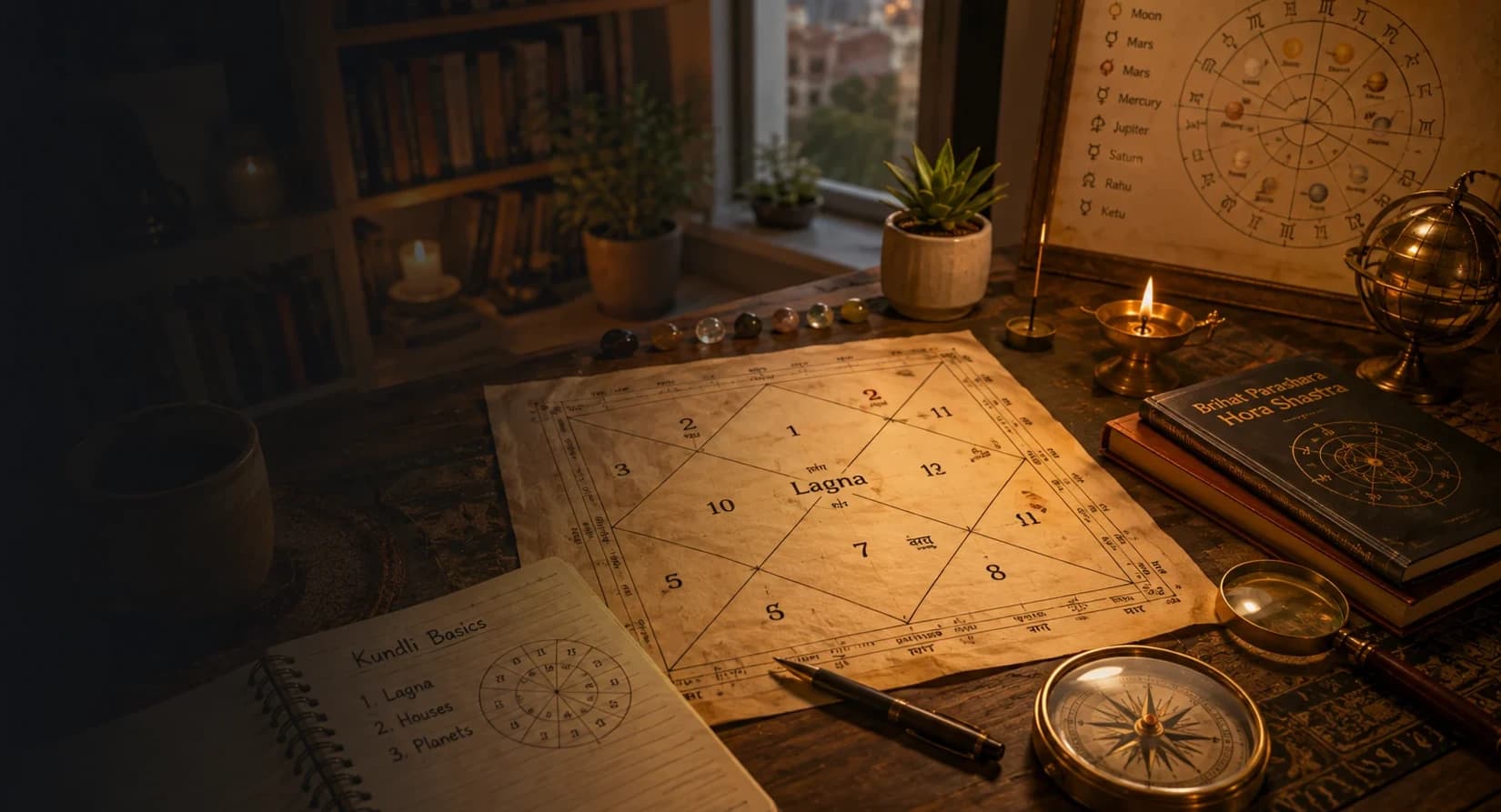


Quick Answer: Is Lagna and Ascendant the Same?
Yes. In Vedic astrology, Lagna and Ascendant usually mean the same thing: the zodiac sign rising on the eastern horizon at your exact birth time. Lagna becomes the first house of your Kundali and sets the full house structure for the chart.
Lagna, Ascendant, Moon Sign, and Sun Sign Compared
Term Meaning Why it matters
Lagna / Ascendant
Rising sign at birth
Sets the first house and the whole chart framework
Moon Sign
Sign occupied by the Moon
Shows mind, emotions, and many timing systems
Sun Sign
Sign occupied by the Sun
Shows vitality, authority, and core will
Why Birth Time Matters for Lagna
Lagna changes roughly every two hours, so a small birth-time error can change the Ascendant and shift the house layout. That is why Kundali readings, marriage matching, Dasha interpretation, and house-based predictions become less reliable when the birth time is approximate or unknown.
Frequently Asked Questions
What does Ascendant mean in Kundali?
Ascendant means the rising sign at birth. It becomes the first house and shows body, temperament, identity, health direction, and how the rest of the chart is organized.
Is Lagna more important than Moon sign?
Lagna and Moon sign are both important. Lagna sets the chart structure, while Moon sign shows the mind and emotional experience. A serious reading checks both.
What if I do not know my birth time?
You can still read broad Moon-sign and planetary themes, but Lagna-based house readings should be treated as approximate until the birth time is confirmed or rectified.
Introduction: Why the Ascendant Matters So Much
If you are new to Vedic Astrology, you may have started with your Sun sign or Moon sign. That is very common. But the deeper you go into Jyotish, the more you begin to hear the same message from serious astrologers: the Ascendant matters enormously. In fact, many astrologers would say that if you do not understand the Ascendant, also known as Lagna, you do not yet understand how the chart itself is built.
This surprises many beginners. Popular astrology culture has trained people to identify strongly with one sign. Someone says, “I’m a Leo,” or “I’m a Pisces,” and assumes that is the most important piece of the chart. But in Vedic Astrology, life is never reduced to one sign label. The chart is a living structure. And Lagna is the structural starting point.
The Ascendant is the sign rising on the eastern horizon at the exact time of your birth. That rising sign becomes the 1st house of your Kundali. From that point onward, the rest of the houses are counted in sequence. This means that your Lagna does not merely describe part of your personality. It determines the entire framework through which your chart is interpreted.
That is why two people with the same Moon sign can have very different lives. It is why the same planet can become highly beneficial in one chart and more complicated in another. It is why birth time matters so much. And it is why an astrologer usually begins chart interpretation by studying the Lagna and its lord before moving into more detailed predictions.
This article explains what the Ascendant is, how it is calculated, why it is so important, how it differs from your Moon sign and Sun sign, and how it shapes the interpretation of your Janam Kundali. If you want to move from surface-level astrology into real chart understanding, Lagna is one of the best places to begin.
What Is the Ascendant in Astrology?
The Ascendant, called Lagna in Sanskrit, is the zodiac sign rising in the east at the exact moment of your birth. As the Earth rotates, different signs rise over the eastern horizon throughout the day. Because this movement is continuous, the Ascendant changes regularly. This is why birth time is so crucial in astrology.
In the chart, the Ascendant becomes the beginning of the 1st house. The remaining houses are then counted from there in sequence. So if Aries is rising at the moment of birth, Aries becomes the 1st house, Taurus becomes the 2nd, Gemini becomes the 3rd, and so on. If Libra is rising, then Libra becomes the 1st house, Scorpio the 2nd, Sagittarius the 3rd, and so forth.
This sounds simple, but the consequences are huge. Once Lagna changes, the entire house structure changes. That means the same planets will fall into different houses. House rulership will change. Functional benefics and malefics can change. Life emphasis changes. This is why the Ascendant is not a minor technical detail. It is the organizing principle of the whole chart.
Why Is It Called Lagna?
In Vedic Astrology, the word Lagna refers to that point of connection where the zodiac meets the horizon at the moment of birth. It is one of the central reference points of the chart. Traditional astrologers treat it with great importance because it symbolizes the embodied self entering the world at a precise moment in time.
Where the Moon may show your inner emotional field, and the Sun may show your central life-force and dignity, Lagna shows the point at which the soul takes incarnation into a particular embodied and worldly framework. It is the chart’s way of saying: “This is how life begins for this person in this birth.”
That is why Lagna is often associated with the body, identity, temperament, vitality, and the way life is approached outwardly. But again, its role is larger than just personality. Lagna is the point from which the entire house system is constructed.
How the Ascendant Is Calculated
The Ascendant is calculated using:
- your date of birth
- your exact time of birth
- your place of birth
The place of birth matters because the horizon differs from location to location. The time matters because the zodiac appears to rise continuously as the Earth rotates. Even a modest time difference can sometimes shift the Ascendant, especially near sign boundaries.
This is why someone cannot reliably determine their Lagna just by knowing the date of birth alone. Unlike the Sun sign, which stays in a sign for many days, the Ascendant changes much more quickly. In practice, it usually changes roughly every two hours, although the exact rate varies depending on latitude and other astronomical factors.
As a result, people born on the same date in the same city may still have different Ascendants if their birth times differ. And once the Ascendant changes, the whole chart may be interpreted differently.
Why Birth Time Matters More Than Many People Realize
If you remember one technical truth from this article, let it be this: birth time is not a formality in Vedic Astrology. It is one of the keys to the entire interpretive system.
Many beginners assume that a small difference in birth time will not matter much. But when it comes to Lagna, it can matter a great deal. A different Lagna means a different house structure. A different house structure means that the same planets may now influence very different areas of life.
For example, Venus may rule the 1st and 8th houses for one Ascendant but the 5th and 12th for another. Saturn may become a powerful yoga-giving planet in one chart and a more difficult karmic force in another. Mars may energize profession in one chart and domestic peace in another. These are not small interpretive changes. They can reshape the whole reading.
This is why astrologers often ask whether the birth time is exact, approximate, or uncertain. And it is why chart rectification exists. If the birth time is significantly wrong, then Lagna-based analysis can become unreliable.
The Ascendant and the 1st House
The Ascendant becomes the 1st house of the chart, and the 1st house is one of the most important houses in all of astrology. It represents:
- the body
- physical vitality
- appearance
- temperament
- general life direction
- the way a person meets the world
- the overall lens through which life is experienced
This means the Ascendant is not just another point in the chart. It is the living doorway through which the rest of the chart expresses itself. A strong Lagna can support resilience, presence, confidence, and stability. A challenged Lagna may create difficulties with vitality, direction, consistency, or self-definition.
The 1st house is also deeply linked with selfhood. It does not tell the whole story of identity, but it tells a major part of it. In practice, it helps explain how a person enters situations, presents themselves, reacts instinctively to life, and moves through the world.
The Lagna Lord: Why the Ruler of the Ascendant Is Critical
Once the Ascendant sign is known, the next major step is to identify the lord of the Ascendant, also called the Lagnesh. This is the planet that rules the sign rising at birth. The condition of the Lagna lord is one of the first things an astrologer studies.
Why? Because the Lagna lord carries the energy of the self. It tells us where the life-force of the chart is directed. It shows how the person’s identity, vitality, and overall life orientation are being expressed.
If the Lagna lord is strong, well-placed, and supported, the person may have greater coherence, resilience, and ability to act effectively in life. If it is weak, afflicted, or burdened, the person may still succeed, but there may be more struggle in self-definition, physical well-being, psychological confidence, or direction.
For example:
- if Aries rises, Mars becomes the Lagna lord
- if Taurus rises, Venus becomes the Lagna lord
- if Gemini rises, Mercury becomes the Lagna lord
The position of that Lagna lord—by sign, house, dignity, aspect, and conjunction—gives major clues about how the person moves through life.
How Lagna Shapes the Whole House Structure
One of the deepest reasons Lagna is so important is that it determines the house framework of the chart. This means it tells us which life area each sign falls into. And that, in turn, determines which planets rule which houses.
This is a major structural difference between Vedic Astrology and superficial astrology content. In real chart reading, house rulership matters enormously. It tells us which planet becomes responsible for marriage, career, wealth, health, spirituality, and other life topics in a particular chart.
For example, Saturn does not mean exactly the same thing in every chart. Its natural significations remain the same—karma, time, discipline, delay, endurance—but its functional role changes depending on Lagna. For one Ascendant, Saturn may rule highly productive houses and become supportive. For another, it may rule more challenging houses and behave differently.
This is why astrologers cannot read a chart properly without knowing the Lagna. It is the key to personalization.
Ascendant vs. Moon Sign: What’s the Difference?
This is one of the most common beginner questions. The answer is simple but important: your Ascendant and your Moon sign are not the same thing.
Your Ascendant is the sign rising on the eastern horizon at birth. It is the structural starting point of the chart. It is closely related to embodiment, orientation, physical presence, and the outward framework of life.
Your Moon sign is the sign occupied by the Moon at birth. It reflects your mind, emotions, inner reactions, comfort needs, and how you experience life psychologically.
So the Ascendant and the Moon sign answer different questions:
- Lagna asks: How is this life structured? How does this person enter life?
- Moon sign asks: How does this person feel, respond, and process experience internally?
Both are important. But they are not interchangeable. Someone may look confident and direct outwardly because of the Ascendant, while feeling highly sensitive and uncertain inwardly because of the Moon. Or the opposite may be true. This is why serious astrology goes beyond one-sign identity.
Ascendant vs. Sun Sign: What’s the Difference?
The Sun sign is the sign occupied by the Sun at birth. In Vedic Astrology, the Sun represents soul-force, dignity, vitality, authority, and the central organizing light of life. It is important, but it is not the whole chart.
The difference is that the Sun sign does not determine your house framework. It tells us something about the quality of your self-expression and life-force, but it does not set up the whole chart architecture. Lagna does.
This is why two people with the same Sun sign can still have very different charts and very different lives. The same Sun in the same sign may fall into different houses depending on Lagna. And once the house changes, the expression of that Sun changes too.
In simple terms:
- the Sun sign tells us about your core light and dignity
- the Moon sign tells us about your mind and emotional pattern
- the Ascendant tells us how your life is organized and expressed in embodied reality
That is why Lagna is often treated as the first gateway into real chart reading.
What the Ascendant Says About Personality
Because Lagna is connected to the 1st house, it says a great deal about personality and temperament. But it is important not to oversimplify this. Lagna does not describe the entire psyche by itself. Instead, it describes the way you naturally present, initiate, and orient yourself to life.
For example:
- Aries Lagna may appear direct, bold, fast-moving, and initiative-driven
- Taurus Lagna may appear steady, grounded, deliberate, and materially aware
- Gemini Lagna may appear curious, verbal, flexible, and mentally alert
- Cancer Lagna may appear protective, sensitive, and emotionally responsive
But the full story depends on much more:
- the condition of the Lagna lord
- which planets occupy the 1st house
- which planets aspect the 1st house
- the condition of the Moon
So while Lagna is foundational, it must still be interpreted within the whole chart.
What the Ascendant Says About Life Direction
Lagna is also deeply connected with life direction. Because it represents the self in motion, it often tells us how the person approaches existence, what kind of path feels natural, and how they tend to engage with their environment.
A fiery Lagna may move life through initiative and assertion. An earthy Lagna may build slowly and steadily. An airy Lagna may navigate through ideas, communication, and networks. A watery Lagna may move through emotional responsiveness, intuition, and feeling-based adaptation.
This does not mean your whole destiny can be read from Lagna alone. But it does mean that Lagna gives the first clue about how your life-force prefers to operate.
Why Astrologers Start with Lagna in Chart Reading
When a serious astrologer begins reading a chart, Lagna is usually one of the first places they look. There are several reasons for this:
- it establishes the house structure
- it reveals the condition of the self and body
- it determines house rulership
- it helps identify functional benefic and malefic logic
- it provides the base from which the rest of the chart is understood
Without Lagna, the chart remains too abstract. With Lagna, the chart becomes individualized.
This is also why real astrology differs from generic online content. A generic article may say, “Venus means love” or “Saturn means struggle.” A real chart reading asks, “What is the Ascendant? What does Venus rule in this chart? Where is Saturn placed? How do those roles interact?” That is where real precision begins.
Can the Ascendant Explain Physical Appearance?
Yes, to a degree. The Ascendant, the 1st house, the Lagna lord, and planets influencing the 1st house can all contribute to physical appearance and bodily style. Traditionally, astrologers do use Lagna as one factor in understanding physique, posture, facial expression, and energetic presence.
But this should be approached carefully. No single factor should be used to make rigid claims. Physical appearance is shaped by genetics, environment, culture, health, and many chart factors. So Lagna can contribute to understanding the body, but it should not be used in a crude or overconfident way.
What Happens if Birth Time Is Uncertain?
If birth time is uncertain, then the Ascendant may be uncertain as well. And if Lagna is uncertain, the house structure can be uncertain. This makes interpretation more difficult—especially for predictive work, marriage analysis, house rulership, and divisional charts.
In such cases, astrologers may:
- work with a time range
- compare possible Ascendants
- use life-event-based rectification
- lean more heavily on Moon-based techniques temporarily
Some charts remain readable even with minor time uncertainty, but for detailed prediction, precision helps greatly. This is why it is wise to preserve accurate birth records whenever possible.
Common Mistakes Beginners Make About Lagna
Beginners often make a few recurring mistakes when learning about the Ascendant:
- assuming Lagna is just another sign label
- treating Sun sign as more important in every case
- ignoring the Lagna lord
- judging Lagna from stereotypes alone
- forgetting that planets in or aspecting the 1st house modify the result
- ignoring birth time accuracy
These mistakes are understandable, but they limit the usefulness of the chart. Lagna becomes truly valuable when studied structurally, not superficially.
How to Start Understanding Your Own Lagna
If you want to start learning your own chart through Lagna, here is a practical approach:
- identify your Ascendant sign
- identify the lord of that sign
- see where the Lagna lord is placed by house and sign
- check which planets sit in the 1st house
- check which planets aspect the 1st house
- study how the Lagna lord behaves in your current Dasha
This gives you a much more meaningful understanding than simply reading a one-paragraph Lagna description. It shows how the self is structured in the actual chart.
Final Thoughts: Why Lagna Is the Gateway to Real Chart Reading
The Ascendant is one of the most important points in the entire Kundali because it marks the beginning of embodied life in the chart. It sets the 1st house. It defines the house framework. It personalizes the role of every planet. And it tells the astrologer how to start interpreting the chart in a grounded way.
For beginners, understanding Lagna is a major turning point. It is often the moment when astrology shifts from vague sign-based identity into real chart structure. The chart begins to make sense not as a pile of symbols, but as an organized system.
If you want to read your own birth chart more intelligently, begin with Lagna. Study the Ascendant sign. Study its ruler. Study the 1st house. And from there, the rest of the chart will gradually begin to open.
That is why Lagna is not just important. It is foundational.
Frequently asked questions
Why does Lagna need an accurate birth time?
The rising sign changes through the day, so an inaccurate birth time can change the Ascendant and the house structure.
Is Lagna more important than the Moon or Sun sign?
They describe different layers. Lagna organizes the houses, while the Moon and Sun add emotional and identity-related context.
Jyotish basics and related reading
- What is Vedic astrology?
- The three pillars: planets, signs, and houses
- The 12 houses in a birth chart
- The nine Grahas explained
- Understanding the structure of a birth chart before exploring timing, compatibility, or reports.
- A Vedic birth chart with planetary positions, houses, signs, and interpretive sections.
Astrology guidance is interpretive, not deterministic. Outcomes also depend on choices, circumstances, and context.
Last updated:
Editorial insight
The Ascendant is where astrology becomes personal. Without Lagna, the chart is a collection of symbols. With Lagna, those symbols become a structured life-pattern that can actually be interpreted. That is why serious chart reading almost always begins there.
- My Destiny Path Editorial Team
Real-Life Case Study
A client once came in confused because she had read so many articles about her Moon sign that none of them seemed to match her actual life. She felt emotionally unlike the descriptions she kept seeing online. When her chart was examined more carefully, it became obvious why: her Lagna was creating a very different outward life-structure than the generic Moon-sign material suggested. Her Ascendant lord was strong, her 1st house carried a very distinct influence, and her life choices were being shaped far more by house structure and current Dasha than by broad sign descriptions. Once she understood her Lagna, the chart suddenly became coherent. She stopped asking, “Why don’t I relate to this sign description?” and started asking the more useful question: “How is my actual chart built?” That shift changed astrology from confusion into clarity for her.
Key terms in this article
- Dasha
- A planetary period used in Vedic astrology to understand life chapters and timing themes.
- Lagna
- The rising sign at birth, used as the starting point for house-based chart interpretation.
- House
- A life area in the birth chart, such as marriage, career, wealth, home, or health.
Explore related tools
Free Kundali
Generate your Vedic birth chart
Today's Panchang
Tithi, Nakshatra, Yoga & Muhurats
Kundali Matching
Check marriage compatibility
Western Natal Chart
Tropical birth chart · Placidus houses
Unlock Your Complete Destiny Report
40-page personalised PDF — Dasha predictions, Yogas, remedies & life guidance