

Introduction: Why Reading a Kundli Feels Hard at First
For most beginners, a Kundli looks far more complicated than it really is. The first time someone opens a birth chart, they often see a maze of boxes, signs, planets, abbreviations, and unfamiliar Sanskrit terms. Words like Lagna, Bhava, Rashi, Drishti, Dasha, and Nakshatra all appear at once, and the natural reaction is: “Where am I even supposed to start?”
This feeling is completely normal. The problem is not that astrology is impossible to understand. The problem is that many beginners try to understand everything at the same time. They jump from one YouTube video to another, read scattered meanings of planets, hear frightening statements about the 8th house or Saturn, and end up with more confusion than clarity.
The truth is that a Kundli becomes readable when you stop chasing every advanced concept at once and begin with a structured method. In practical terms, the most useful beginner sequence is this: start with the Lagna, then understand the houses, and then study the planets. That order matters. If you do not know the Lagna, you do not know how the chart is structured. If you do not understand the houses, you do not know which part of life is being discussed. And if you do not understand the planets, you do not know what kind of energy is active in those life areas.
In other words, the Kundli is not meant to be read as random symbolism. It is a system. And systems become much easier when you learn their grammar properly.
This article is written for genuine beginners. It is not a keyword-stuffed shortcut and it is not meant to impress you with technical jargon. Its purpose is to help you look at a Kundli and actually begin to read it in a calm, logical, useful way. By the end of this guide, you should understand the reading order, the role of Lagna, the importance of the 12 houses, the meaning of planetary placement, and the common mistakes that make beginner astrology unnecessarily confusing.
What a Kundli Actually Is
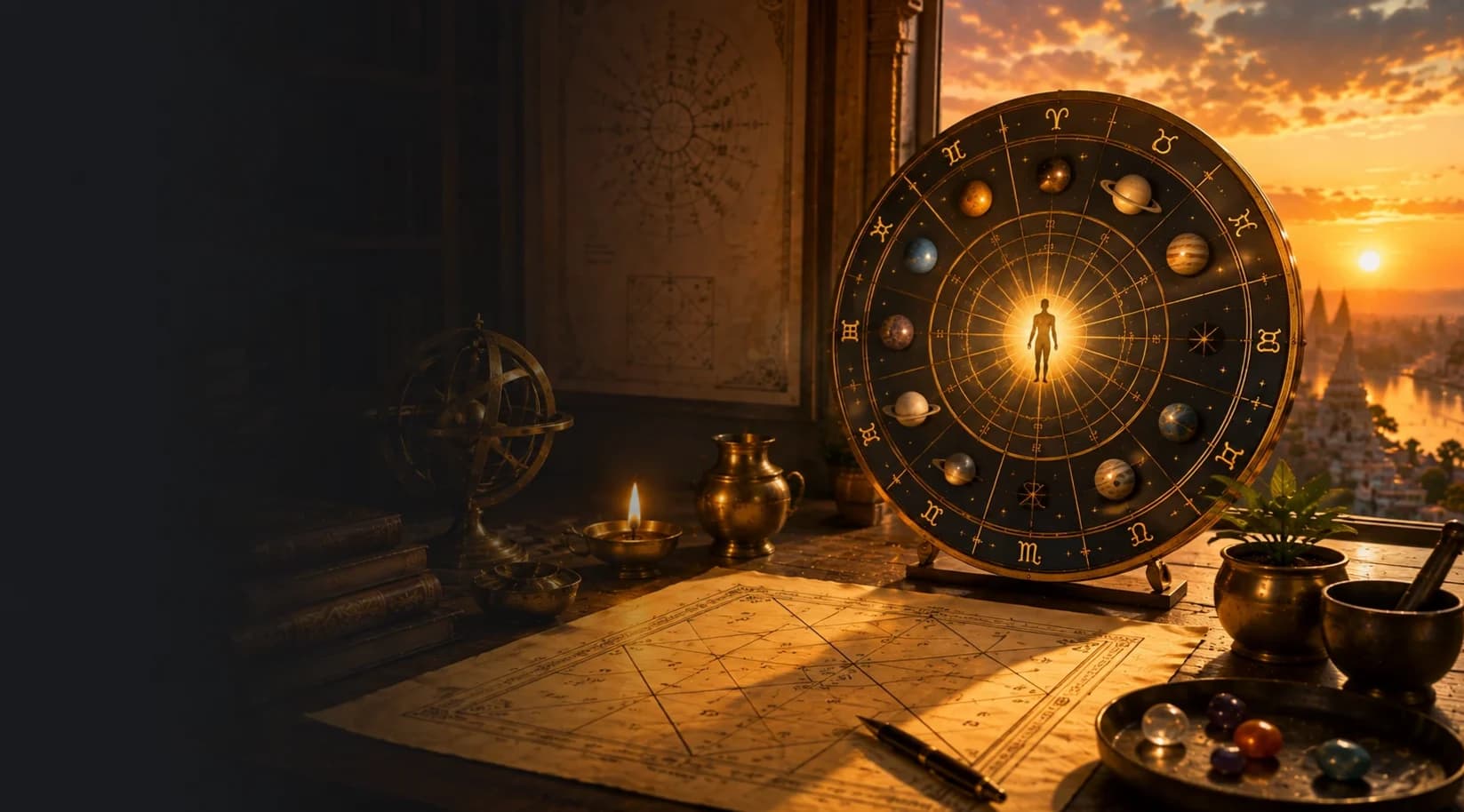
A Kundli, also called a Janam Kundali or birth chart, is a symbolic map of the sky at the exact time and place of your birth. It shows where the planets were positioned, which sign was rising on the eastern horizon, and how the whole chart is arranged into 12 houses.
In Vedic Astrology, a Kundli is not just used to give fortune-cookie style predictions. It is used to understand temperament, life direction, strengths, pressure points, timing patterns, relationship tendencies, career karma, emotional life, and spiritual development. A well-read Kundli is less like a magical answer sheet and more like a structured life map.
But to read that map properly, you must know what each part is doing. A chart contains three core building blocks:
- Planets show what kind of force or energy is active.
- Signs show how that force expresses itself.
- Houses show where in life that force becomes visible.
These three are the grammar of chart reading. And the point that holds the whole structure together is the Lagna.
Why Lagna Comes First
If there is one habit that instantly improves beginner chart reading, it is this: always start with the Lagna. Many people begin with the Moon or Sun because those are the most familiar ideas in popular astrology. But in serious Vedic chart reading, Lagna is usually the true starting point.
The Lagna, or Ascendant, is the sign rising in the east at the moment of birth. That sign becomes the 1st house of the chart. From there, the rest of the houses are counted in sequence. This means that the Lagna is not just a personality label. It is the structural anchor of the entire chart.
When the Lagna changes, the house structure changes. When the house structure changes, the life themes connected to different planets also change. A planet that rules career in one chart may rule marriage in another. A planet that becomes highly supportive for one Lagna may become more difficult for another. This is why two people with the same Sun sign can live very different lives.
So before you ask what Mars means, or whether Saturn is good or bad, first ask: What is the Lagna? Without that answer, your reading has no proper base.
Step One: Find the Lagna
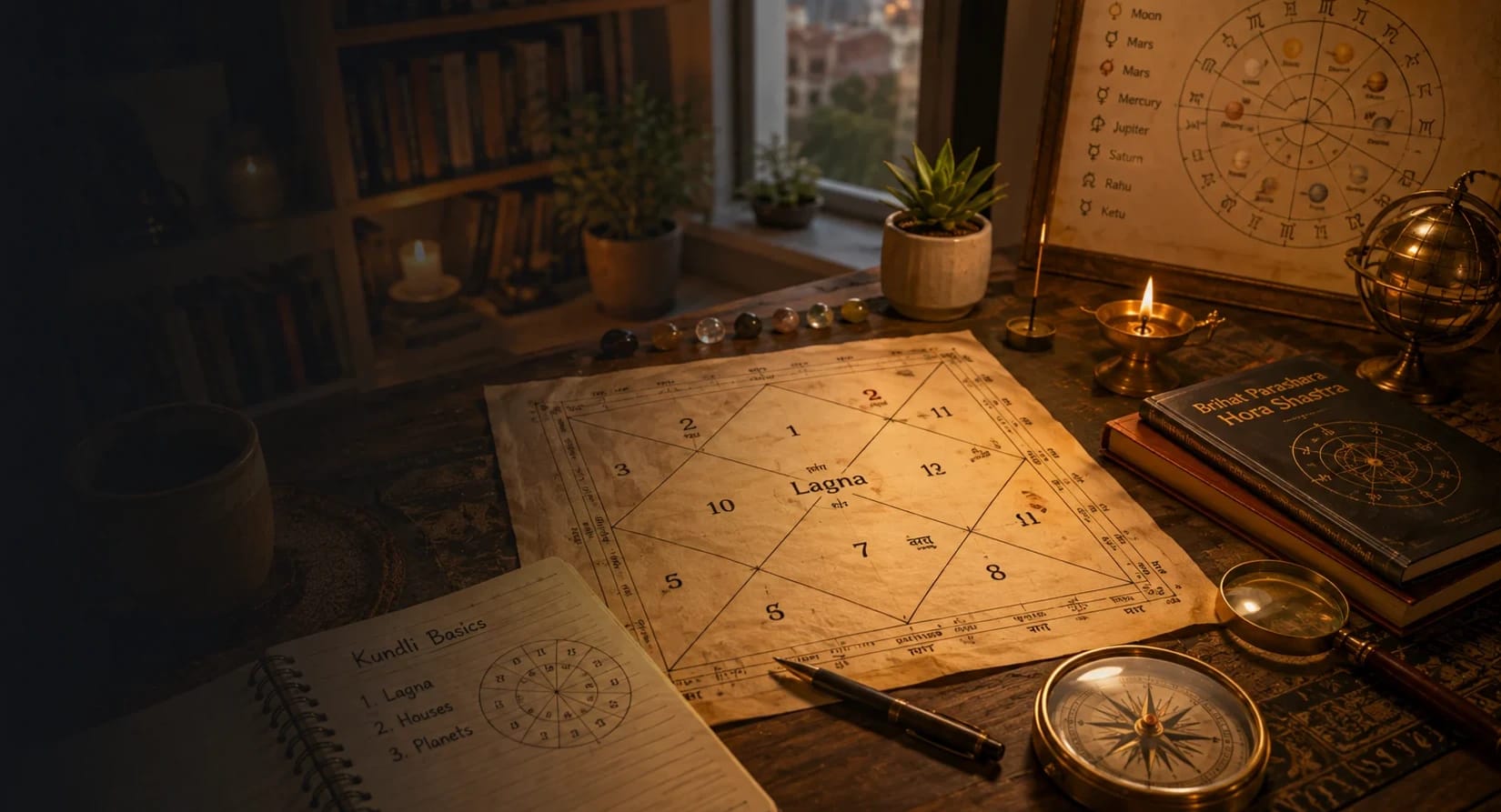
When you first look at a Kundli, especially a North Indian chart, your first task is to identify the Lagna. Depending on the software or format, it may be shown with labels like Lagna, Asc, La, or it may simply be implied by the sign placement in the 1st house.
Once you identify the Lagna sign, note it down clearly. Do not rush forward. Just pause and observe:
- Which sign is rising?
- Which planet rules that sign?
- Is the Lagna occupied by any planet?
- Is the Lagna receiving any aspects?
These questions already give you an enormous amount of information. The Lagna tells you about the person’s outer framework, physical presence, instinctive way of entering life, and the structure of the entire chart.
Understand What the Lagna Means
After finding the Lagna, the next step is to understand what it represents. The Lagna is closely tied to the 1st house, and the 1st house governs selfhood in an embodied sense. This includes:
- the body
- physical vitality
- outer personality
- presence
- basic life orientation
- the way a person meets the world
A strong Lagna can support vitality, steadiness, presence, and resilience. A challenged Lagna can show health concerns, low confidence, inconsistency, or confusion around direction. The Lagna is not the whole personality, but it is one of the strongest gates through which life expression becomes visible.
Step Two: Understand the Twelve Houses
Once you know the Lagna, you must turn to the houses. The houses are what make the chart practical. If the Lagna gives you the structure, the houses tell you what part of life each section of the chart refers to.
Every Kundli contains 12 houses, and each one corresponds to a major life field. If you want to read a chart in a grounded way, you must understand what each house broadly represents:
- 1st house – self, body, identity, life direction
- 2nd house – family, speech, food, stored wealth
- 3rd house – courage, communication, siblings, effort
- 4th house – mother, home, inner peace, property
- 5th house – intelligence, children, creativity, romance
- 6th house – disease, debt, conflict, service, discipline
- 7th house – marriage, partnership, agreements, the other
- 8th house – transformation, secrecy, sudden events, depth
- 9th house – dharma, blessings, father, higher wisdom
- 10th house – career, karma, status, public action
- 11th house – gains, networks, fulfilment, income
- 12th house – loss, retreat, sleep, foreign lands, liberation
Why Houses Matter More Than Beginners Think
Many beginners spend too much time memorizing planet meanings and too little time learning the houses. That creates an imbalance. You may know that Venus means love and beauty, but unless you know the house, you do not know where that energy is expressing itself.
Step Three: Identify the Planets
Once the Lagna and houses are clear, then turn to the planets. This is the third major step because now you finally know where those planets are operating.
Use the Basic Reading Formula
At this stage, the most useful beginner formula is: Planet + House + Sign = Basic Interpretation
Learn the Difference Between Signs and Houses
This is one of the most important beginner lessons: signs and houses are not the same thing. Signs describe quality. Houses describe life areas.
Why Beginners Should Not Start with Prediction
One of the biggest mistakes beginners make is trying to jump directly into prediction. The healthier beginner approach is to focus on structure first, interpretation second, timing later.
Understand House Lords Early
After Lagna, houses, and planets, the next major concept to learn is the house lord. Each house contains a sign, and each sign has a ruling planet. That ruling planet becomes the lord of the house.
Read the Lagna Lord Carefully
Among all house lords, the most important for beginners to study early is the Lagna lord. This is the ruler of the Ascendant sign. It tells you where the self is going and how the person’s core life-force is trying to function.
Do Not Fear Difficult Houses or Planets Too Early
Another common beginner problem is fear. In real astrology, difficult houses can produce resilience, depth, healing, and spiritual growth. Train yourself to read context, not just symbols.
How to Practice Reading a Chart
The best way to learn chart reading is by practicing in a fixed sequence: Find Lagna, Count houses, Identify planets, and Apply the formula.
A Simple Beginner Example
For example, Libra Lagna with Venus in the 1st house strengthens grace and relational presence. It respects the structural logic of the chart.
Common Beginner Mistakes in Kundli Reading
Avoid starting with prediction, ignoring Lagna, or reading placements in isolation. Patience is the key to reading in layers.
When to Move Beyond the Basics
Once you are comfortable, move to Drishti, Nakshatras, and Dashas. Foundations make advanced layers easier to understand.
Final Thoughts: Start Simple and Read Clearly
A Kundli is not meant to overwhelm you. It is meant to be read with patience and order. Once you approach it that way, it begins to feel beautifully logical.
Editorial insight
A beginner does not need more complexity. A beginner needs the right order. Find the Lagna, understand the houses, place the planets, and only then move toward interpretation.
- My Destiny Path Editorial Team
Real-Life Case Study
A beginner once followed a strict sequence: first find the Lagna, then identify the houses, then read the planets. Within days, her confusion dropped sharply. That is the power of method in astrology.
Key terms in this article
- Dasha
- A planetary period used in Vedic astrology to understand life chapters and timing themes.
- Lagna
- The rising sign at birth, used as the starting point for house-based chart interpretation.
- Nakshatra
- A lunar mansion used by many Vedic timing and personality methods.
- House
- A life area in the birth chart, such as marriage, career, wealth, home, or health.
Explore related tools
Free Kundali
Generate your Vedic birth chart
Today's Panchang
Tithi, Nakshatra, Yoga & Muhurats
Kundali Matching
Check marriage compatibility
Western Natal Chart
Tropical birth chart · Placidus houses
Unlock Your Complete Destiny Report
40-page personalised PDF — Dasha predictions, Yogas, remedies & life guidance