The Difference Between Sun Sign, Moon Sign, and Ascendant Sign
Many people know their Sun sign, fewer understand their Moon sign, and even fewer realize that the Ascendant can completely change how a chart is interpreted. This beginner-friendly guide explains what each one means, how they differ, and why all three matter in Vedic Astrology.
Introduction: Why So Many People Get Confused
One of the most common beginner questions in astrology is also one of the most important: What is the difference between the Sun sign, Moon sign, and Ascendant sign? Many people enter astrology through simplified content on social media, newspaper horoscopes, or short personality descriptions. In that world, the Sun sign is usually treated as the whole identity. Someone says, “I’m a Leo” or “I’m a Capricorn,” and assumes that one label explains the entire chart.
But when people later encounter Vedic Astrology, they quickly realize something does not fully match. They hear terms like Lagna, Chandra Rashi, Ascendant, and Moon sign. They may discover that their Vedic Sun sign is different from the one they knew before. They may read a Moon-sign description that feels more emotionally accurate. They may then hear an astrologer say that the Ascendant is actually the structural foundation of the whole chart. At that point, confusion becomes inevitable.
The good news is that the confusion can be cleared up. The Sun sign, Moon sign, and Ascendant sign are not competing truths. They are three different lenses inside the same chart. Each describes a different layer of life and selfhood. The problem begins only when people try to make one of them do the job of all three.
In simple terms:
- The Sun sign shows your core life-force, identity, dignity, and central radiance.
- The Moon sign shows your mind, emotions, inner reactions, and psychological comfort pattern.
- The Ascendant sign shows how your life is structured, how you enter the world, and how the entire chart is organized.
All three are important. But they are important in different ways. This article will explain what each one means, how they are calculated, how they differ in practical chart reading, why Vedic Astrology gives such importance to Lagna and the Moon, and how beginners can use all three without getting lost.
Why One Sign Is Never Enough
It is natural to want one simple answer to the question “Who am I?” That is one reason people become strongly attached to one sign label. But astrology, especially Jyotish, is not built on one-label identity. It is built on structure, relationship, and context.
If a person says, “My Sun sign is Aries, so I must be bold and direct,” that may be partly true. But what if the Moon is in Pisces and the Ascendant is Cancer? Then the inner emotional world may be sensitive, imaginative, receptive, and cautious in ways that do not fit a simplistic Aries stereotype. On the outside, the person may appear protective, guarded, or emotionally aware because of the Ascendant. Internally, they may feel far softer than the Sun sign alone suggests.
This is why many people feel disappointed or confused when they read only one kind of sign description. They are trying to make one factor explain a whole chart. Once they understand that different signs in the same chart describe different layers of life, astrology starts to make far more sense.
What Is the Sun Sign?
The Sun sign is the zodiac sign occupied by the Sun at the time of birth. In Vedic Astrology, the Sun is a major graha representing soul-force, dignity, vitality, father, authority, self-respect, leadership, and the central light of personal being. It is not the whole self, but it is an important center of identity and life direction.
When astrologers talk about the Sun, they are often talking about:
- how a person seeks purpose
- how they express dignity and self-respect
- how they relate to power, responsibility, and recognition
- how their inner fire or self-radiance operates
The Sun can also describe the father, authority figures, public confidence, and the strength of the individual will. A strong Sun can bring clarity, presence, leadership, and inner steadiness. A weak or afflicted Sun may create insecurity around identity, recognition, authority, or self-worth.
This means the Sun sign is important. But it does not tell us the whole chart. It tells us one important layer: the central organizing light of the self.
What the Sun Sign Feels Like in Real Life
The Sun sign often shows what kind of qualities a person needs in order to feel centered and aligned. Someone with the Sun in Leo may need creative self-expression, dignity, recognition, and a feeling of purposeful presence. Someone with the Sun in Virgo may feel stronger when improving, refining, serving, or organizing life with intelligence and discipline. Someone with the Sun in Sagittarius may feel most alive in growth, truth-seeking, meaning, and exploration.
But again, this is not the whole emotional or behavioral picture. Many people do not “feel” their Sun sign in everyday mood, because the Sun does not primarily describe daily mood. The Moon often describes that much better. The Ascendant may describe the outward behavioral style much better. So the Sun sign can feel real but not always immediately obvious in the way pop astrology suggests.
What Is the Moon Sign?
The Moon sign is the zodiac sign occupied by the Moon at the time of birth. In Vedic Astrology, the Moon is extremely important. It represents the mind, emotional responsiveness, memory, sensitivity, nourishment, adaptation, receptivity, and the lived inner experience of life.
Where the Sun may show your central identity and radiance, the Moon shows how you feel, react, process, bond, and seek comfort. It is often closer to your emotional truth than the Sun sign in everyday life.
This is one reason many people say, “I relate more to my Moon sign than my Sun sign.” In practical life, we live through the mind constantly. We experience the world through inner reaction, emotional atmosphere, habit, feeling, memory, and psychological sensitivity. The Moon is central to all of that.
In Vedic Astrology, the Moon sign also becomes highly important for timing and predictive systems. For example:
- Sade Sati is judged from the Moon sign.
- Many transit effects are read relative to the Moon.
- Guna Milan in relationship matching depends strongly on the Moon.
- Vimshottari Dasha begins from the Moon’s birth nakshatra.
So the Moon sign is not just an emotional label. It is one of the most active interpretive anchors in the whole system.
What the Moon Sign Feels Like in Real Life
The Moon sign often feels like your emotional reflex. It shows how you instinctively react before your conscious mind edits the experience. It can show what makes you feel safe, what kind of care you need, how you manage emotional stress, and how you relate to belonging and nourishment.
For example, a Moon in Cancer may seek emotional protection, familiarity, family-like connection, and safe inner space. A Moon in Aquarius may process feeling through thought, perspective, and distance. A Moon in Scorpio may feel deeply but privately, intensely, and often with a protective edge. A Moon in Taurus may seek steadiness, comfort, consistency, and sensory reassurance.
This is why Moon-sign descriptions often feel emotionally intimate. They are frequently describing the private self, not only the public personality.
What Is the Ascendant Sign?
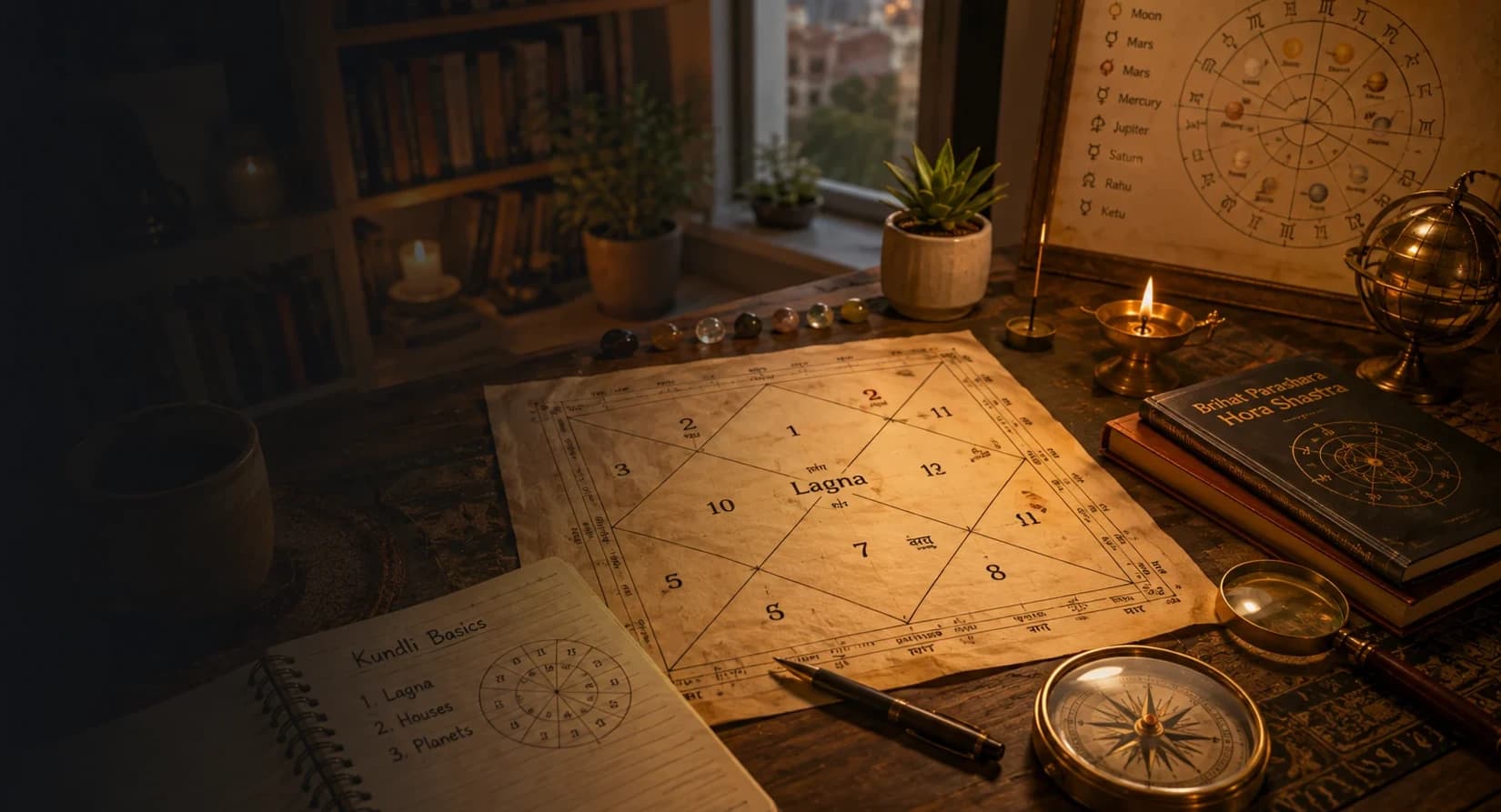
The Ascendant sign, also called the Lagna, is the zodiac sign rising in the east at the exact time of birth. This is one of the most important points in Vedic Astrology because it determines the entire house structure of the chart.
The Ascendant becomes the 1st house. Then the remaining houses are counted from there. So if Aries is rising, Aries becomes the 1st house, Taurus the 2nd, Gemini the 3rd, and so on. If Libra is rising, then Libra becomes the 1st house, Scorpio the 2nd, Sagittarius the 3rd, and so forth.
This means the Ascendant is not merely another psychological factor. It is the architectural foundation of the chart. Once the Ascendant changes, the house structure changes. Once the houses change, house rulership changes. Once house rulership changes, the functional role of planets changes. And once that changes, the interpretation of career, marriage, wealth, health, spirituality, and life direction can all shift significantly.
This is why serious astrologers place so much importance on Lagna. It personalizes the chart and grounds it in embodied life.
What the Ascendant Feels Like in Real Life
The Ascendant often shows how a person enters life, how they meet the world, how their body and outer presence operate, and what kind of framework surrounds the expression of the self. It is closely related to first impressions, bodily presence, outward style, and general life orientation.
For example, an Aries Ascendant may move quickly, directly, and assertively into experience. A Taurus Ascendant may move more steadily, deliberately, and tangibly. A Gemini Ascendant may respond through curiosity, language, and mental movement. A Cancer Ascendant may engage through protection, feeling, and cautious responsiveness.
But the Ascendant is more than personality style. It tells us how the whole chart is organized. That is why many astrologers would say: the Moon shows your inner climate, the Sun shows your inner light, but the Ascendant shows the stage and structure of your life.
How They Are Calculated Differently
Understanding how these three are calculated helps explain why they behave differently in interpretation.
The Sun sign is determined by the zodiac sign where the Sun was located at birth. Because the Sun moves relatively slowly through the zodiac, it stays in one sign for a longer period. That is why many people born within the same date range share the same Sun sign.
The Moon sign is determined by the zodiac sign where the Moon was located at birth. The Moon moves much faster than the Sun, so the Moon sign changes more frequently. This makes it more sensitive to birth timing, though not as structurally decisive as the Ascendant.
The Ascendant depends on the exact sign rising on the eastern horizon at the time and place of birth. Because the Earth rotates continuously, the Ascendant changes rapidly, often around every two hours. This is why birth time matters so much when calculating Lagna.
So even though all three are “signs,” they are not produced in the same way and do not function in the same way.
Sun Sign vs. Moon Sign: The Core Difference
If we compare the Sun sign and Moon sign directly, the simplest distinction is this:
- The Sun sign is about core identity, dignity, purpose, and conscious life-force.
- The Moon sign is about mind, emotion, comfort, habit, and lived inner experience.
Someone may have a strong and proud Sun sign but a very sensitive Moon sign. They may look steady and capable externally while feeling emotionally delicate inside. Someone else may have a humble Sun expression but an extremely strong and independent Moon pattern.
This is why it is possible to “act” differently in public than you feel in private. The chart contains more than one layer of truth. The Sun and Moon are both describing you, but from different angles.
Moon Sign vs. Ascendant: The Core Difference
This comparison is especially important in Vedic Astrology, because both the Moon sign and the Ascendant are taken very seriously.
- The Moon sign shows how you feel and process experience psychologically.
- The Ascendant shows how your life is structured and how you move through the world in embodied form.
If the Moon sign is your inner weather, the Ascendant is your outward frame. If the Moon describes emotional processing, the Ascendant describes directional embodiment. If the Moon tells us how you respond inwardly, the Ascendant tells us how the chart is organized outwardly.
This is one reason the Moon sign may feel emotionally familiar while the Ascendant may explain why your life circumstances, priorities, and outer presentation seem to work a particular way.
Sun Sign vs. Ascendant: The Core Difference
This distinction is also essential. The Sun sign may tell us about your central pride, leadership style, self-respect, and soul-expression. But the Ascendant determines the house framework and the personal structure of the chart.
So the Sun sign tells us something important about who you are at the center. The Ascendant tells us how that center enters life and how life is arranged around it.
Two people with the same Sun sign can have very different Ascendants. That means their Sun may fall into different houses, receive different aspects, rule different life areas, and function very differently overall. This is why Sun-sign-only astrology often feels too general.
Why Vedic Astrology Gives So Much Importance to the Moon and Lagna
Beginners often wonder why Vedic Astrology does not place all its emphasis on the Sun sign in the way popular Western-style astrology often appears to. The answer is that Vedic Astrology is deeply interested in mind, karma, timing, and structure.
The Moon is central because it reflects mind, habit, internal experience, and many important timing systems. The Ascendant is central because it creates the house structure that makes the chart truly individual. Together, the Moon and Lagna make the chart emotionally alive and structurally precise.
The Sun remains important. It is not neglected. But it is understood as one major factor among several, not the only key to identity.
A Practical Example: Same Sun Sign, Different Moon and Lagna
Imagine two people both have the Sun in Leo. On paper, both may have themes of pride, dignity, creativity, centrality, and self-expression. But let us imagine the first person has Moon in Cancer and Ascendant in Virgo, while the second has Moon in Aquarius and Ascendant in Aries.
The first person may have a strong need to feel emotionally safe, may process life sensitively, and may present themselves outwardly in a careful, analytical, and service-oriented way. The second may process emotion through detachment, perspective, and mental distance, while outwardly appearing quick, assertive, and action-driven.
Same Sun sign. Very different lived reality.
This is why all three factors matter. Without the Moon and Ascendant, the chart would remain too shallow. Without the Sun, an important central layer of identity would be missing. Together, the picture becomes real.
Which One Is the Most Important?
This is the question many people want answered in one line, but astrology rarely rewards one-line answers. The truthful response is:
- The Ascendant is often the most important for chart structure and house-based interpretation.
- The Moon sign is often the most important for mind, emotional life, timing, and many practical Vedic techniques.
- The Sun sign is extremely important for vitality, dignity, purpose, self-expression, and central identity.
So the question is not really, “Which one completely replaces the others?” The better question is, “What does each one describe?”
In actual reading, an astrologer usually uses all three. But Lagna often becomes the starting point for structural interpretation, and the Moon becomes central for lived mental experience and timing.
Why Many People Relate More to One Than Another
Some people strongly relate to their Moon sign because they live very close to their emotional reality. Others relate more to their Ascendant because their outward personality, body, and life-approach dominate the way they experience themselves. Others feel their Sun sign strongly because purpose, pride, creativity, or central identity are major themes in their life.
There is no single “correct” one to relate to emotionally. It depends on temperament, chart emphasis, and what layer of self the person is noticing most consciously.
That said, many people who feel disappointed by generic Sun-sign content often feel relieved once they learn about the Moon sign and the Ascendant. Suddenly the chart begins to explain not just a public label, but an actual human life.
How Beginners Should Use All Three Together
If you are just starting out, here is a practical way to think about them:
- Use the Sun sign to understand your central vitality, will, dignity, and life-purpose tone.
- Use the Moon sign to understand your emotional needs, inner reactions, comfort patterns, and psychological style.
- Use the Ascendant to understand your outer life framework, the house structure of your chart, and the way your life is organized.
Then go one step deeper:
- See where the Sun is placed by house.
- See where the Moon is placed by house and nakshatra.
- See which sign is rising and where the Lagna lord is placed.
This already creates a much more meaningful chart interpretation than relying on one label alone.
Common Mistakes People Make
There are several common beginner mistakes in this area:
- assuming the Sun sign explains the whole self
- thinking the Moon sign and Ascendant are interchangeable
- ignoring birth time when discussing Lagna
- using one sign description as absolute truth
- forgetting that houses change the whole meaning of planets
Another common mistake is feeling that astrology is “wrong” because the Sun-sign description does not fully match. Often the issue is not that astrology is wrong. The issue is that the person is reading only one layer of the chart and mistaking it for the whole.
How an Astrologer Actually Uses Them in a Reading
A serious astrologer typically does not choose only one of these and ignore the others. Instead, they synthesize them.
A typical reading may begin with:
- the Ascendant and Lagna lord for structure and life direction
- the Moon sign and Moon condition for mind and emotional life
- the Sun for identity, vitality, authority, and purpose
From there, the astrologer moves into house rulership, aspects, yogas, nakshatras, Dashas, and transits. But the three sign factors remain part of the reading throughout.
This is why beginners should not ask, “Which one should I throw away?” The better approach is to ask, “What part of me is this showing?”
Final Thoughts: Three Lenses, One Chart
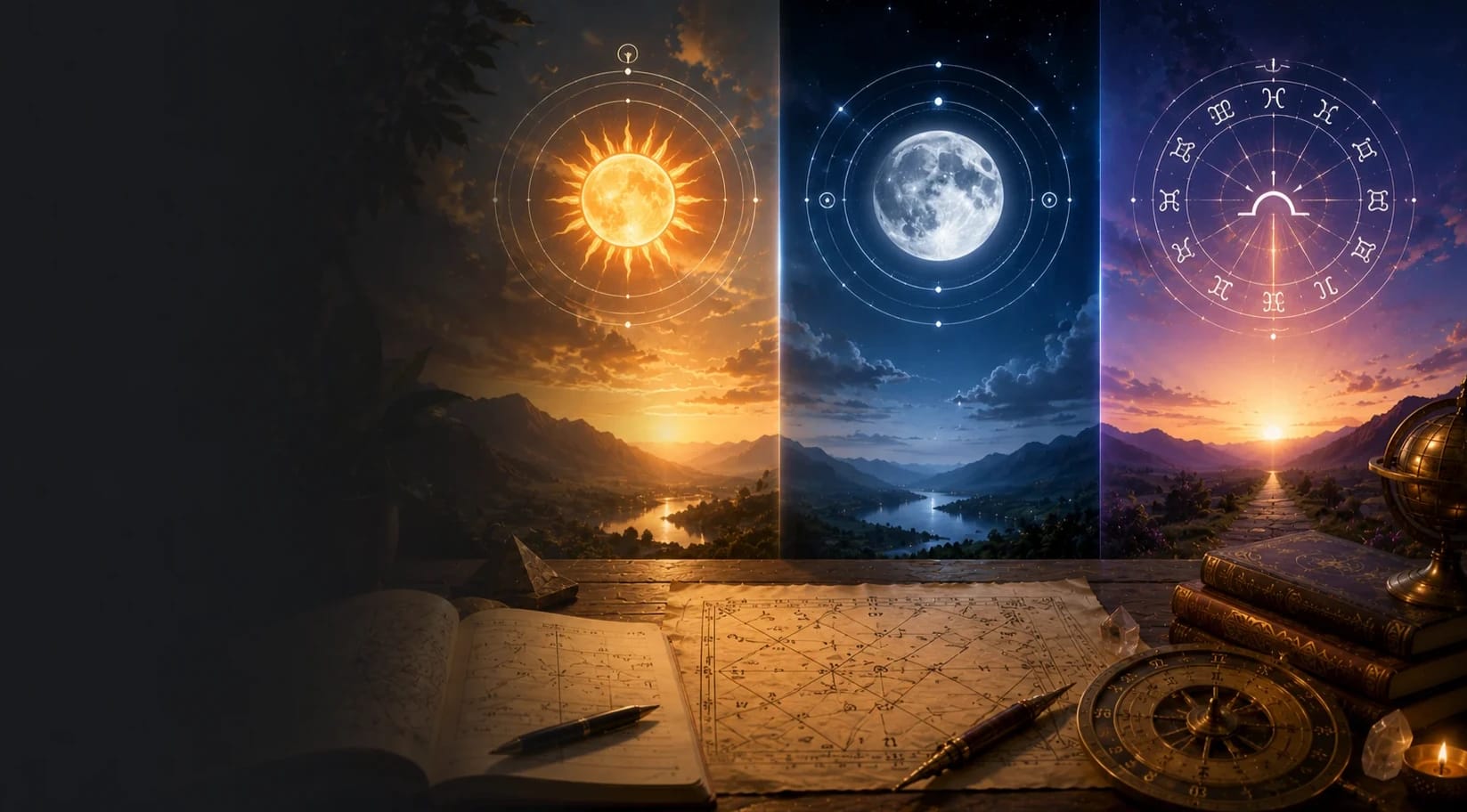
The Sun sign, Moon sign, and Ascendant sign are not contradictions. They are three different lenses through which the birth chart becomes understandable.
The Sun sign shows the core light of identity and self-respect. The Moon sign shows the inner mental and emotional life. The Ascendant sign shows the structure of lived existence and the framework of the whole chart.
Once you understand this, astrology becomes much more realistic and much more humane. You stop trying to force your whole self into one label. You begin to see that a chart is layered, and that human life is layered too.
If you are serious about learning Jyotish, remember this: the Sun tells you something essential, the Moon tells you something intimate, and the Ascendant tells you something foundational. Together, they form a much wiser beginning than any one of them alone.
Expert Insight
The confusion disappears the moment a student understands that the Sun sign, Moon sign, and Ascendant are not three competing identities. They are three different windows into the same life. The Sun shows central radiance, the Moon shows inner experience, and Lagna shows the structure of embodiment and chart interpretation.
— Rajiv Menon
Real-Life Case Study
A reader once came for guidance after years of feeling disconnected from astrology because her popular Sun-sign descriptions never seemed accurate. She had assumed astrology simply did not work for her. But once her Vedic chart was examined properly, it became clear that her Moon sign described her emotional reality far better, while her Ascendant explained the outward style and life-structure she had actually been living through. The problem was never that astrology was wrong. The problem was that she had been given only one lens and expected it to explain the whole person. Once she saw all three layers together, the chart finally felt true to life.
Rajiv Menon
Vedic astrologer and Jyotish Visharad with 22 years of experience in chart reading, kundali interpretation, and timing analysis.