Understanding the Janam Kundali: Your Cosmic Blueprint Explained
A Janam Kundali is far more than a chart full of symbols. This beginner-friendly guide explains what a birth chart is, why birth time matters, how Lagna, planets, signs, and houses work together, and how an astrologer actually begins reading your cosmic blueprint.
Introduction: What Exactly Is a Janam Kundali?
If you have ever seen a Vedic birth chart for the first time, you probably had the same reaction most beginners do: it looks mysterious, technical, and slightly overwhelming. There are boxes, numbers, symbols, planetary abbreviations, house positions, and words like Lagna, Rashi, Bhava, and Nakshatra that seem to belong to a very old system. Many people assume a Janam Kundali is only for astrologers, or that it is too complicated to understand without years of study. But the truth is simpler and much more encouraging.
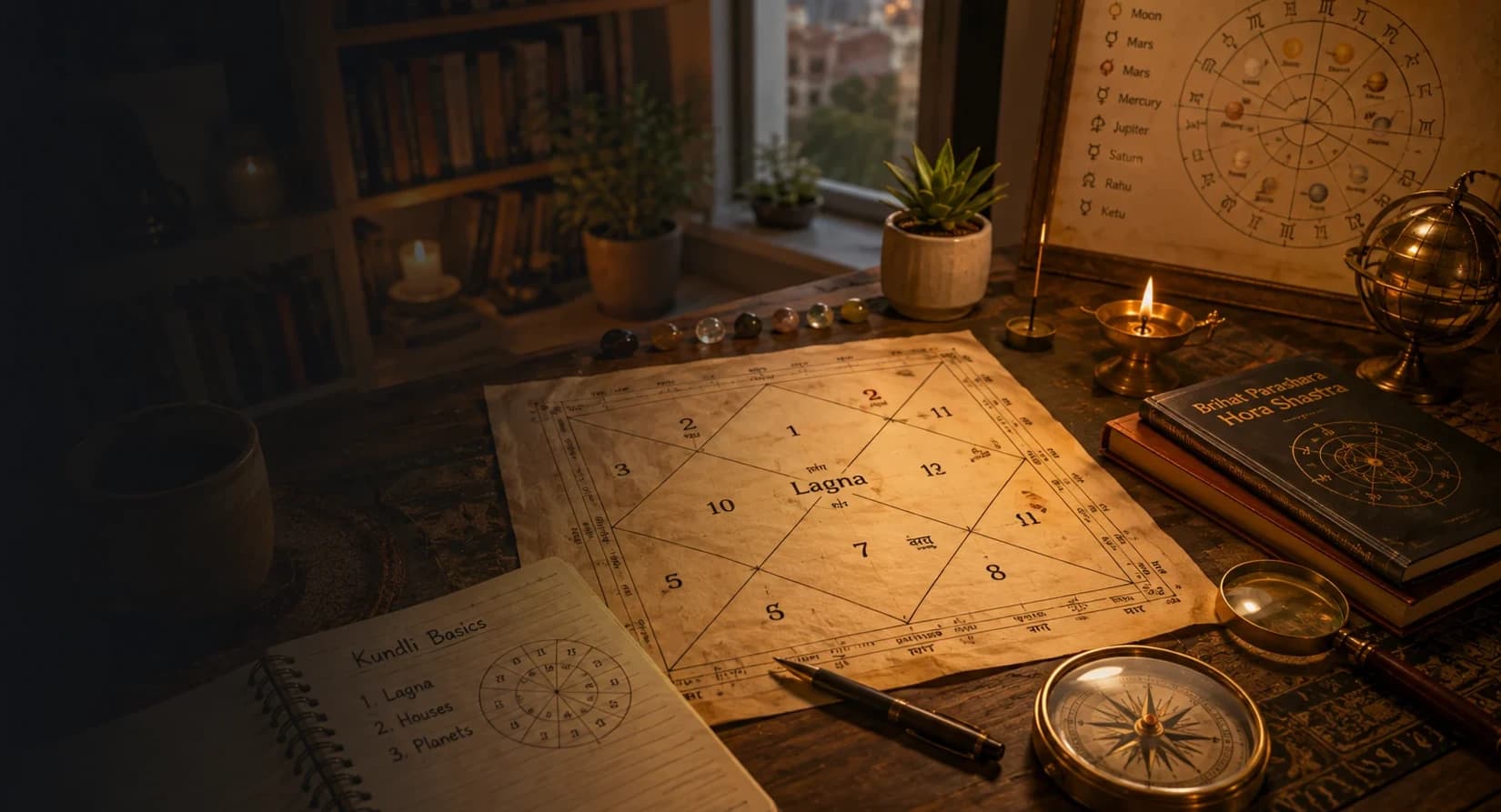
A Janam Kundali, also called a birth chart or natal chart, is the foundational map used in Vedic Astrology to understand a person’s life pattern. It is created from your exact date, time, and place of birth. At the moment you were born, the planets occupied specific positions in the sky. The Janam Kundali captures that celestial pattern and turns it into a symbolic map of your life.
That map is not random. In Jyotish, or Vedic Astrology, the birth chart is seen as a karmic blueprint. It reflects your tendencies, strengths, vulnerabilities, timing patterns, natural gifts, life lessons, emotional makeup, relationship style, career direction, and spiritual inclinations. It does not reduce your life to a single label. Instead, it gives structure to the complexity of your experience.
For that reason, understanding your Janam Kundali is one of the most important steps in learning astrology properly. It helps you move beyond superficial Sun-sign content and into the real architecture of Vedic chart reading. This guide is written for beginners who want a clear, grounded, and genuinely useful explanation of what a Janam Kundali is, how it works, what the key components mean, and how an astrologer actually reads it in practice.
What Does “Janam Kundali” Mean?
The term Janam means birth, and Kundali refers to the chart or horoscope created from the moment of birth. So Janam Kundali literally means “birth chart.” In different regions and traditions, you may also hear terms like Kundli, Janma Kundali, Jataka, or simply birth horoscope.
In practical terms, a Janam Kundali is a two-dimensional astrological diagram showing where the planets were located at the time you were born. But in Vedic Astrology, that diagram is not treated as a dead chart. It is read as a living system. The planets are not just objects in space. They represent karmic forces, psychological tendencies, areas of life emphasis, and timing triggers. The chart becomes meaningful because it is interpreted as a whole.
This is why people often call the Janam Kundali a cosmic blueprint. It is not a blueprint in the rigid, mechanical sense that everything is fixed and nothing can change. Rather, it is a symbolic pattern that shows how life is configured at the starting point. It shows where effort is likely to be needed, where grace may flow more easily, what themes may repeat, and what inner work can lead to growth and maturity.
What Information Is Needed to Create a Janam Kundali?
A proper Janam Kundali is calculated using three essential details:
- Date of birth
- Exact time of birth
- Place of birth
All three matter. Many beginners underestimate the importance of birth time, but in Vedic Astrology it is absolutely central. The reason is simple: the Ascendant, or Lagna, changes regularly as the Earth rotates. When the Lagna changes, the entire house structure of the chart changes with it. That means two people born on the same date in the same city can still have very different charts if their birth times are different enough.
The place of birth matters because planetary rising and house calculation depend on local horizon and geographic location. Time zone correction, daylight saving issues in some cases, and precision in location can all influence the final chart calculation.
This is why astrologers take birth details seriously. A chart made with inaccurate time can distort the reading of life areas such as marriage, profession, children, health, and major timing patterns. In some cases, if the birth time is uncertain, astrologers may use rectification methods to estimate a more accurate time based on life events.
Why Birth Time Matters So Much
If there is one technical lesson every beginner should learn early, it is this: birth time is not a minor detail. In Vedic Astrology, it can completely reshape how the chart is read.
The most obvious reason is the Ascendant. The Ascendant is the sign rising on the eastern horizon at the exact moment of birth. That sign becomes the 1st house of the chart, and the remaining houses follow from there. When the Ascendant changes, the placement of planets into houses can change. House rulership can change. The functional benefic and malefic logic can change. And because of that, the whole interpretive structure may shift.
A person may think, “My Moon sign is the same, so my chart must be basically the same.” But that is not how Jyotish works. The same Moon sign with a different Lagna can create an entirely different life emphasis. For one person, Saturn may rule highly productive houses. For another, Saturn may bring more obstacles and psychological pressure. The same planet can behave very differently depending on the Ascendant framework.
That is why experienced astrologers often say that if the chart is the script, Lagna is the stage on which the script is performed. Without accurate Lagna, much of the subtlety of the chart can be lost.
The Janam Kundali Is a Map, Not a Sentence
One of the healthiest ways to approach a birth chart is to remember that it is a map, not a sentence. It is not there to trap you in fear. It is not there to tell you that one difficult placement means your life is doomed. And it is not there to eliminate personal agency.
Instead, the Janam Kundali helps you understand patterns. It can show where you are naturally confident, where you are emotionally sensitive, where delays may teach patience, where responsibilities increase maturity, where relationships become a major area of learning, and where opportunities may arrive through effort and timing.
A mature reading never treats one placement in isolation. It does not say, “This one planet means your marriage will fail,” or “This one yoga guarantees wealth.” Real astrology is always contextual. Every promise in the chart must be assessed with strength, timing, condition, and relationship to other factors. That is why the best astrologers are careful, layered, and realistic in interpretation.
When understood in this way, the Janam Kundali becomes empowering rather than frightening. It helps you work with life more consciously. It shows where acceptance is needed, where correction is needed, and where courage is needed.
The Three Core Layers: Planets, Signs, and Houses
The easiest way to begin reading a Janam Kundali is to understand three core layers:
- Planets – the energies or actors
- Signs – the style or environment of expression
- Houses – the life areas where things unfold
You can think of it this way: the planet tells you what kind of energy is active. The sign tells you how that energy behaves. The house tells you where in life it is most likely to show itself.
For example, Mars always carries themes like action, drive, conflict, courage, and assertion. But Mars in Aries will behave differently from Mars in Cancer. And Mars in the 10th house will express differently from Mars in the 4th house. This is why chart interpretation must combine all three layers.
Once beginners understand this simple model, the chart becomes much less intimidating. Instead of seeing a confusing diagram, they start seeing relationships between energy, style, and life area.
The Role of the Ascendant (Lagna)
If the Janam Kundali has one master key, it is the Ascendant, known in Sanskrit as Lagna. Lagna is the sign rising at the moment of birth. In many ways, it is the doorway into the entire chart.
Lagna determines the 1st house, which represents the self, body, personality, vitality, and overall life direction. But its importance goes beyond that. Once Lagna is fixed, every other house is fixed. That means the rulership of houses by planets is also fixed. This becomes the basis for a huge amount of Vedic interpretation.
The Lagna and its ruler, called the Lagnesh, are among the first things an astrologer studies. A strong Lagna and Lagnesh can support resilience, direction, and vitality. A challenged Lagna may require more awareness around health, confidence, stability, or self-definition.
For beginners, one important lesson is this: do not reduce your chart to your Moon sign or Sun sign alone. In Vedic Astrology, Lagna is often the structural anchor of the whole reading.
The Importance of the Moon and the Sun
Many people coming from pop astrology expect the Sun to be the center of everything. In Vedic Astrology, the Sun is certainly important, but the Moon is often just as important, and in many practical matters even more immediately revealing.
The Moon represents the mind, emotions, adaptation, memory, receptivity, and inner experience of life. It tells us how a person processes reality, what gives emotional comfort, how mentally stable or impressionable they may be, and how they experience daily life on the inside.
The Sun represents soul-force, authority, identity, dignity, father, confidence, vitality, and self-respect. It shows where a person seeks purpose, recognition, and inner radiance.
In real chart reading, both matter. But the Moon has a special place in Vedic Astrology because major timing systems and transit-based interpretations often reference it. For example, Sade Sati is judged from the Moon sign. The starting point of Vimshottari Dasha depends on the Moon’s birth nakshatra. Compatibility systems such as Guna Milan also depend heavily on the Moon.
So when reading a Janam Kundali, the Moon is not a side detail. It is one of the emotional and predictive centers of the chart.
The Twelve Houses: Life Areas in the Chart
The 12 houses, or Bhavas, are among the most practical parts of astrology because they show the major areas of life. Each house governs a set of themes:
- 1st House – self, body, identity, direction
- 2nd House – wealth, family, speech, food
- 3rd House – courage, communication, siblings, skills
- 4th House – home, mother, emotional roots, property
- 5th House – creativity, children, intelligence, romance, merit
- 6th House – health, debts, service, enemies, struggle
- 7th House – marriage, partnership, agreements, public interaction
- 8th House – transformation, secrets, vulnerability, sudden events, occult depth
- 9th House – dharma, luck, father, blessings, higher knowledge
- 10th House – action, profession, status, karma, public life
- 11th House – gains, fulfilment, networks, aspirations
- 12th House – losses, retreat, foreign lands, sleep, surrender, liberation
One beginner mistake is to memorize these meanings and stop there. In real chart reading, the story is shaped not only by the house itself, but also by the planet occupying it and the ruler of that house. The condition of the house lord can dramatically modify results.
House Lords: The Secret Logic of Vedic Chart Reading
If you want to understand why Vedic Astrology is so precise, study the concept of the house lord. Every house begins in a sign, and each sign is ruled by a planet. That planet becomes the lord of that house. The house lord carries the meaning of that house wherever it goes.
For example, if the 10th house of career is ruled by Venus, then Venus becomes crucial for understanding professional life. If that Venus goes to the 9th house, career may connect with teaching, creativity, values, higher learning, or travel. If it goes to the 6th, work may involve service, competition, health systems, or daily discipline.
This is why house lords are central to interpretation. It is not enough to ask, “What does Venus mean?” You must also ask, “Which houses does Venus rule in this chart?” and “Where is Venus placed?”
Without house-lord analysis, the chart remains too generic. With it, the chart becomes personal.
The Twelve Signs: The Style of Expression
Signs, or Rashis, do not merely label personality. They shape the style through which planetary energy expresses itself. Aries is direct, pioneering, and fiery. Taurus is stable, material, grounded, and sensual. Gemini is curious and communicative. Cancer is emotional and protective. Leo seeks dignity and centrality. Virgo analyses and improves. Libra harmonizes and compares. Scorpio intensifies and transforms. Sagittarius expands and seeks meaning. Capricorn structures and perseveres. Aquarius systems and distributes. Pisces dissolves and spiritualizes.
When a planet occupies a sign, it expresses through that sign’s temperament. Mercury in Gemini expresses differently from Mercury in Pisces. Saturn in Capricorn behaves differently from Saturn in Aries. Understanding signs therefore helps you read planetary tone more accurately.
This is one reason Jyotish can never be reduced to a few memorized “good” or “bad” placements. The sign changes the mood of the planet. The house changes the field of experience. The rulership changes the karmic agenda.
The Planets: The Energies at Work
In Vedic Astrology, the nine grahas are Sun, Moon, Mars, Mercury, Jupiter, Venus, Saturn, Rahu, and Ketu. Each has natural significations and a distinct psychological and karmic role.
Mars energizes and cuts through resistance. Mercury analyses and communicates. Jupiter protects, teaches, and expands. Venus harmonizes and enjoys. Saturn tests, delays, disciplines, and matures. Rahu amplifies desire and ambition. Ketu cuts attachment and deepens spiritual sensitivity.
But a planet’s actual result depends on more than its natural meaning. A benefic planet can become problematic in certain roles. A naturally challenging planet can produce tremendous growth and achievement if well placed and functionally supportive in the chart. That is why astrology demands context and not slogans.
Nakshatras: The Fine Detail of the Chart
One of the most distinctive and beautiful features of Vedic Astrology is the use of Nakshatras, the 27 lunar mansions. Every planet is placed not only in a sign and house but also in a nakshatra. Nakshatras give texture, symbolism, psychology, and karmic nuance that sign placements alone cannot provide.
For instance, two people may both have the Moon in Taurus. But if one Moon is in Rohini and the other in Krittika, their emotional nature, desire pattern, and life texture may still differ strongly. That additional layer often explains subtleties that basic sign reading cannot.
Nakshatras also matter enormously for timing, because the birth nakshatra of the Moon determines the starting point of the Vimshottari Dasha sequence. So for beginners, even if you are not yet ready to study all 27 in detail, it is useful to understand that nakshatras are part of what makes the Janam Kundali so refined.
Dashas: Why Timing Changes Everything
A birth chart may show many promises and possibilities, but not all of them unfold at once. This is where Dasha systems become essential. If the chart is the map, Dasha is the clock.
The most commonly used system is Vimshottari Dasha, a planetary period system that divides life into cycles ruled by different planets. When a particular planet’s Mahadasha or Antardasha runs, that planet becomes much more active in shaping experience.
This is why timing matters so much in chart interpretation. A person may have a strong career promise in the chart, but if the relevant Dasha has not yet activated, the visible outcome may not appear. Another person may go through emotional upheaval during a Moon or Rahu period even though the long-term chart holds stronger stability.
Beginners are often relieved to learn this because it explains why life seems to move in seasons. The Janam Kundali does not say that everything is always happening at once. It says that different karmic themes are activated at different times.
North Indian vs. South Indian Chart Layouts
Many beginners think different chart layouts mean different astrology systems. That is not true. The North Indian and South Indian chart styles are simply different visual formats for presenting the same chart data.
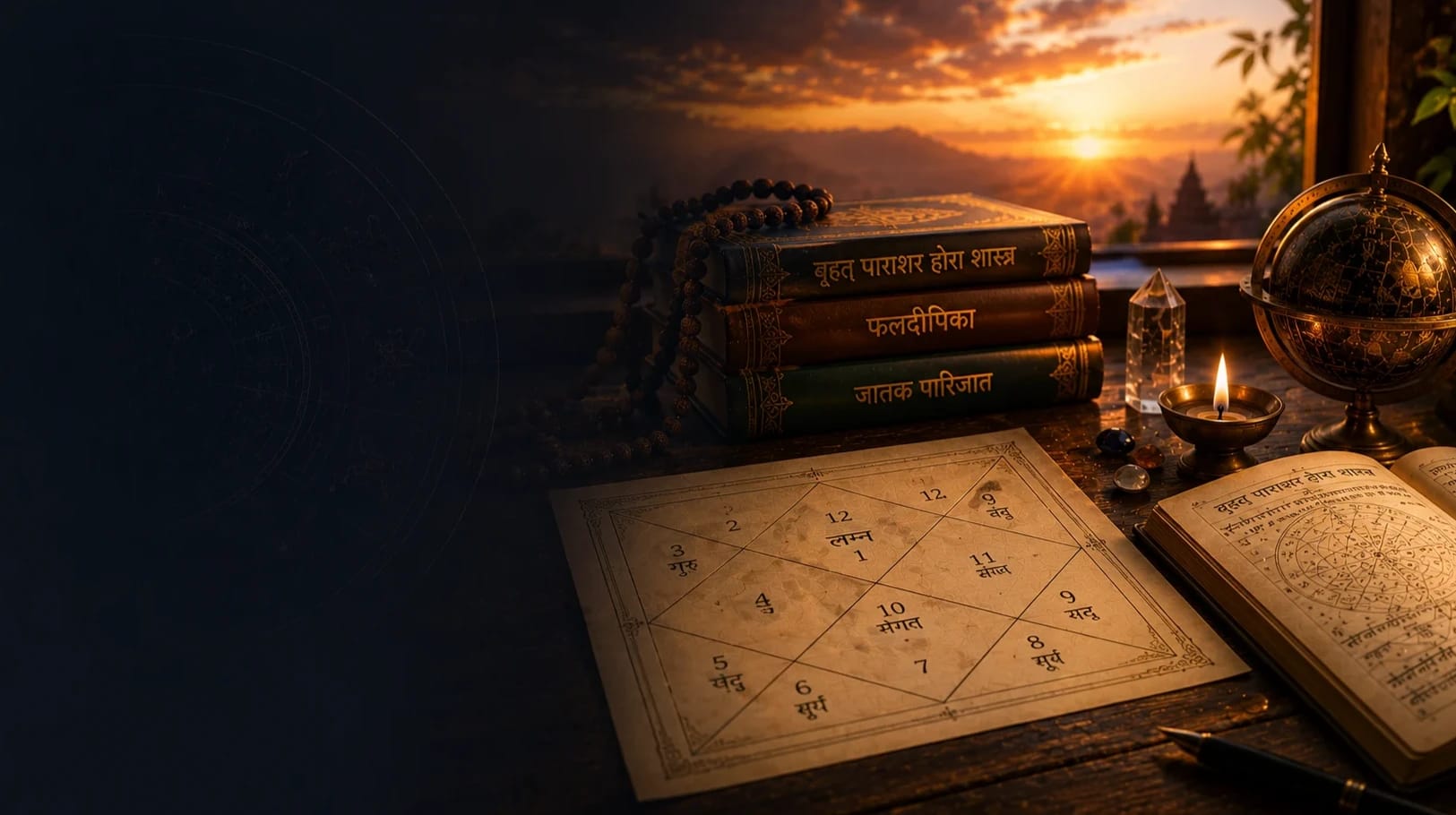
In the North Indian style, houses are fixed and signs move through them. In the South Indian style, signs are fixed and houses are counted from the Ascendant. The underlying planetary placements are the same; only the visual presentation differs.
This is an important point because many beginners panic when they see two layouts and assume their chart changed. It did not. The language of display changed, not the astrological reality.
What an Astrologer Looks At First
A real astrologer usually does not begin by hunting for one dramatic placement. Instead, there is a structured way of reading. The process often starts with:
- the Ascendant and Ascendant lord
- the Moon and mental condition
- the strength of key houses like the 1st, 4th, 7th, 9th, and 10th
- house lords and their placements
- planetary dignity, aspects, conjunctions, and yogas
- current Dasha and major transits
This layered method prevents oversimplification. It also explains why chart reading is a skill. Astrology is not just looking up meanings in isolation. It is the art of synthesis.
Common Beginner Mistakes When Looking at a Janam Kundali
Beginners often make a few predictable mistakes:
- judging the whole chart from one placement
- ignoring the Ascendant and focusing only on Sun or Moon sign
- assuming one difficult house means lifelong failure
- treating every online interpretation as universally true
- forgetting the role of planetary strength and house rulership
- ignoring timing and Dashas
These mistakes are understandable, but they create confusion. The chart becomes much more useful when you treat it as a system rather than a list of isolated statements.
What a Janam Kundali Can Tell You, and What It Cannot
A Janam Kundali can offer deep insight into tendencies, timing, strengths, relationships, work patterns, emotional structure, karmic themes, and growth areas. It can help you understand yourself more honestly. It can also help you make wiser decisions by showing which areas need discipline, patience, or conscious correction.
But it cannot replace maturity, effort, ethics, communication, health care, or responsibility. Astrology is not a substitute for action. Nor should it be used to remove all uncertainty from life. A good chart reading gives perspective, not mechanical certainty.
When used properly, the Janam Kundali becomes a guide, not a crutch. It gives context. It does not take away free will.
How to Start Reading Your Own Janam Kundali
If you want to begin learning your own chart, start in this order:
- identify your Ascendant and Ascendant lord
- identify your Moon sign and Sun sign
- learn the meanings of the 12 houses
- see which planets occupy which houses
- learn which planets rule which houses in your chart
- then gradually move to yogas, nakshatras, and Dashas
This approach is much better than diving straight into advanced technical combinations without foundational understanding. The strongest astrology students always respect the basics.
Final Thoughts: Why Understanding Your Janam Kundali Matters
The Janam Kundali is not just an astrological chart. It is a language of pattern. It offers a structured way to understand life, not as a random collection of events, but as a meaningful interplay of karma, timing, desire, effort, grace, and self-awareness.
For a beginner, the most important shift is this: stop seeing the Kundali as a bundle of mysterious symbols and start seeing it as a readable map. The moment that shift happens, astrology stops feeling intimidating and starts feeling illuminating.
If you learn the role of Lagna, planets, signs, houses, nakshatras, and Dashas patiently, the chart begins to speak. And when it speaks clearly, it does not merely tell you what may happen. It helps you understand who you are becoming.
That is why the Janam Kundali remains one of the most powerful tools in Vedic Astrology. It is not there to scare you. It is there to help you see.
Expert Insight
A Janam Kundali is not meant to be read like a list of isolated placements. The real insight comes from synthesis: Lagna, house lords, planetary strength, the Moon, timing, and yogas must all be read together. That is when the chart becomes a meaningful blueprint instead of a confusing diagram.
— Rajiv Menon
Real-Life Case Study
A client in her early thirties came for a reading after years of feeling that she could never “understand” her own chart. She had read many generic interpretations online and became convinced that one difficult 7th-house factor meant she was destined for unhappy relationships. But once the full Janam Kundali was read properly, a different picture emerged. Her 7th-house themes were indeed sensitive, yet the house lord was stronger than she realized, and the running Dasha was activating inner healing more than immediate partnership fulfilment. The chart was not denying relationship happiness; it was teaching emotional clarity before commitment. The biggest shift for her came not from prediction, but from understanding that a Kundali must be read as a whole. That changed fear into perspective, and perspective into wiser decisions.
Rajiv Menon
Vedic astrologer and Jyotish Visharad with 22 years of experience in chart reading, kundali interpretation, and timing analysis.