

Can marriage compatibility be checked by name alone?
Name-based marriage matching can offer a traditional, preliminary indication of compatibility. It usually starts with the first sound of each person’s name, then estimates a name Rashi or possible Nakshatra and compares those symbols. It can be useful when birth details are unavailable or when a family wants a gentle cultural starting point. It cannot, however, establish a complete Kundli match or predict whether a marriage will succeed.
A careful approach keeps the limitation visible. Full Ashtakoot or 36-Guna matching is traditionally based on the Moon’s actual sign and Nakshatra at birth. Names are not always chosen from the birth Nakshatra, so a name-based result is an estimate rather than a substitute for a birth-chart calculation. Consent, mutual respect, communication and practical readiness remain more important than any score.
What name-based Guna Milan means
Name-based Guna Milan is a customary form of matching that uses the first pronounced sound of a name. Depending on the naming table used, that sound may be associated with a name Rashi, a Nakshatra group, or both. The two estimated placements are then compared for broad themes such as temperament, communication, emotional style and planetary friendship.
Different traditions and websites may use different name-letter tables, especially across languages and spellings. That is one reason two tools can sometimes return different results for the same names. The result is best treated as a conversation prompt: it may suggest areas to understand better, but it does not describe either person completely.
A useful reader question is not “Does this name score decide our future?” but “What assumptions produced this estimate, and what do we know directly about one another?” That framing keeps the practice respectful and prevents a symbolic tool from carrying more authority than it can reasonably support.
Can it calculate all 36 Gunas?
Some name-matching systems display an estimated score out of 36. They do this by inferring a likely Rashi or Nakshatra from the opening sound of the names and applying Ashtakoot rules to that inference. The calculation may be internally consistent, but it remains conditional on the assumption that both names actually reflect the birth Nakshatras.
In a proper Ashtakoot calculation, the Moon’s birth Nakshatra and Chandra Rashi are calculated from the date, exact local time and place of birth. A traditional score such as 18/36, 24/36 or 30/36 is an indicator within that system, not a guarantee of success or failure. A name-only score is even more limited and should never be used to pressure either person into, or out of, marriage.
When name matching is useful
Name matching can be reasonable as an initial cultural reference when a birth time is unknown, old records are incomplete, or two people simply want to explore a traditional idea before seeking a detailed reading. It can also help families distinguish between a preliminary name-based check and a later Kundli discussion.
Try the Name Matching tool as an estimate, not a verdict. If reliable birth details later become available, use the Kundli Matching tool for the fuller Moon-based framework.
How the method works
- Identify the first clearly pronounced sound of each name, not merely the first Roman letter.
- Use a stated naming table to estimate the related name Rashi or Nakshatra group.
- Compare the estimated symbols, their rulers and selected traditional compatibility factors.
- State the uncertainty openly, especially if the name was chosen for family, language, faith, fashion or personal preference rather than Nakshatra naming.
Pronunciation matters. For example, transliteration can make one Indian sound appear as several English spellings, while a nickname, pet name and legal name may all begin differently. A transparent name-based reading says which name and pronunciation it used.
Name Rashi versus Janma or Chandra Rashi
Name Rashi is inferred from a name sound. Janma Rashi, often called Chandra Rashi, is the sign occupied by the Moon at birth. They may coincide when a name was deliberately chosen from the birth Nakshatra syllable, but they do not automatically match. Modern names are often selected for many valid reasons unrelated to an astrology naming table.
This distinction matters because classical Guna Milan is Moon-based. The Kundli calculator uses birth information to calculate the chart rather than making a name-based assumption. If birth details are accurate, that is the more suitable foundation for a detailed compatibility discussion.
What a name check can and cannot show
A name check may offer broad symbolic prompts about communication style, emotional expectations or possible differences in pace and temperament. It cannot reliably assess the actual 7th house, its lord, Navamsa, Manglik factors, running Dashas, health questions, financial circumstances or the quality of a relationship.
It also cannot tell whether two people are kind to each other, able to repair conflict, ready for shared responsibilities, or freely choosing the relationship. These are not minor details outside the match; they are central to married life.
The eight Ashtakoot factors in context
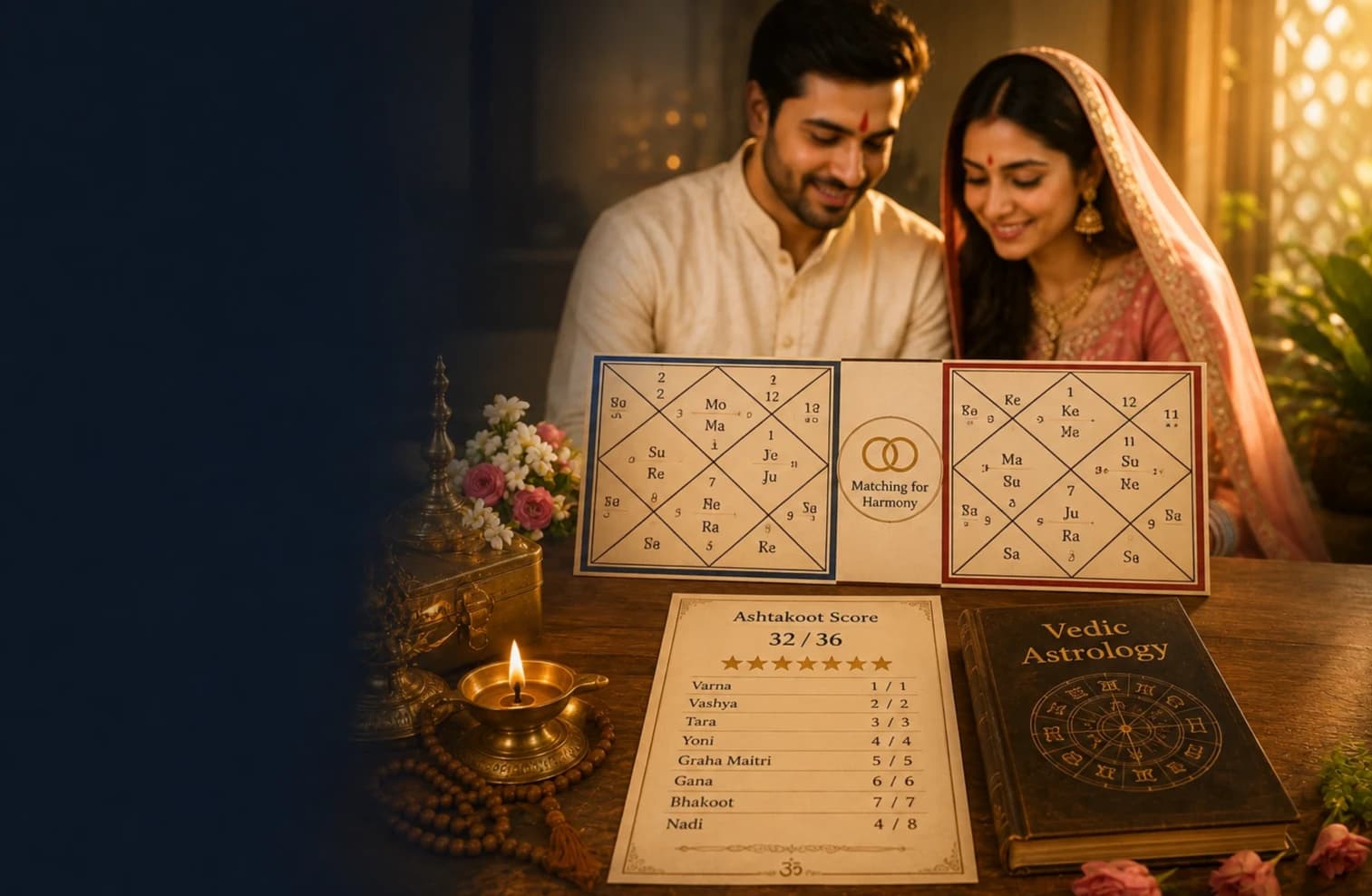
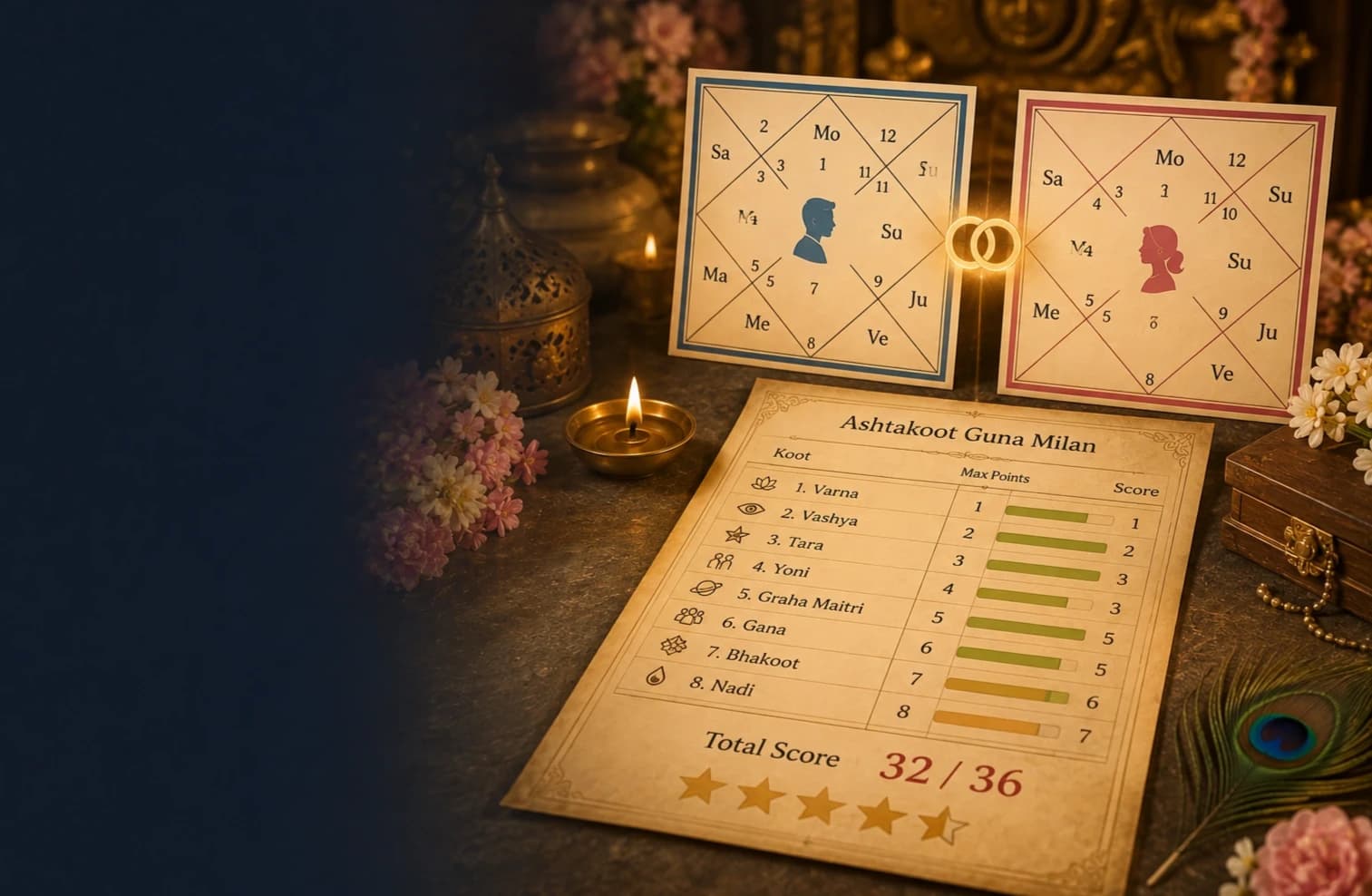
When a possible Nakshatra is inferred, a tool may refer to the eight traditional Koots: Varna, Vashya, Tara, Yoni, Graha Maitri, Gana, Bhakoot and Nadi. In a birth-based reading they form a structured compatibility framework. Their meanings should be explained without fear or social ranking.
KootTraditional focus
Varna
A traditional temperament classification, not a measure of a person’s worth.
Vashya
Patterns of influence, adaptation and mutual responsiveness.
Tara
General Nakshatra-based support and rhythm.
Yoni
Traditional symbolism around attraction and intimacy; respect and consent are indispensable.
Graha Maitri
Friendship or tension between the relevant sign rulers.
Gana
Temperamental style and ways of responding.
Bhakoot
A traditional Rashi relationship that needs full-chart context.
Nadi
A traditional factor that should be interpreted carefully, never used to frighten people.
Nadi and Bhakoot are often discussed in alarming language online. A responsible reading does not turn either into a fixed prediction about health, children or marital failure. Where a family has concerns, reliable birth data and a calm, qualified full-chart discussion are preferable to fear-based conclusions.
Limits of estimated matching
Name-based matching has clear limits: the name may not follow birth-Nakshatra naming, its pronunciation may be uncertain, and the method does not examine the actual chart. It cannot determine Manglik Dosha, marriage timing, or all the factors that may be relevant in a traditional Kundli analysis.
Do not interpret a low estimated score as a warning that a relationship is doomed, or a high one as proof that difficult issues will disappear. The score is a narrow symbolic input. Real compatibility is built through choices, information and how two people treat one another.
Name changes and compatibility
Changing a name can change the input to a name-based calculator, but it does not change the Moon’s birth position, the birth chart or the relationship work required from two people. A person may change a name for personal, cultural, professional or legal reasons; that choice should not be driven by fear about marriage.
If a family is considering a traditional naming discussion for a child, the Baby Names tool can help explore names. It should not be presented as a way to guarantee a future marriage outcome.
Name matching in a love-marriage context
When two people already know one another, a name match is an additional tradition, not the primary evidence about the relationship. More useful questions include whether both people feel heard, whether they can discuss disagreement safely, whether their long-term values align, and whether each person can say yes or no freely.
Family expectations can be important, but they should not replace the couple’s independent consent. A respectful conversation can make room for cultural practices while keeping the people entering the marriage at the centre of the decision.
Practical conversations before marriage
Any compatibility discussion should make room for ordinary life. Talk openly about career plans, location, finances and debt, household responsibilities, family boundaries, faith and lifestyle, children, health information, emotional wellbeing and personal time. These conversations are not less meaningful than a Guna score; they help people understand what partnership will actually require.
There is no single correct arrangement for every couple. The useful goal is clarity, mutual respect and a plan that both people can accept without coercion.
Questions worth discussing early
It helps to move from general agreement to practical examples. If one person receives an offer in another city, how would the couple decide? If a parent needs care, what support and boundaries would be fair? How will day-to-day work be shared when both people have demanding careers? These questions are not tests with one right answer. They are ways to discover whether the relationship has room for honest negotiation.
Financial clarity is equally important. Couples may differ in income, saving habits, family obligations or comfort with debt. Discussing these matters before marriage can reduce surprise and resentment later. The same is true of children: whether to have them, when, how responsibilities may be shared, and what support network is realistically available are decisions for the people involved, not for a compatibility score.
Health conversations deserve care and privacy. Each person should be able to disclose relevant information in a safe setting, without humiliation or coercion. Where medical, legal or mental-health support would help, use an appropriately qualified professional. Traditional matching can be meaningful to a family, but it should never be used as a substitute for informed, compassionate real-world decision-making.
When full Kundli matching is needed
Use full Kundli matching when accurate birth date, time and place are available and the family wants a traditional detailed assessment. It is especially more appropriate than name matching when questions concern a birth-chart-based Ashtakoot score, Manglik Dosha, timing, repeated delays, or concerns that someone is treating as serious.
Even a full chart should be read with proportion. It is a traditional interpretive framework, not a replacement for medical, legal, financial or mental-health advice, and not an authority over consent or safety.
Birth-time quality matters here. A remembered time such as “around dawn” may be enough for a broad conversation but can be too uncertain for fine divisional-chart or timing claims. If records are uncertain, say so plainly instead of presenting an exact-looking result with false confidence. A good practitioner explains both what a method can contribute and where its evidence becomes less dependable.
Frequently asked questions
The following answers keep the distinction between a preliminary name estimate and a birth-chart match clear.
Conclusion and ethical disclaimer
Name-based marriage Guna Milan can be a respectful starting point when it is presented honestly: it estimates compatibility from names and cannot replace birth-chart Ashtakoot matching. If birth details are available, use them for a fuller traditional calculation. In every case, treat scores as prompts for reflection, not as instructions about a person’s future.
This article explains traditional concepts for general information. It does not predict marriage, health, children, finances or relationship outcomes. Important decisions should be guided by independent consent, practical discussion, trusted professional advice where needed, and the safety and wellbeing of both people.
Key terms in this article
- Dasha
- A planetary period used in Vedic astrology to understand life chapters and timing themes.
- Nakshatra
- A lunar mansion used by many Vedic timing and personality methods.
- House
- A life area in the birth chart, such as marriage, career, wealth, home, or health.