

Why So Many People Misunderstand Kundali Matching
For many families, Kundali matching before marriage is treated like a single yes-or-no test. Someone asks for the birth details. The horoscopes are matched. A number is given. Then people start reacting immediately. If the score is high, they relax. If the score is low, they panic. If one dosha is mentioned, the conversation turns fearful. If an astrologer says the charts “match,” the matter is often considered settled.
This is exactly where misunderstanding begins. Kundali matching is not one number, one dosha, or one shortcut. It is a layered process. A serious compatibility reading does not stop at Guna Milan, and it definitely does not end with a single statement like “28 out of 36, so marriage is fine.” That kind of conclusion may sound convenient, but it is incomplete.
In real practice, Kundali matching is meant to examine whether two people are likely to support each other in marriage at multiple levels: emotional, practical, temperamental, karmic, sexual, domestic, psychological, and long-term. Some of this appears in the well-known 36-point system. But much of it lies beyond the score.
This is why people often feel confused when different astrologers give different opinions on the same match. One person may focus heavily on Guna Milan. Another may focus on Mangal Dosha. A third may ignore the score and look directly at the 7th house, Navamsa, and dasha support. To a beginner, this looks inconsistent. But in reality, it often reflects the difference between a surface-level matching and a deeper one.
The truth is simple: Kundali matching works properly only when it is treated as a complete marriage compatibility assessment, not a ritual formality. That means score matters, doshas matter, house analysis matters, dasha matters, and actual human maturity matters too.
This guide explains how Kundali matching really works before marriage. It will help you understand what is actually checked, what Guna Milan does and does not do, why Mars is not the only issue, why the 7th house matters so much, what role Navamsa plays, how astrologers judge emotional and practical stability, and why wise matching is never based on fear alone.
What Kundali Matching Actually Means
Kundali matching means comparing two birth charts to assess marriage compatibility. In Vedic astrology, this is not only about whether the marriage will happen, but also about how the relationship may function after marriage.
A thoughtful matching process tries to answer questions such as:
- Are the two people temperamentally compatible?
- Is there support for emotional understanding?
- Are there signs of attraction and mutual adjustment?
- Is the marriage likely to be stable or strained?
- Are there serious doshas that need deeper examination?
- Do the individual charts support marriage at all?
- Can the timing of marriage be supportive or difficult?
So Kundali matching is not just about “Will they marry?” It is about “What kind of married life is this combination likely to create?”
This is a very important distinction. A couple may feel emotionally drawn to each other and still have serious adjustment issues in married life. On the other hand, a couple may have a moderate score but strong long-term stability factors. That is why proper matching requires layered judgment.
When done responsibly, Kundali matching is less about superstition and more about structured caution. It does not remove free will, maturity, communication, or shared values. But it can reveal patterns of ease, challenge, friction, support, and timing that are useful before a major life commitment.
The First Layer: Guna Milan or Ashta Koota Matching
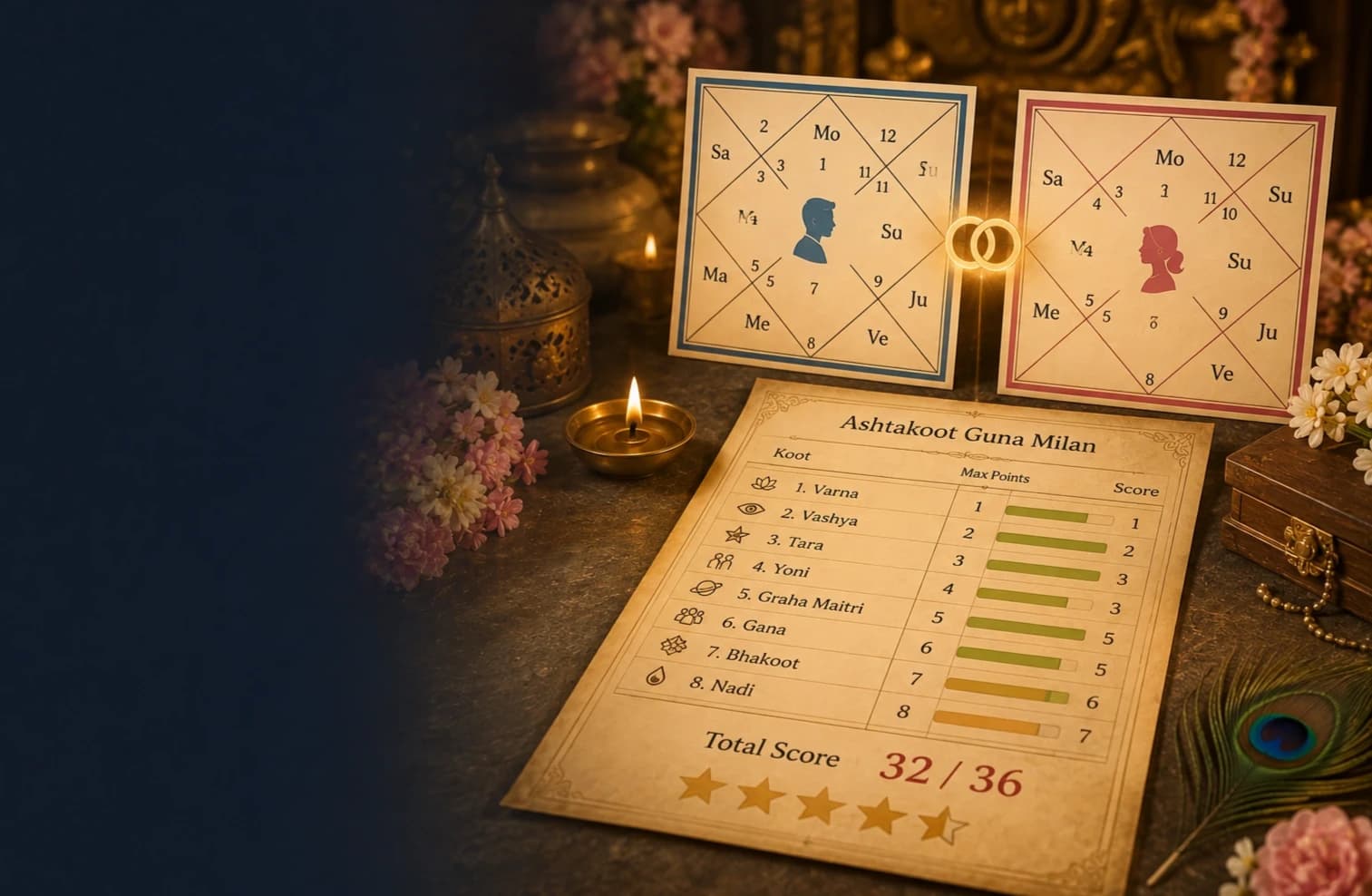
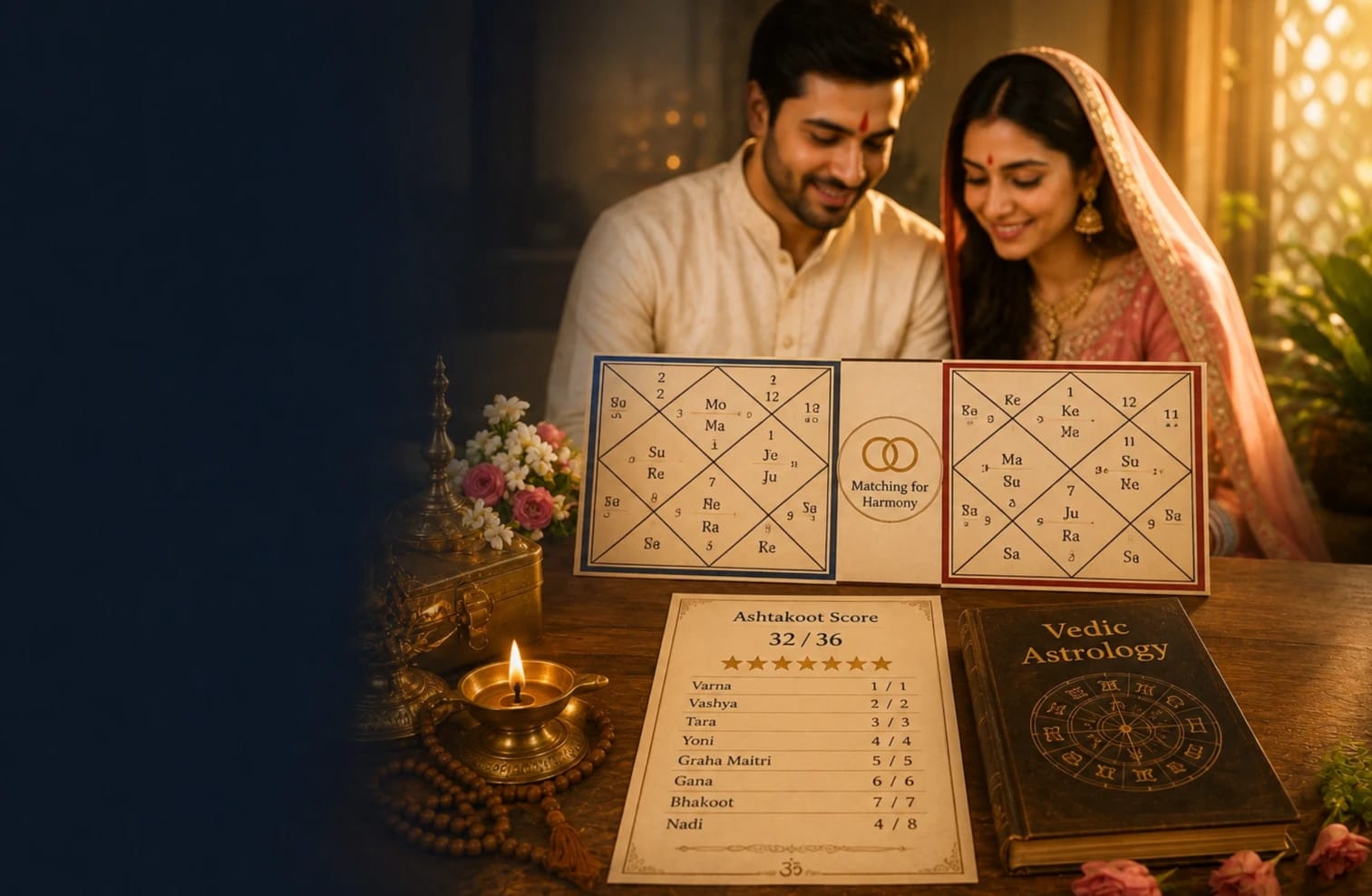
The part of Kundali matching that most people know is Guna Milan, also called Ashta Koota Milan. This is the familiar 36-point system.
It compares the Moon-based compatibility of the couple across eight factors:
- Varna
- Vashya
- Tara
- Yoni
- Graha Maitri
- Gana
- Bhakoot
- Nadi
Total possible score: 36 points.
This system is useful because it gives a structured first look at compatibility. It attempts to assess broad harmony in areas such as temperament, attraction, mental friendship, instinctive bonding, health-linked compatibility, and traditional family-life balance.
But it is essential to understand what Guna Milan really is: a first-layer screening system. It is not the whole marriage reading.
This means two things at once:
- A good score is helpful, but not enough on its own.
- A weaker score deserves caution, but is not always the final answer.
A mature astrologer uses Guna Milan as an important beginning, not the whole conclusion.
What the 36 Points Check and What They Do Not Check
One of the biggest mistakes in modern marriage matching is assuming that the 36-point score covers everything. It does not.
What the 36-point system does check:
- basic Moon-based compatibility
- some temperament alignment
- some attraction and adjustment indicators
- some traditional signals related to harmony and well-being
What it does not fully check:
- whether marriage itself is strongly promised in both charts
- the real condition of the 7th house and 7th lord
- the strength of Venus and Jupiter for relationship support
- serious Mangal Dosha conditions in full context
- Navamsa strength
- dasha support for marriage timing and sustainability
- emotional maturity or practical values
- divorce tendency, neglect pattern, domination, emotional coldness, or communication breakdown in full detail
This is why a couple can have a decent Guna Milan score and still have major marital strain in the deeper horoscope. And it is also why some couples with moderate or even modest scores may still have workable charts when broader factors are supportive.
So if someone says, “The score is enough,” that is not a complete marriage reading. It is only a partial one.
Why Nadi and Bhakoot Get So Much Attention
Within Guna Milan itself, some Kootas are weighted more heavily than others. Two of the most discussed are Nadi and Bhakoot.
Nadi carries the highest weight in the system, with 8 points. It is traditionally associated with health, vitality, heredity, and deeper bio-energetic compatibility. This is why Nadi Dosha is often taken seriously.
Bhakoot carries 7 points and is linked with marital harmony, family flow, emotional alignment, and long-term prosperity pattern. Many families become worried when Bhakoot mismatch appears, especially if the rest of the score also looks weak.
These two factors matter because tradition itself gives them higher weight. But once again, maturity is required. A serious astrologer will ask:
- Is the weakness concentrated only here or everywhere?
- Are there cancellation conditions?
- Do the individual horoscopes support marriage strongly otherwise?
- Is the 7th house strong enough to handle this?
So yes, Nadi and Bhakoot deserve respect. But they should be read as part of a larger marriage judgment, not as isolated panic buttons.
Why Mangal Dosha Is Checked Separately
One of the most talked-about parts of marriage astrology is Mangal Dosha. Many people assume that Kundali matching means only two things: 36 points and Mangal Dosha. That is still incomplete, but it explains why Mars gets so much attention.
Mars is associated with force, aggression, heat, conflict, assertion, impatience, and impulsive energy. In marriage analysis, certain placements of Mars are thought to create friction, domination, anger, emotional volatility, or strain in domestic harmony if not balanced properly.
This is why Mangal Dosha is often checked separately from Guna Milan. A couple may score well in Ashta Koota but still require careful Mars assessment. Similarly, a Mars concern may sometimes be softened, cancelled, or made manageable depending on both charts.
A wise astrologer does not ask only, “Is there Mangal Dosha?” The better questions are:
- How strong is it really?
- Is it cancelled or reduced?
- Do both partners carry similar Mars energy?
- Does the rest of the chart absorb the strain well?
This is why simplistic internet-style “Manglik or not” answers are often misleading. Real matching requires context.
The Importance of the 7th House and 7th Lord
If Guna Milan is the first layer, then the 7th house is one of the deepest core layers of actual marriage analysis.
In Vedic astrology, the 7th house is the primary house of marriage, spouse, partnership, and formal relational commitment. A serious marriage reading must examine:
- the 7th house itself
- the 7th lord
- planets influencing the 7th house
- afflictions or support patterns connected to it
Why does this matter so much? Because a person may have a reasonable compatibility score with someone else, yet their own chart may show delay, instability, emotional disconnect, difficult partnership lessons, or unusual marital patterns. If the astrologer ignores the 7th house and only looks at score, the reading remains shallow.
In real matching, both charts must individually support marriage. A compatible pair is not enough if one chart itself struggles heavily with partnership patterns.
So before saying “good match” or “bad match,” a wise astrologer checks whether both people’s charts can actually hold marriage with maturity and stability.
Why Venus and Jupiter Matter in Marriage Analysis
Beyond the 7th house, two planets are especially important in relationship and marriage analysis: Venus and Jupiter.
Venus is connected with love, attraction, pleasure, bonding, relationship style, beauty, desire, and emotional softness in partnership. A damaged or heavily strained Venus can affect how love is expressed, how intimacy is experienced, or how relationship expectations function.
Jupiter is connected with wisdom, ethics, guidance, stability, maturity, blessings, and larger support in married life. In many traditional readings, Jupiter is especially important for the quality of counsel, dharmic support, and long-term relational intelligence.
This does not mean one simply looks at Venus and Jupiter in isolation. But their condition matters a great deal in deciding whether the relationship is likely to feel emotionally nourishing, responsible, respectful, and sustainable.
A match with fair points but very strained Venus-Jupiter patterns may need more caution than a slightly lower-scoring match with strong relationship support through these planets.
That is why real Kundali matching is always larger than one score sheet.
What Navamsa Adds to Kundali Matching
No serious marriage reading is complete without paying attention to the Navamsa chart. In Vedic astrology, Navamsa is one of the most important divisional charts for understanding marriage, dharma, relationship maturity, and the deeper unfolding of partnership.
Why does Navamsa matter? Because the birth chart may show one surface pattern, while Navamsa reveals how marriage energy matures, deepens, or gets tested over time. Many astrologers treat the Navamsa as an essential support chart when judging the quality of marital life.
In practical terms, Navamsa can help answer questions such as:
- Is the marriage promise internally strong?
- Does the spouse pattern look supportive or strained?
- Do the key relationship planets gain strength or weakness in Navamsa?
- Does the marriage settle into maturity or show deeper instability?
This is why two charts may look acceptable in basic matching but reveal very different truths once Navamsa is checked. A wise astrologer does not skip this layer if the marriage decision is serious.
How Dasha and Timing Change the Reading
Even a strong compatibility reading must be placed in time. This is where dasha becomes extremely important.
Dasha shows which planetary periods are active in a person’s life. These periods can strongly affect:
- marriage timing
- emotional readiness
- relationship stability
- stress patterns
- whether a marriage begins during a supportive or difficult phase
This means a couple may have decent compatibility on paper, but if one or both people enter marriage during a difficult relationship-related dasha, the early married phase may feel much more strained than expected. On the other hand, supportive dasha periods can strengthen adjustment and timing.
This is another reason why points alone cannot tell the whole story. Compatibility is one thing. Timing is another. Both matter.
A good astrologer asks not only, “Are these two people compatible?” but also, “Is this a supportive period for them to enter marriage?”
Why Emotional and Practical Compatibility Still Matter
This point is often neglected in astrology discussions, but it is essential: horoscope compatibility does not replace real-life compatibility.
Even a strong chart match cannot compensate for:
- lack of respect
- poor communication
- major value conflict
- emotional immaturity
- dishonesty
- family pressure without consent
- abusive patterns
A chart may support marriage, but human behavior still matters. Astrology can show tendencies, strengths, vulnerabilities, and timing. It cannot do the work of honesty, emotional maturity, and shared responsibility for the couple.
This is why the wisest use of Kundali matching is not fatalistic. It is diagnostic. It helps people understand where support exists and where caution is needed. But real marriage still requires awareness, effort, communication, and consent.
How a Responsible Astrologer Actually Judges a Match
A responsible astrologer usually follows a layered process instead of a one-line verdict. That process often looks something like this:
- Check the Guna Milan score and Koota distribution.
- Pay special attention to Nadi, Bhakoot, and major mismatch areas.
- Check Mangal Dosha carefully and in context.
- Study the 7th house and 7th lord in both charts.
- Examine Venus, Jupiter, and relevant relationship planets.
- Review Navamsa for deeper marriage support.
- Look at dasha and timing.
- Assess overall emotional and practical compatibility.
- Then give a balanced judgment.
This is how Kundali matching really works in serious practice. Not by one number, not by one fear, and not by one dosha alone.
Common Myths About Kundali Matching Before Marriage
There are several myths that cause confusion and fear:
- Myth 1: A high Guna Milan score guarantees a happy marriage.
- Reality: It supports compatibility but does not guarantee emotional maturity or long-term stability by itself.
- Myth 2: A low score means marriage must never happen.
- Reality: It means caution and deeper analysis are necessary.
- Myth 3: Mangal Dosha alone decides everything.
- Reality: Mars matters, but only in context of the whole chart.
- Myth 4: If families approve and score is decent, no further check is needed.
- Reality: 7th house, Navamsa, dasha, and planetary support still matter.
- Myth 5: Astrology can replace real communication between two people.
- Reality: It cannot. Charts show patterns; people still have to build the marriage.
Once these myths are removed, Kundali matching becomes much healthier and much more useful.
What a Wise Reader Should Take Away
If you are trying to understand marriage compatibility through astrology, the most important thing to remember is this: Kundali matching is a layered evaluation, not a shortcut verdict.
A wise reader should take away the following lessons:
- Guna Milan is useful, but not complete.
- Nadi and Bhakoot matter, but they are not the whole chart.
- Mangal Dosha deserves context, not panic.
- The 7th house and 7th lord are essential.
- Venus, Jupiter, and Navamsa deepen the reading.
- Dasha can change how compatibility plays out in time.
- Real-life maturity and values still matter enormously.
This approach is more responsible, more realistic, and far more helpful than reducing marriage to one score.
Final Thoughts on How Kundali Matching Really Works Before Marriage
Kundali matching before marriage works properly only when it is treated as a complete compatibility process. The 36-point Guna Milan system is an important first layer, but it is not the whole story. Serious matching also requires attention to Mangal Dosha, the 7th house, the 7th lord, Venus, Jupiter, Navamsa, dasha, and the practical emotional reality of the relationship.
So how does Kundali matching really work? It works by combining structured score-based compatibility with deeper chart judgment and practical relational intelligence.
That is the real answer. Not blind optimism. Not blind fear. Not one number. Not one dosha. A complete reading.
If you want the simplest possible takeaway, remember this: Kundali matching is not about asking only “How many points?” It is about asking “How do these two charts actually support marriage, and what should be understood before commitment?”
Once you understand that, the entire subject becomes more useful, more dignified, and much less confusing.
Editorial insight
A responsible Kundali matching is never just a score report. It is a layered marriage analysis in which Guna Milan begins the conversation, but the deeper horoscope decides how seriously that conversation should be taken.
- My Destiny Path Editorial Team
Real-Life Case Study
A family once received a reassuring score in Guna Milan and assumed the match was unquestionably strong. But when the charts were studied more deeply, the astrologer found that one partner’s 7th house was heavily strained, Venus was under pressure, and the upcoming dasha period was not naturally supportive for emotional stability. In another case, a couple had only a moderate point score, which worried both families at first. Yet the broader horoscope showed strong marriage promise, supportive Navamsa patterns, and much healthier long-term stability than the raw score suggested. These situations show why real Kundali matching cannot end with “good score” or “low score.” The score begins the process; the deeper chart explains the truth behind it.
Key terms in this article
- Dasha
- A planetary period used in Vedic astrology to understand life chapters and timing themes.
- House
- A life area in the birth chart, such as marriage, career, wealth, home, or health.