

Why So Many People Get Confused About the 36 Points
For many people, Guna Milan is the first thing they hear about when the topic of Kundali matching comes up. Families ask for the score. Marriage portals mention it. Astrologers are often expected to give a simple number quickly. Someone says a match got 28 out of 36, another says 18 out of 36, and within minutes everyone starts reacting as if the entire future of the marriage has already been decided.
This is exactly where confusion begins. Most people know that 36 points are involved, but very few know what those points are actually measuring. They may have heard the words Ashta Koota, Nadi, Bhakoot, or Gana, but they do not understand what these factors mean, why some are given more weight than others, or why two astrologers sometimes give the same score but very different marriage advice.
The result is predictable. Some people become overconfident because the score is high. Others become frightened because the score is low. A few reject a potentially good relationship too quickly. Others ignore serious compatibility warnings because “the points are enough.” In both cases, the real issue is the same: the 36-point system is being used without being understood properly.
The truth is that Guna Milan is useful, but it is not magic. It is a structured compatibility framework inside traditional Vedic marriage matching. It helps assess certain important dimensions of compatibility, but it does not summarize the entire marriage into one number. The 36 points are meaningful, yet they are only one part of a responsible relationship analysis.
This guide explains Guna Milan in simple language. It will show you what the 36 points are, how they are distributed, what each Koota is meant to measure, what score ranges generally suggest, why high points do not automatically guarantee a happy marriage, why low points do not always destroy a match, and what other chart factors should be checked before making a serious decision. The goal is not fear. The goal is clarity.
What Guna Milan Actually Is
Guna Milan is a traditional Vedic astrology method used to assess compatibility between two people for marriage. In everyday language, it is often called Kundali matching, although technically Kundali matching is broader and may include more than Guna Milan alone.
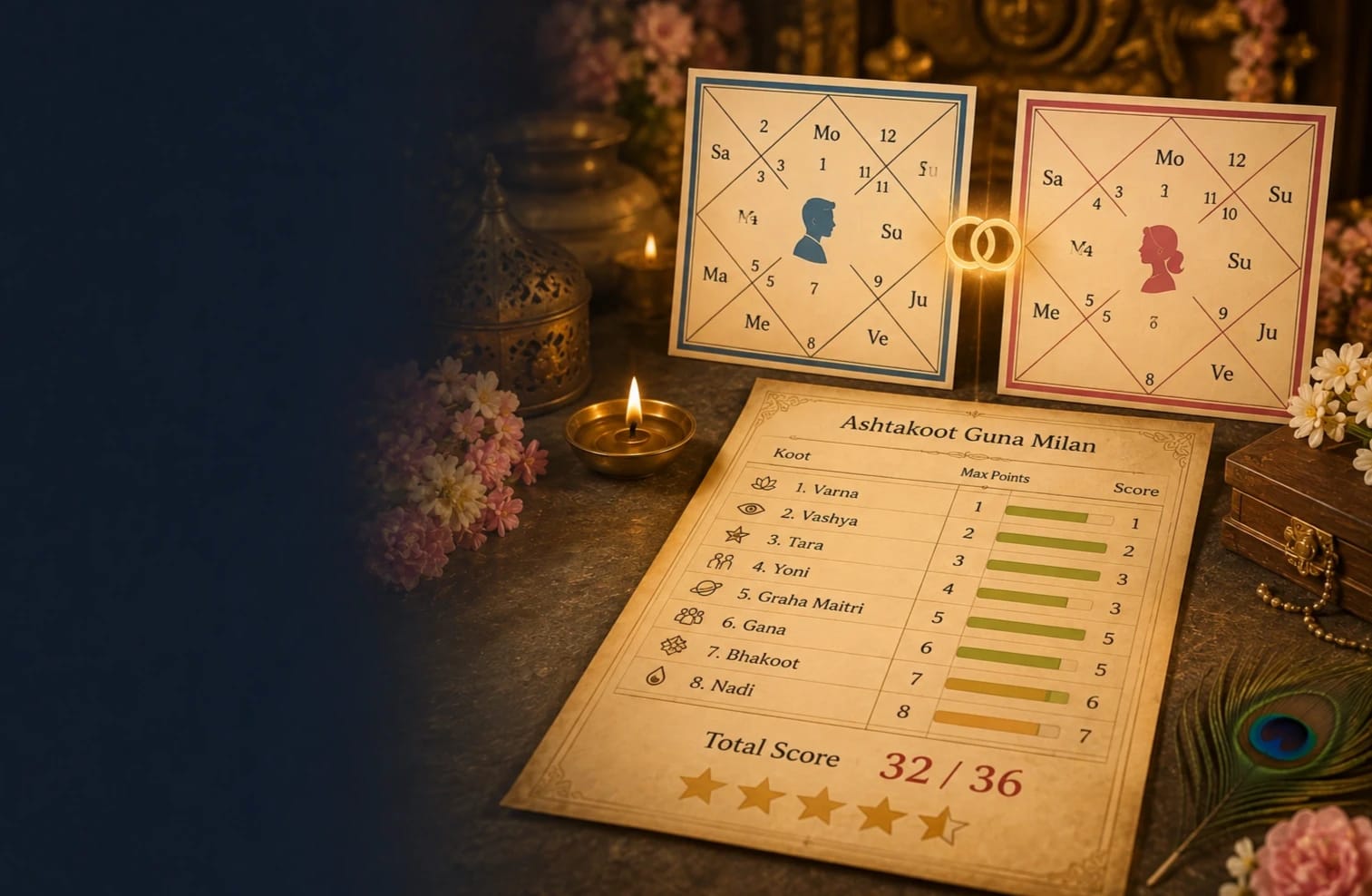
The most commonly used framework is called Ashta Koota Milan. “Ashta” means eight, and “Koota” refers to eight matching factors or dimensions. Each of these eight Kootas is assigned a certain number of points. When the points are added together, the total comes to 36.
So when people say, “The match is 27 out of 36,” what they usually mean is that the couple has scored 27 points in the Ashta Koota system.
At a broad level, Guna Milan is trying to evaluate harmony across different areas such as temperament, emotional compatibility, attraction pattern, mental friendship, instinctive adjustment, family well-being, health-linked compatibility, and certain traditional markers connected to long-term married life.
However, this is where an important clarification is needed: Guna Milan is not the same thing as checking the entire marriage promise of a horoscope. It is a compatibility scoring system, not a complete marital destiny reading. A full relationship analysis should also examine the 7th house, Venus, Jupiter, Mars, Navamsa, dasha support, emotional pattern, stability factors, and major doshas or yogas relevant to marriage.
That is why mature astrologers respect Guna Milan, but do not reduce marriage judgment to points alone.
How the 36 Points Are Divided
The 36 points in Guna Milan come from eight Kootas. Each Koota has its own maximum score. The system is not equal-weighted. Some factors carry fewer points, while others carry significantly more.
The standard distribution is:
- Varna – 1 point
- Vashya – 2 points
- Tara – 3 points
- Yoni – 4 points
- Graha Maitri – 5 points
- Gana – 6 points
- Bhakoot – 7 points
- Nadi – 8 points
Total = 36 points.
Even this simple distribution already teaches an important lesson. Not all matching factors are treated equally. For example, Varna contributes only 1 point, while Nadi contributes 8 points. So if someone says “all 36 points matter equally,” that is not accurate. Traditional matching itself assigns different importance to different Kootas.
Understanding this distribution helps readers avoid one common mistake: assuming that every missing point means the same kind of problem. Losing one point in Varna is not read the same way as losing all eight points in Nadi. The symbolic weight is different.
Varna Koota: What the 1 Point Means
Varna Koota is the first and smallest part of the system. It carries only 1 point. Traditionally, it is linked with spiritual and ego-based compatibility, especially the degree of respect, guidance, and adjustment between the partners.
In older frameworks, Varna classification is associated with a hierarchy of temperament types. In modern reading, many astrologers treat it more lightly than some of the heavier Kootas because it contributes only one point and because rigid social interpretation is not always useful in present-day matching.
If this Koota matches well, it is seen as a small supportive sign. If it does not, it is usually not treated as a major standalone rejection factor. This is one of the clearest examples of why the total score should not be read simplistically. A mismatch in a 1-point Koota should not be given the same dramatic emphasis as a major Nadi or Bhakoot issue.
So what does Varna really mean in practical language? It is loosely concerned with alignment of disposition, respect pattern, and the psychological ease or discomfort that may arise from differing self-orientation. Useful to note, yes. But in most mature readings, not decisive by itself.
Vashya Koota: What the 2 Points Mean
Vashya Koota carries 2 points and is often linked with influence, mutual responsiveness, attraction, and the ability of partners to accommodate each other’s nature.
In simpler language, Vashya asks whether the two people are likely to relate to each other in a way that feels manageable and mutually responsive. Does one overpower the other too much? Is there a natural dynamic of adjustment? Is the bond likely to feel cooperative or resistant?
Like Varna, this is not one of the heaviest Kootas. A poor Vashya score does not automatically mean the relationship is doomed. But it may indicate that power dynamics, instinctive adjustment, or mutual control patterns need more attention.
For beginners, the key point is this: Vashya does not decide the entire marriage. It only gives a small clue about how the relational energy may flow in terms of mutual influence and adjustment.
Tara Koota: What the 3 Points Mean
Tara Koota carries 3 points and is connected with the birth stars of the couple. It is often interpreted in relation to well-being, supportive fortune, and general harmony of life-force between the partners.
In practical terms, Tara is sometimes treated as a health-and-prosperity-support indicator within the matching system. A favorable Tara score suggests smoother energetic support and less strain in the basic star-based compatibility. A weaker Tara score may suggest some unevenness in how the two life patterns interact.
This is not the easiest Koota for beginners to grasp emotionally because its symbolism feels more subtle than something like attraction or temperament. But it still matters as part of the larger compatibility matrix.
A mature way to understand Tara is this: it reflects whether the star relationship between the two charts is generally supportive, neutral, or more strained. It adds one more layer to the overall reading rather than standing alone as the final verdict.
Yoni Koota: What the 4 Points Mean
Yoni Koota carries 4 points and is one of the parts people are often curious about because it is connected with physical attraction, intimacy pattern, instinctive chemistry, and sexual compatibility symbolism.
This does not mean Yoni Koota should be read in a vulgar or superficial way. In classical matching, it is meant to capture the instinctive and intimate harmony between two people. In modern language, you can think of it as part of the attraction-and-comfort layer of the relationship.
A favorable Yoni match may suggest smoother physical rapport and instinctive comfort. A difficult Yoni match may suggest friction in attraction style, chemistry, or intimacy expectations. But once again, this must be interpreted with proportion. Yoni is important, yes—but it is still one part of the total matching system.
Many poor-quality online explanations either sensationalize Yoni or oversimplify it. A balanced astrologer treats it as one meaningful layer of human bonding, not the only layer.
Graha Maitri: What the 5 Points Mean
Graha Maitri carries 5 points and is often one of the most relatable Kootas for modern readers because it deals with mental friendship and emotional-intellectual compatibility. It is based on the relationship between the lords of the Moon signs involved.
In practical terms, Graha Maitri asks whether the couple is likely to share a natural friendship of mind. Can they understand each other mentally? Is there supportive communication? Is there psychological ease? Does the relationship have the feeling of inner companionship, or is the mental-emotional wavelength difficult?
This is why many astrologers take Graha Maitri seriously. Marriage is not sustained by attraction alone. If friendship of mind is weak, even a match with decent points elsewhere may feel dry, strained, or emotionally tiring over time.
A strong Graha Maitri score often supports warmth, mutual understanding, and relational intelligence. A weaker score may suggest that emotional language and thought patterns need more conscious work. It is not a sentence. But it is definitely meaningful.
Gana Koota: What the 6 Points Mean
Gana Koota carries 6 points and is connected with temperament type. In simple language, Gana is often read as a compatibility factor for basic nature, behavioral style, and instinctive temperament.
Traditional classifications divide nakshatras into three Ganas— Deva, Manushya, and Rakshasa. These categories are symbolic and often misunderstood by modern readers. They do not mean that one person is “good” and another is “bad.” Rather, they indicate different modes of temperament, response, refinement, intensity, and instinctive functioning.
A strong Gana match is often taken as a sign that the two people can coexist more easily in terms of basic nature. A challenging Gana mismatch may suggest friction in temperament style— one person may be more sensitive, another more intense, one more refined, another more direct or forceful.
Because it carries 6 points, Gana is not trivial. But it should still be interpreted with intelligence. A temperament mismatch can sometimes be handled through maturity and awareness if other stronger factors support the marriage well. At the same time, ignoring a sharp temperament clash simply because the total score looks passable can also be unwise.
Bhakoot Koota: What the 7 Points Mean
Bhakoot Koota carries 7 points, which makes it one of the heavier components in Guna Milan. It is connected with the relative placement of the Moon signs and is often read in relation to marital harmony, family well-being, emotional flow, and long-term prosperity pattern.
This is one of the Kootas that many families become especially concerned about, because Bhakoot Dosha is widely discussed in traditional matching. In some schools, a complete Bhakoot mismatch is treated quite seriously.
Why does it matter? Because Bhakoot is traditionally linked with how the two lives flow together over time— not only in romance, but also in shared domestic and emotional direction. A difficult Bhakoot relationship is often seen as a sign of strain in practical harmony or the long-term flow of married life.
However, as with all strong factors, there are nuances. Some astrologers check whether the apparent Bhakoot issue is softened or cancelled through other chart conditions. Others look at actual 7th-house support, Navamsa, Jupiter-Venus condition, and dasha compatibility before deciding how serious the mismatch really is.
So Bhakoot deserves respect. But it should be judged in a broader astrological context, not in isolation.
Nadi Koota: What the 8 Points Mean
Nadi Koota carries the highest weight in the system: 8 points. This alone tells you that traditional matching gives Nadi special importance. It is often associated with health, vitality, heredity, and deeper bio-energetic compatibility within marriage.
In popular language, people often say “Nadi Dosha is very serious,” and that belief is not coming from nowhere. Within Ashta Koota scoring, this is the heaviest single factor. A total failure in Nadi matching can pull the score down sharply and traditionally raises concern in many matching systems.
That said, mature astrologers do not panic automatically. They check for exceptions, cancellations, supporting chart strength, and the total marriage pattern before making a final judgment. Still, Nadi is not something to dismiss casually. If Bhakoot and Nadi are both weak, many astrologers become more cautious, especially if the rest of the chart also shows relational stress.
For beginners, the most useful takeaway is this: Nadi matters a lot because tradition itself gives it the highest weight. If it is problematic, that does not mean instant rejection—but it absolutely deserves deeper examination, not careless optimism.
What Score Ranges Usually Mean
People often want a quick score interpretation, so here is the practical broad view most readers are looking for:
- Below 18 – usually considered weak for traditional matching and often examined very carefully
- 18 to 24 – generally considered workable or moderate, depending on where the points are gained or lost
- 25 to 32 – usually considered good by general matching standards
- 33 to 36 – considered very strong in the score-based system
But this is where readers must become more intelligent than rumor. The distribution of the score matters. A couple may score 25 but lose badly in Nadi or Bhakoot. Another couple may score 22 but have a relatively healthy spread with no deeply alarming factor. These two situations are not identical, even if one has a higher score than the other.
So yes, score ranges are useful. But raw totals should never replace Koota-level understanding.
Is a High Score Always a Good Sign?
No. A high score is supportive, but it is not a guarantee of a successful marriage.
This is one of the biggest misconceptions in modern matchmaking culture. People sometimes assume that if the score is 30 or above, the marriage will automatically be happy, stable, emotionally fulfilling, and free from struggle. That is simply not how life or astrology works.
A high Guna Milan score means the match looks favorable within the Ashta Koota framework. That is good. But a happy marriage also depends on many other factors, such as:
- strength of the 7th house and 7th lord
- condition of Venus and Jupiter
- Navamsa support
- Mars-related marital tension
- dasha timing
- emotional maturity
- communication style
- family and value alignment
A high score can support the marriage. It cannot do the whole job by itself.
Is a Low Score Always a Bad Sign?
Also no. A lower score deserves careful examination, but it is not automatically a rejection stamp.
Many people hear a score below 18 and become frightened immediately. Traditional caution exists for a reason, yes. But a low score still has to be interpreted intelligently. Where are the points being lost? Is the weakness concentrated in light Kootas or heavy ones? Are there chart-level compensations? Is the marriage promise itself strong? Are there cancellation conditions? Are the individual horoscopes supportive of partnership despite a modest score?
Sometimes a lower-scoring match may still be workable if the deeper horoscope supports marriage strongly and the apparent scoring weakness is not concentrated in the most serious places. That does not mean you ignore the score. It means you do not worship it blindly either.
A good astrologer knows how to distinguish between a genuinely risky low score and a manageable low score.
What Guna Milan Does Not Check
This is one of the most important sections in the entire discussion. Guna Milan checks certain dimensions of compatibility, but it does not check everything required for a full marriage reading.
It does not fully answer:
- Will the marriage definitely happen?
- Will there be divorce or separation tendency?
- Is there strong promise of marriage delay?
- Will the spouse be emotionally supportive?
- Will one person dominate or neglect the other?
- Will the marriage survive difficult dashas?
- Will there be strong romantic bonding after marriage?
These require broader chart analysis.
This is why serious astrologers check the 7th house, 7th lord, Venus, Jupiter, Navamsa, Mars dosha, relationship yogas, dasha support, emotional indicators, and practical life factors in addition to Guna Milan. If someone evaluates marriage compatibility by points alone, the reading is incomplete— no matter how confident it sounds.
Common Myths About the 36 Points
There are several myths that create unnecessary fear and confusion:
- Myth 1: 36 out of 36 means perfect marriage.
- Reality: It means a very strong score, not a perfect human relationship.
- Myth 2: Below 18 means automatic disaster.
- Reality: It means caution and deeper analysis are needed.
- Myth 3: Only the total matters.
- Reality: Which Kootas matched or failed matters a great deal.
- Myth 4: Guna Milan alone is enough for marriage judgment.
- Reality: Full horoscope analysis is still necessary.
- Myth 5: A good score can cancel every serious dosha.
- Reality: It cannot replace independent chart-level issues.
Once these myths are removed, people start using Guna Milan in a much healthier way. It becomes a serious tool, but not a blind authority.
How a Wise Astrologer Uses Guna Milan
A responsible astrologer usually uses Guna Milan as an important first compatibility framework, not as the final answer.
A wise process often looks like this:
- Check the 36-point score and its distribution across Kootas.
- Pay special attention to heavier factors like Nadi and Bhakoot.
- Examine Mangal Dosha, if relevant.
- Study the 7th house, 7th lord, Venus, Jupiter, and Navamsa.
- Assess actual emotional and practical compatibility.
- Look at dasha support and timing.
- Only then offer a grounded judgment.
This layered approach protects people from both extremes: false reassurance and unnecessary fear.
Final Thoughts on What the 36 Points Really Mean
The 36 points in Guna Milan are not random. They come from a structured Ashta Koota system designed to assess different layers of marriage compatibility. Each Koota contributes a specific number of points, and each one symbolizes a different dimension of adjustment, comfort, temperament, attraction, harmony, or life support.
So what do the 36 points actually mean? They mean that Vedic marriage matching is trying to study compatibility in a systematic way— not with one vague label, but through eight different lenses. That is the strength of the method.
But the system must be used intelligently. A high score is helpful, but not sufficient. A low score is cautionary, but not automatically fatal. The distribution of points matters. The heavier Kootas matter. And beyond all of that, the deeper horoscope still matters.
If you want the simplest possible takeaway, remember this: Guna Milan is a valuable marriage compatibility scoring system, but the 36 points are not the whole marriage. They are the beginning of a serious reading, not the end of it.
When readers understand that, they stop fearing the number and start understanding the pattern behind it.
Frequently asked questions
Is a higher Guna Milan score always better?
A higher score shows more agreement within the scoring system, but it does not evaluate every relationship factor or guarantee compatibility.
Should marriage be rejected only because of a low score?
No. Personal compatibility, consent, communication, circumstances, and a broader chart review also matter.
Jyotish basics and related reading
- What is Vedic astrology?
- The three pillars: planets, signs, and houses
- The 12 houses in a birth chart
- The nine Grahas explained
- What is the Ascendant or Lagna?
- Understanding the structure of a birth chart before exploring timing, compatibility, or reports.
- A Vedic birth chart with planetary positions, houses, signs, and interpretive sections.
Astrology guidance is interpretive, not deterministic. Outcomes also depend on choices, circumstances, and context.
Last updated:
Editorial insight
The 36 points in Guna Milan are useful only when they are read as a structured compatibility framework, not as a shortcut to final judgment. The score matters, but the meaning behind the score matters even more.
- My Destiny Path Editorial Team
Real-Life Case Study
A family once approached an astrologer with a match that had scored 26 out of 36. At first, everyone felt relieved because the number seemed comfortably above the minimum. But a closer reading showed that the score had hidden an important weakness: a serious concentration of points lost in a heavier compatibility area, while the lighter Kootas had inflated the total enough to make it look better than it really was. In another case, a couple with a modest score around 20 appeared weak on paper, but the deeper horoscope showed strong marriage support, healthy emotional compatibility, and no major structural threat to married life. These two examples show exactly why the 36 points must be understood, not just counted.
Key terms in this article
- Dasha
- A planetary period used in Vedic astrology to understand life chapters and timing themes.
- Nakshatra
- A lunar mansion used by many Vedic timing and personality methods.
- House
- A life area in the birth chart, such as marriage, career, wealth, home, or health.