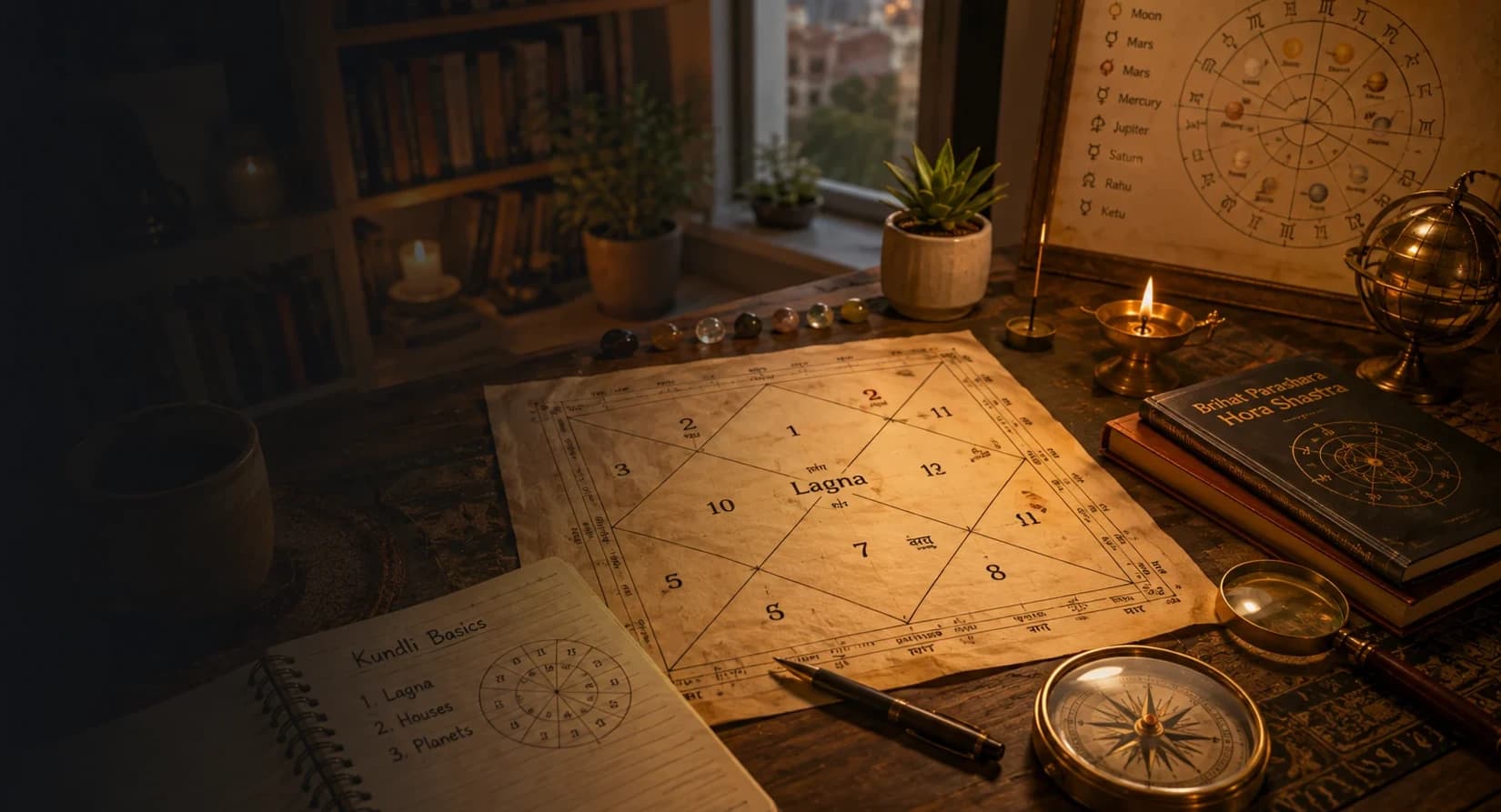


Introduction: Why the North Indian Chart Looks So Confusing at First
For many beginners, the first encounter with a North Indian birth chart is intimidating. The chart does not look like a simple wheel. It is made of diamonds and boxes. There are numbers, abbreviations, and symbols placed in different sections. Sometimes the same chart is called a Kundali, sometimes a Janam Kundali, sometimes a birth chart. And if you are completely new to Jyotish, it can feel impossible to tell where to begin.
The good news is that the North Indian chart is not actually difficult once you understand its basic logic. It only looks complicated because you are seeing an unfamiliar visual language. Like any language, it becomes much easier once you learn the grammar. In fact, the North Indian chart is one of the clearest ways to read a Kundali once your eyes get used to it.
This guide is designed for beginners who want a practical, real-world explanation of how to read a North Indian birth chart step by step. We will not assume prior expertise. We will start from the visual structure, explain what the boxes mean, show how to identify the Ascendant or Lagna, understand sign numbers, recognize planets, count houses, and begin making sense of the chart in a structured way.
The goal of this article is not to turn you into a professional astrologer in one sitting. The goal is something more useful: to help you stop feeling lost when you look at a North Indian chart. Once you can identify the Lagna, the houses, the signs, and the planetary placements, the chart stops feeling mysterious and starts feeling readable.
What Is a North Indian Birth Chart?
A North Indian birth chart is one of the traditional visual formats used to display a Vedic horoscope. It is especially common in North India, though astrologers everywhere may use it. The key thing to understand is this: the North Indian chart is not a different astrology system. It is simply a different chart layout.
This matters because many beginners assume that the North Indian chart and South Indian chart must mean different astrological principles. That is not true. The astrology is the same. The calculations are the same. The planetary positions are the same. Only the visual presentation is different.
In the North Indian format, the houses stay fixed. That is the most important principle to remember. The signs move through the chart depending on the Lagna, but the house positions themselves remain fixed in the visual structure. This is the opposite of the South Indian format, where signs remain fixed and houses are counted from the Lagna.
If you understand only this one distinction, you are already much less likely to feel confused.
Before You Start: Know the Three Building Blocks
Before reading any chart, remember the basic formula:
- Planets show what kind of energy is active.
- Signs show how that energy behaves.
- Houses show where in life that energy is operating.
When you look at a North Indian chart, you are really trying to answer three questions:
- Which planet is involved?
- In which sign is it placed?
- In which house is it giving results?
Everything else in interpretation grows from this structure. So even though the chart may look crowded, do not try to understand everything at once. Your first job is simply to identify these basics correctly.
Step 1: Understand the Visual Logic of the North Indian Chart
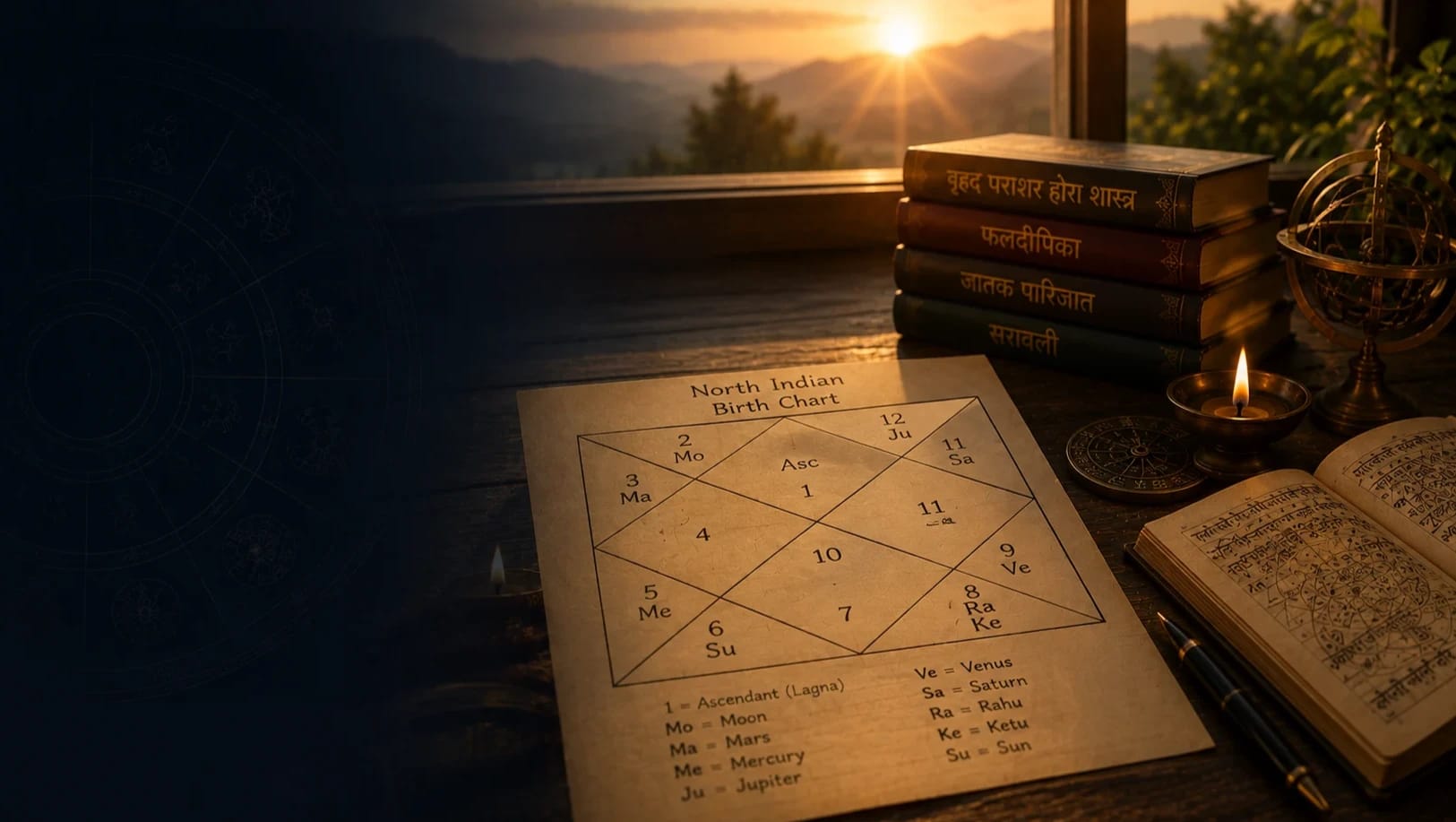
The first step is to stop thinking of the chart as random boxes. It is a structured map. In the North Indian system, each compartment represents a house, not a sign. The houses are fixed in place. That means the chart is designed so that each box always corresponds to the same house position in the layout.
You do not need to memorize every visual angle on day one. What you do need to remember is that the North Indian chart is house-based in presentation. The signs will be written into the houses according to the Ascendant.
This is why the very first thing you should look for is not the Sun or Moon. It is the Lagna. Once you know where the 1st house begins, everything else becomes easier to count and understand.
Step 2: Identify the Lagna or Ascendant First
The Lagna, or Ascendant, is the most important starting point in reading a North Indian chart. It tells you which sign was rising in the east at the exact moment of birth. That sign becomes the 1st house of the chart and determines the entire house structure.
In many North Indian charts, the Lagna may be marked in one of several ways:
- with the word Lagna or Asc
- with a special notation such as La or As
- with the sign number occupying the 1st house and sometimes highlighted
If you find the Lagna, you have found the key to the whole chart. From there, all the houses can be understood relative to that starting point.
This is also why birth time is so important. If the birth time changes enough to change the Ascendant, then the entire house structure may change. That means the chart may tell a very different life story.
Step 3: Learn the Zodiac Sign Numbers
Most North Indian charts use numbers to indicate signs. These numbers do not represent houses. They represent zodiac signs. This is one of the most common points of confusion for beginners.
Here is the sign-number key you must memorize:
- 1 = Aries (Mesha)
- 2 = Taurus (Vrishabha)
- 3 = Gemini (Mithuna)
- 4 = Cancer (Karka)
- 5 = Leo (Simha)
- 6 = Virgo (Kanya)
- 7 = Libra (Tula)
- 8 = Scorpio (Vrishchika)
- 9 = Sagittarius (Dhanu)
- 10 = Capricorn (Makara)
- 11 = Aquarius (Kumbha)
- 12 = Pisces (Meena)
Once you know these numbers, the chart becomes much easier to decode. If you see a 4 in a house, that means Cancer occupies that house. If you see a 10, that means Capricorn is there. These are sign labels, not house numbers.
Step 4: Remember That Houses Stay Fixed in the North Indian Style
This is the rule that beginners must repeat until it becomes natural: in the North Indian chart, the houses stay fixed. The signs are placed into those houses according to the Lagna.
So if the Lagna is Taurus, then Taurus becomes the 1st house, Gemini the 2nd, Cancer the 3rd, and so on. If the Lagna is Scorpio, then Scorpio becomes the 1st house, Sagittarius the 2nd, Capricorn the 3rd, and so on. The house positions do not move in the layout. Only the sign assignment changes.
This is why the visual layout may look similar from chart to chart even though the actual life structure is different. The boxes are fixed, but what fills them changes.
Step 5: Count the Houses from the Lagna
Once you know where the Lagna is, you can count the houses in order. The sign occupying the Lagna box becomes the 1st house. Then you count onward house by house in the fixed North Indian structure.
This is the moment when the chart begins to make practical sense. You are no longer looking at random symbols. You are now asking:
- What sign is in the 1st house?
- What sign is in the 2nd house?
- What sign is in the 7th house?
- What sign is in the 10th house?
This gives you the life-structure of the chart. From there, you can begin understanding house lords, planetary placements, and actual life themes.
If you skip this step and just stare at planets, you will remain confused. Always orient yourself through the Lagna and house count first.
Step 6: Learn the Basic Meaning of the 12 Houses
Once you can identify the houses, you must know what they mean. Here is the most practical beginner summary:
- 1st house – self, body, identity, life direction
- 2nd house – family, speech, food, stored wealth
- 3rd house – courage, siblings, communication, effort
- 4th house – mother, home, emotional peace, property
- 5th house – intelligence, children, creativity, romance
- 6th house – disease, debt, conflict, service, discipline
- 7th house – marriage, partnership, agreements, the other
- 8th house – transformation, secrecy, sudden events, depth
- 9th house – dharma, blessings, father, higher wisdom
- 10th house – career, karma, status, public action
- 11th house – gains, networks, fulfilment, income
- 12th house – loss, retreat, sleep, foreign lands, liberation
You do not need to master every subtlety immediately. But you do need this broad map. Otherwise you cannot translate planetary placements into life themes.
Step 7: Identify the Planets in the Chart
Once you know the houses and the sign numbers, the next step is to identify the planets. Many charts use abbreviations. Common abbreviations include:
- Su = Sun
- Mo = Moon
- Ma = Mars
- Me = Mercury
- Ju or Jup = Jupiter
- Ve = Venus
- Sa = Saturn
- Ra = Rahu
- Ke = Ketu
Some charts may use full names, some may use regional abbreviations, and some software may display them slightly differently. But the basic idea is the same: identify which planets are sitting in which houses and signs.
At this stage, you should be able to say things like:
- Moon is in the 4th house in Cancer.
- Saturn is in the 10th house in Capricorn.
- Venus is in the 7th house in Libra.
Even without advanced astrology, this is already meaningful information.
Step 8: Use the Core Reading Formula
Now that you can identify planets, signs, and houses, you can apply the most important beginner formula:
Planet + Sign + House = Basic Interpretation
For example:
- Moon = mind, emotion, comfort, mother, responsiveness
- Cancer = nurturing, sensitive, protective, emotional
- 4th house = home, mother, inner peace, emotional foundation
So Moon in Cancer in the 4th house may suggest a person whose emotional life is deeply connected to home, belonging, inner comfort, and private emotional security.
Another example:
- Mars = energy, courage, action, assertion
- Capricorn = disciplined, structured, patient, practical
- 10th house = career, action, public life, karma
Mars in Capricorn in the 10th house may point toward disciplined ambition, strong work ethic, and forceful action in the sphere of profession and achievement.
This is the point where the chart stops feeling like code and starts becoming readable language.
Step 9: Understand House Lords
Once you are comfortable with basic placements, the next powerful step is learning house lords. Every house contains a sign, and every sign has a planetary ruler. That ruler becomes the lord of the house.
For example, if Taurus is in the 7th house, then Venus becomes the lord of the 7th house. If Capricorn is in the 10th house, then Saturn becomes the lord of the 10th house.
This matters because the house lord carries the agenda of that house wherever it goes. So if the 10th lord is in the 5th house, career may connect with creativity, teaching, children, performance, or counsel. If the 7th lord is in the 9th, marriage may connect with shared beliefs, guidance, travel, or dharmic learning.
House-lord analysis is where North Indian chart reading becomes much more precise.
Step 10: Do Not Judge a Chart from One Placement
This is one of the most important lessons for beginners: do not make absolute conclusions from one planet in one house.
For example, if someone sees Saturn in the 7th house and immediately panics about marriage, that is not good astrology. If someone sees Mars in the 8th house and decides the whole chart is negative, that is not good astrology either. Real chart reading requires synthesis.
An astrologer will ask:
- How strong is the planet?
- What sign is it in?
- What aspects does it receive?
- What houses does it rule?
- Is it activated in Dasha?
- What is happening in divisional charts?
So the North Indian chart is readable step by step, but it still demands patience and context. The purpose of learning the chart layout is to start reading intelligently, not to jump to fear or certainty too quickly.
Step 11: Learn the Natural Karakas of the Houses
As you grow more comfortable, it is useful to remember that some planets naturally support certain house themes. For example:
- Sun naturally relates to authority, father, status
- Moon naturally relates to mind, mother, emotional stability
- Mars naturally relates to courage, conflict, force
- Mercury naturally relates to intellect, communication, skill
- Jupiter naturally relates to wisdom, children, blessings
- Venus naturally relates to love, marriage, harmony, pleasures
- Saturn naturally relates to karma, responsibility, endurance
This can help you when reading houses. For example, Jupiter in the 5th may feel naturally supportive because Jupiter has resonance with intelligence and children. Venus in the 7th may feel naturally relationship-oriented. But even then, real reading depends on dignity, rulership, aspects, and context. Natural significations are helpful, but they are not the whole story.
Step 12: Use the Moon Chart Later, Not First
In Vedic Astrology, it is common to also read from the Moon sign. This is useful and often very revealing. But if you are just learning how to read a North Indian birth chart, do not begin there. Start with the Lagna chart first.
The Moon chart becomes valuable once you already understand how the basic house framework works. Then you can compare how life looks from the emotional and psychological center of the chart. But if you try to mix Lagna chart reading and Moon chart reading too early, you may only become more confused.
So the proper order for beginners is:
- Learn the North Indian layout
- Identify the Lagna
- Count the houses
- Decode sign numbers
- Identify planets
- Read the basic formula
- Then move to house lords, Moon chart, and Dasha
Common Beginner Mistakes When Reading a North Indian Chart
There are a few predictable errors beginners make:
- thinking the numbers are house numbers instead of sign numbers
- forgetting that houses stay fixed in the North Indian layout
- looking for Sun sign first instead of Lagna
- mixing up houses and signs
- reading one placement without context
- ignoring the importance of house lords
If you avoid these mistakes, your learning speed improves dramatically. Most confusion in North Indian chart reading comes from layout misunderstanding, not from astrology itself.
A Practical Mini Walkthrough
Let us imagine you are looking at a North Indian chart and you find that the Lagna is Virgo. That means:
- Virgo is the 1st house
- Libra is the 2nd house
- Scorpio is the 3rd house
- Sagittarius is the 4th house
- Capricorn is the 5th house
- Aquarius is the 6th house
- Pisces is the 7th house
- Aries is the 8th house
- Taurus is the 9th house
- Gemini is the 10th house
- Cancer is the 11th house
- Leo is the 12th house
Now if you see Jupiter in Pisces, that means Jupiter is in the 7th house. If you see Saturn in Gemini, Saturn is in the 10th house. If Moon is in Cancer, Moon is in the 11th house. Suddenly the chart begins to speak. This is exactly how beginners should practice.
Why the North Indian Chart Becomes Easy with Practice
At first the North Indian chart looks complicated because your eyes are not trained yet. But once you understand the fixed-house logic, learn the sign numbers, and begin counting from the Lagna, it becomes surprisingly efficient.
In fact, many astrologers prefer it precisely because the fixed-house design keeps structural interpretation visually clear. Once you know the logic, the chart becomes fast to read for life themes, house lords, and planetary emphasis.
So do not be discouraged by the first impression. The chart is not trying to confuse you. It is simply asking you to learn its language.
Final Thoughts: Read the Structure Before the Prediction
The best way to read a North Indian birth chart is to stay systematic. Do not start with prediction. Start with structure.
Find the Lagna. Decode the sign numbers. Count the houses. Identify the planets. Combine planet + sign + house. Then move to house lords and deeper interpretation.
If you do that consistently, the North Indian chart will stop looking like a puzzle and start looking like what it really is: a structured map of life.
That is the real beginning of chart reading. Not memorizing dramatic predictions, but learning to see the architecture of the Kundali clearly and patiently.
Frequently asked questions
What should I identify first in a North Indian chart?
Identify the first house and Ascendant sign first, because they establish the sign sequence across all twelve houses.
Do the boxes represent fixed signs?
No. In the North Indian layout the houses are fixed; the sign numbers placed in them change with the Ascendant.
Jyotish basics and related reading
- What is Vedic astrology?
- The three pillars: planets, signs, and houses
- The 12 houses in a birth chart
- The nine Grahas explained
- What is the Ascendant or Lagna?
- Understanding the structure of a birth chart before exploring timing, compatibility, or reports.
- A Vedic birth chart with planetary positions, houses, signs, and interpretive sections.
Astrology guidance is interpretive, not deterministic. Outcomes also depend on choices, circumstances, and context.
Last updated:
Editorial insight
A North Indian chart becomes readable the moment you stop looking at it as shapes and start looking at it as structure. Find the Lagna, count the houses, decode the signs, place the planets, and the chart immediately begins to reveal its logic.
- My Destiny Path Editorial Team
Real-Life Case Study
A beginner once told me that every North Indian chart looked like a maze. She had tried to memorize planets and signs, but the layout itself kept blocking her confidence. The breakthrough came when she stopped trying to “read everything” and followed a strict sequence: first find the Lagna, then count the houses, then decode the sign numbers, then identify the planets. Within a week, the same charts that once looked impossible began to feel orderly and logical. She realized the problem was never the complexity of astrology; it was the lack of a reading method. Once the method became clear, the chart stopped being intimidating and became readable.
Key terms in this article
- Dasha
- A planetary period used in Vedic astrology to understand life chapters and timing themes.
- Lagna
- The rising sign at birth, used as the starting point for house-based chart interpretation.
- House
- A life area in the birth chart, such as marriage, career, wealth, home, or health.
Explore related tools
Free Kundali
Generate your Vedic birth chart
Today's Panchang
Tithi, Nakshatra, Yoga & Muhurats
Kundali Matching
Check marriage compatibility
Western Natal Chart
Tropical birth chart · Placidus houses
Unlock Your Complete Destiny Report
40-page personalised PDF — Dasha predictions, Yogas, remedies & life guidance