

Introduction: Why the Houses Matter So Much
When people first begin reading a Kundali, they usually notice planets and signs first. They ask where the Moon is, what the Ascendant is, or which sign the Sun occupies. Those are all important questions. But sooner or later, every serious beginner reaches a deeper question: What do the houses actually mean?
In Vedic Astrology, the 12 houses, known as Bhavas, form the practical map of life. If planets are the active forces and signs show the style of expression, the houses show where in life those energies are playing out. That is why houses are essential. They turn abstract symbolism into lived reality.
You may know that Venus relates to love, beauty, harmony, and pleasure. But what does that mean if Venus is in the 10th house instead of the 4th? You may know that Saturn relates to karma, discipline, delay, and endurance. But how does that change if Saturn is in the 3rd house rather than the 7th? The answer lies in the houses.
Each house represents a specific domain of life. Some relate to the body, family, and personal identity. Others relate to relationships, wealth, health, career, children, spirituality, loss, or transformation. When an astrologer studies your Kundali, they are not only looking at planets and signs. They are always asking: Which house is involved?
This is why learning the houses is one of the best things a beginner can do. Once you understand them, the chart stops feeling like a collection of mysterious symbols. It starts to feel like a map of real life.
This article will explain what the 12 houses are, how they differ from signs, why they matter so much, and what each one represents. It will also show how astrologers begin combining house meaning with planets and signs to create meaningful interpretation.
What Are Houses in Vedic Astrology?
In Vedic Astrology, the 12 houses are divisions of life experience. They are called Bhavas. Each Bhava governs a set of life themes, situations, and karmic territories. You can think of the houses as different departments of life. One house deals with identity, another with wealth, another with siblings, another with career, another with marriage, another with spiritual release, and so on.
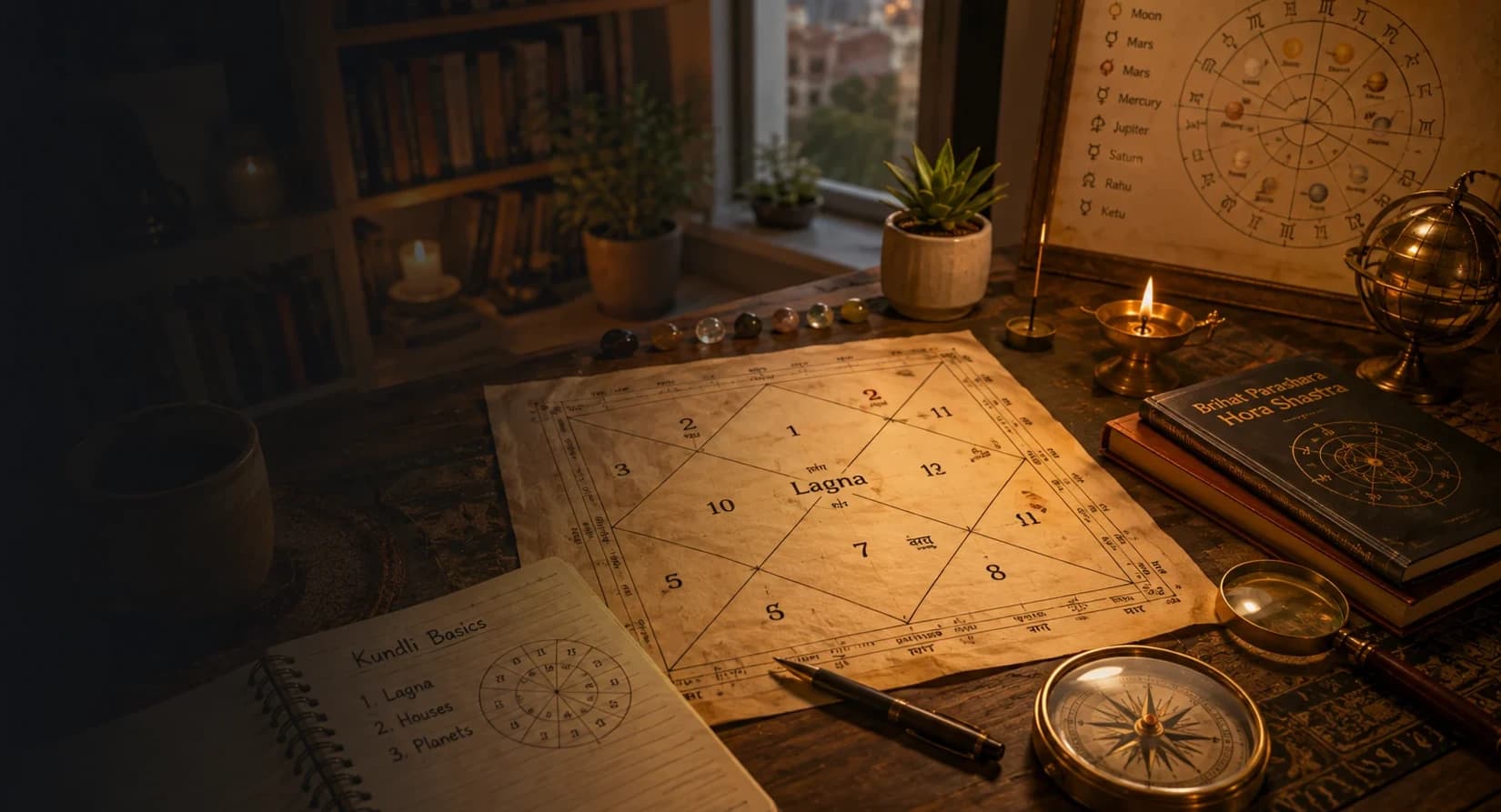
The houses are counted from the Ascendant, or Lagna. The sign rising at the time of birth becomes the 1st house. From there, the remaining houses are counted in order. This is why Lagna is so important: it determines the entire house structure of the chart.
Once the house framework is fixed, an astrologer looks at which planets sit in which houses, which signs occupy which houses, and which planets rule those houses. This is where the chart becomes personal. Two people may have the same Sun sign, but if their house structure is different, their life emphasis will differ greatly.
How Houses Differ from Signs
One of the most common beginner mistakes is confusing houses with signs. They are related, but they are not the same.
Signs show the quality or style of expression. They describe temperament, element, mood, and symbolic nature. Aries is direct and fiery, Taurus is stable and grounded, Gemini is curious and verbal, Cancer is nurturing and emotional, and so on.
Houses show the field of life where experience unfolds. They answer questions like: Is this about the self? Marriage? Career? Money? Health? Family? Travel? Spirituality?
So if Mars is in Capricorn in the 10th house, then:
- Mars = the energy of action, effort, courage, and drive
- Capricorn = the style of discipline, structure, ambition, and patience
- 10th house = the life field of career, karma, public life, and status
Without the house, the interpretation would remain incomplete. This is why signs and houses should never be treated as interchangeable.
Why Houses Are the Map of Your Life
The houses are often called the map of life because together they describe the major human arenas through which life unfolds. Every important topic can be located somewhere within the 12-house system. The self, the body, money, speech, siblings, courage, education, mother, children, marriage, disease, enemies, death, fortune, religion, career, gains, loss, isolation, liberation— all of these belong somewhere in the houses.
This is what makes the system so practical. The houses ground astrology in life. They show not just symbolic meaning but concrete terrain. Once you understand the houses, you can begin asking far better questions about your chart:
- Which houses are strong?
- Which houses are crowded?
- Which house lords are well placed?
- Which life areas are under pressure?
- Which themes are likely to mature later?
These are real interpretive questions. And they all begin with understanding the Bhavas.
The 1st House: Self, Body, Identity, and Life Direction
The 1st house is the house of self. It begins with the Ascendant and is one of the most important houses in the entire chart. It governs the body, physical vitality, appearance, temperament, confidence, overall life direction, and the way a person enters the world.
This house shows how life begins for the individual in an embodied sense. It is connected with the face, general constitution, self-expression, instinctive behavior, and the way others first experience you. A strong 1st house can give resilience, presence, confidence, and vitality. A challenged 1st house may bring confusion about direction, health issues, instability, or difficulty maintaining inner steadiness.
It is also the base from which the rest of the chart is experienced. This is why the 1st house and its lord are central in chart reading. They do not tell the whole story of identity, but they tell a major part of it.
The 2nd House: Wealth, Family, Speech, and Values
The 2nd house deals with accumulated wealth, family of origin, speech, food, resources, stored value, and the things that sustain life materially. It is one of the primary houses of money, although not the only one.
This house often tells us about how someone speaks, what kind of value system they inherit, how they relate to family culture, and how they build resources over time. It can also show nourishment patterns, eating habits, and attachment to security.
Because it relates to speech, a strong 2nd house can give persuasive expression, beautiful speech, commercial skill, or verbal influence. A challenged 2nd house may show strained family values, issues in speech, unstable finances, or difficulty holding resources consistently.
The 3rd House: Courage, Communication, Siblings, and Effort
The 3rd house is the house of effort, initiative, courage, skills, communication, writing, performance, younger siblings, and self-driven action. This house is not about luck in the passive sense. It is about what you make happen through your own hands, voice, will, and consistency.
It often shows how boldly or cautiously a person acts, how they communicate, whether they are willing to take calculated risks, and how they handle competitive or effort-based situations. It can also connect to media, marketing, expression, arts, self-made talent, and practical skill development.
A strong 3rd house can create a courageous, persistent, communicative, and capable person. A weak or burdened 3rd house may create hesitation, uneven confidence, strained sibling dynamics, or difficulty converting intention into action.
The 4th House: Home, Mother, Emotional Foundation, and Inner Peace
The 4th house is one of the most emotionally important houses in a chart. It governs home, mother, inner contentment, emotional roots, property, land, domestic life, and psychological foundation. It shows what gives a person a sense of belonging and internal rest.
This house is not only about physical real estate. It is about the inner home. It speaks to emotional comfort, mental peace, attachment to domestic stability, and the private life beneath the public role. A strong 4th house can support emotional nourishment, family rootedness, comfort, and property-related gains. A stressed 4th house may bring restlessness, family strain, instability of residence, or inner emotional dissatisfaction.
Because the 4th house touches the heart of subjective well-being, it plays an enormous role in understanding how “settled” a person feels inside.
The 5th House: Intelligence, Children, Creativity, and Merit
The 5th house is one of the most beautiful and subtle houses in the chart. It governs intelligence, creativity, children, romance, learning capacity, imagination, performance, and past-life merit. It is a house of both joy and refinement.
It shows how a person creates, how they think in a refined way, how they engage with love, and how their intelligence expresses itself. In many charts, this house is strongly connected to authorship, teaching, advising, speculation, performing arts, and spiritual merit carried from prior karmic patterns.
Because it relates to children, the 5th house is also studied in matters of childbirth and parenting. Because it relates to romance, it also matters in love and attraction. Because it relates to intelligence, it can show the quality of mental refinement and learning style.
A strong 5th house can give brilliance, creativity, joy, good counsel, and emotionally meaningful expression. A burdened 5th house may bring confusion in romance, stress around children, scattered intelligence, or difficulty trusting the heart.
The 6th House: Disease, Debt, Service, Conflict, and Discipline
The 6th house is a house of struggle, but also of strength earned through struggle. It governs disease, debt, enemies, competition, daily work, service, resistance, conflict, and practical discipline. It is often misunderstood as a purely negative house, but that is too simplistic.
The 6th house shows the problems that demand effort. It shows the friction points of life that require resilience, organization, humility, health-consciousness, or service. It is the house of things that do not simply flow, but must be handled well.
In a strong form, this house can produce enormous competence, discipline, endurance, problem-solving ability, and capacity to defeat obstacles. In a difficult form, it may show chronic stress, conflict, illness, debt pressure, or repetitive struggles in work and service.
It is one of the key houses for health analysis and practical life management.
The 7th House: Marriage, Partnership, and the Other
The 7th house governs marriage, partnership, contracts, public relationships, business alliances, and the one-to-one mirror of life. If the 1st house is self, the 7th is the significant other. It represents the external person or counterpart who stands opposite you and brings balance, challenge, attraction, or reflection.
This house matters not only for marriage but for all important partnerships. It tells us about relationship style, attraction patterns, cooperation, agreements, public dealings, and the quality of intimate exchange.
A strong 7th house can support meaningful alliances, balanced relationship skills, strong partnership karma, and successful one-to-one dealings. A stressed 7th house may bring conflict, imbalance, dependency issues, delayed marriage, repeated attraction challenges, or business instability.
Because so many people come to astrology with relationship questions, the 7th house is one of the most frequently studied houses in practical chart reading.
The 8th House: Transformation, Mystery, Crisis, and Depth
The 8th house is one of the most misunderstood houses in astrology. It governs transformation, vulnerability, sudden changes, secrets, hidden processes, occult subjects, inheritance, longevity, and psychological depth. It is not a “bad” house in a simplistic sense, but it is a house of intensity and surrender.
This house often shows where life becomes profound, hidden, or difficult to control. It can relate to trauma, healing, deep research, inner crisis, hidden wealth, mysticism, tantra, astrology, and matters that unfold beneath the surface. It can also show where the person is forced to confront impermanence and change.
A strong 8th house can produce a person of depth, intuitive intelligence, occult interest, research ability, and transformational strength. A heavily burdened 8th house may bring instability, fear, crisis-patterns, secrecy, or difficulty with trust and control.
The 9th House: Dharma, Fortune, Father, and Higher Wisdom
The 9th house is considered one of the most auspicious houses in the chart. It governs dharma, fortune, blessings, father, teachers, higher learning, philosophy, ethics, spirituality, and grace. If the 5th house is intelligence, the 9th is wisdom. If the 3rd is effort, the 9th is the blessing that comes when effort aligns with dharma.
This house often shows one’s relationship with teachers, gurus, faith, meaning, moral orientation, higher education, pilgrimage, and the philosophical framework through which life is understood. It is deeply connected with fortune, but not in a shallow “lucky break” sense. Rather, it reflects the support of dharmic alignment and accumulated merit.
A strong 9th house can give blessings, protection, wise guidance, moral clarity, spiritual orientation, and fruitful higher learning. A challenged 9th house may create confusion about purpose, strained father or guru relationships, blocked fortune, or difficulty trusting guidance.
The 10th House: Career, Karma, Action, and Public Life
The 10th house is one of the most visible and important houses in a chart. It governs career, profession, action in the world, public role, authority, achievement, karma, and reputation. It shows what a person does visibly, what kind of contribution they make, and how they stand in the world of responsibility and duty.
This house is not only about “job title.” It is about work as karma. It shows visible action, worldly effort, ambition, authority, responsibility, and public accountability. For some people, the 10th house becomes the stage of professional excellence. For others, it becomes the field of social impact, leadership, or duty.
A strong 10th house can create visibility, competence, authority, success, and powerful public contribution. A challenged 10th house may show career confusion, delayed recognition, inconsistent direction, conflict with authority, or difficulty finding one’s real path of contribution.
The 11th House: Gains, Networks, Fulfilment, and Aspirations
The 11th house governs gains, income from effort, fulfilment of desires, social circles, networks, elder siblings, group alignment, and long-term rewards. It is one of the key houses of profit, but not merely in a narrow financial sense.
This house shows what comes to you after action has been taken. It relates to outcomes, achievements, support from wider communities, social circles, and the ability to receive the fruits of ambition. It can also show whether a person benefits from networks, collaborations, audiences, or social structures.
A strong 11th house often supports gains, useful connections, fulfilled ambitions, and social opportunity. A burdened 11th house may create blocked gains, disappointing circles, unstable income patterns, or desires that remain unfulfilled despite effort.
The 12th House: Loss, Release, Isolation, Foreign Lands, and Liberation
The 12th house is one of the most subtle and spiritually important houses in the chart. It governs loss, expenditure, retreat, sleep, isolation, withdrawal, foreign lands, hidden suffering, surrender, and liberation. It is a house of both depletion and transcendence.
This house can show where energy drains away, where privacy is needed, where life asks for surrender, and where worldly identity begins to soften. It can connect to foreign residence, ashrams, hospitals, spiritual retreat, private sorrow, hidden expenses, and the deep desire to go beyond ego-based attachment.
A strong 12th house may support spiritual depth, inner release, charity, retreat, and wise detachment. A stressed 12th house may bring waste, isolation, confusion, escapism, sleep trouble, or emotional exhaustion. It is a delicate house that must be read with nuance, not fear.
How Astrologers Actually Use the Houses
In real chart reading, an astrologer does not stop at memorizing house meanings. They ask deeper questions:
- Which planets occupy a house?
- What sign is on the house?
- Who rules the house?
- Where is that house lord placed?
- What aspects influence the house?
- Is the house activated in Dasha or transit?
For example, the 7th house may govern marriage, but the actual marriage story depends on the 7th house itself, the 7th lord, Venus, Jupiter, the Navamsha, current Dashas, and more. Similarly, the 10th house may govern career, but career interpretation also depends on the 10th lord, Saturn, the Sun, the 6th house, and current timing.
So the houses are essential, but they are never read in total isolation. They are the map. The planets are the moving forces on the map.
Why the Houses Help Beginners So Much
For beginners, learning the houses is one of the best ways to make astrology practical. Planets may feel abstract at first. Signs may feel symbolic. But houses feel real because everyone understands life categories: self, family, money, siblings, home, children, work, marriage, crisis, dharma, career, gains, and release.
Once you know the houses, you can begin looking at any chart and asking intelligent questions. You move from vague curiosity to actual observation. This is the point where astrology starts becoming readable instead of mystical noise.
Common Beginner Mistakes About Houses
There are a few common mistakes beginners make:
- thinking houses and signs are the same thing
- assuming one difficult house ruins the whole chart
- memorizing house keywords without studying house lords
- ignoring timing and Dasha activation
- reading a house without checking the planets affecting it
Another common mistake is fear. People often hear that the 6th, 8th, or 12th houses are “difficult” and then assume they are automatically bad. In real Jyotish, even difficult houses can produce great strength, depth, discipline, healing, and wisdom when interpreted properly.
How to Start Studying the 12 Houses Properly
If you want to begin learning the houses in a meaningful way, start like this:
- memorize the broad life themes of each house
- study the difference between houses and signs
- learn to identify the house lord for each house in a chart
- practice combining house meaning with a planet and sign
- observe how Dasha periods activate different houses in life
This gives you a much stronger foundation than memorizing isolated “good” and “bad” placements.
Final Thoughts: The Bhavas Make the Chart Human
The 12 houses of a Kundali are called the map of life for a reason. They organize the enormous complexity of human experience into meaningful life territories. They show where love happens, where work happens, where struggle happens, where blessings unfold, where gains appear, and where surrender becomes necessary.
Without the houses, astrology remains too abstract. With the houses, the chart becomes grounded, personal, and practical. You begin to see not only what the planets mean, but where life is asking you to grow, act, receive, endure, and awaken.
That is why the Bhavas matter so much. They are not just boxes in a chart. They are the lived map of human life.
Editorial insight
The houses are where astrology becomes real. Planets show energy, signs show style, but houses show the actual field of life where karma, growth, challenge, and fulfilment unfold. Without the Bhavas, a Kundali remains symbolic. With them, it becomes human.
- My Destiny Path Editorial Team
Real-Life Case Study
A beginner once came to study astrology after memorizing planet meanings for months and still feeling unable to read a chart. She knew that Saturn meant discipline, Venus meant harmony, and Jupiter meant wisdom, but she could not understand why those meanings felt too abstract. The shift came when she learned the houses properly. Suddenly, Saturn in the 10th was not just “discipline” — it was discipline in career, duty, status, and visible karma. Venus in the 4th was no longer just “love and beauty” — it became harmony in the home, inner comfort, and domestic life. Once the houses entered the picture, astrology stopped being a list of floating symbols and became a real map of life. That is the power of the Bhavas.
Key terms in this article
- Dasha
- A planetary period used in Vedic astrology to understand life chapters and timing themes.
- Transit
- The current movement of planets and how those movements interact with a birth chart.
- Lagna
- The rising sign at birth, used as the starting point for house-based chart interpretation.
- House
- A life area in the birth chart, such as marriage, career, wealth, home, or health.
Explore related tools
Free Kundali
Generate your Vedic birth chart
Today's Panchang
Tithi, Nakshatra, Yoga & Muhurats
Kundali Matching
Check marriage compatibility
Western Natal Chart
Tropical birth chart · Placidus houses
Unlock Your Complete Destiny Report
40-page personalised PDF — Dasha predictions, Yogas, remedies & life guidance