

What Is Vedic Astrology?
Vedic Astrology, traditionally known as Jyotish or Jyotisha, is the sacred Indian system of astrology that studies the relationship between cosmic patterns and human life. The word Jyotish comes from Sanskrit and literally means “the science of light.” That phrase is deeply important, because the purpose of Jyotish is not only to predict events. Its deeper purpose is to illuminate life — to help a person understand their nature, karma, timing, strengths, challenges, and spiritual direction more clearly.
In practical terms, Vedic Astrology begins by calculating a person’s Janam Kundali, or birth chart, based on the exact date, time, and place of birth. That chart shows where the planets were placed in the sky at the moment of birth. But unlike the simplified astrology many people know from newspaper horoscopes, Jyotish does not reduce a person to one Sun sign. It studies the entire chart as a living system: the Ascendant, Moon sign, planetary placements, house structure, sign qualities, nakshatras, planetary strengths, yogas, and timing systems such as the Vimshottari Dasha.
For that reason, Jyotish is less a personality label and more a complete symbolic language for reading life. It can be used to understand temperament, family patterns, education, marriage, health tendencies, finances, career, spiritual growth, and major life turning points. Traditionally, it has also been used alongside Muhurat (auspicious timing), Panchang (Vedic calendar), remedies, mantra practice, and ritual observance.
For beginners, Vedic Astrology can feel intimidating because it contains many layers. But once the basic structure is understood, it becomes one of the most elegant and insightful systems for self-understanding. This guide explains the core building blocks of Jyotish in plain English and helps you understand how to begin reading a chart the right way.
Why Is It Called Jyotish, the Science of Light?
The title “science of light” points to both symbolism and purpose. The planets in astrology are luminous markers of time and consciousness. In Jyotish, their placement reflects the karmic pattern a person brings into this life. That does not mean fate is rigid or that every event is mechanically predetermined. Rather, Jyotish shows tendencies, strengths, lessons, and timings. It reveals where life may flow more easily, where greater effort is required, and what kinds of experiences are likely to become important at different stages of life.
Traditional astrologers often describe the chart as a mirror. The chart does not “cause” everything in a simple physical sense. It reflects the pattern of life, much like a clock reflects time. The purpose of the reading is therefore not fear. It is clarity. A good Jyotish reading gives language to what a person is already experiencing internally and externally. It can validate gifts, explain repeating struggles, and help someone make wiser decisions.
This is why authentic Vedic Astrology should never be reduced to fatalistic statements like “your chart is bad” or “this one placement will destroy your future.” Real chart interpretation is nuanced. Every chart has supportive combinations and challenging combinations. Every chart has growth areas. Every chart has timing periods in which certain life themes come to the front. Jyotish becomes useful when it helps a person live more consciously, not when it traps them in fear.
The Philosophical Foundation: Karma, Dharma, and Rebirth
To understand Vedic Astrology properly, it helps to understand the worldview behind it. Jyotish is rooted in the larger philosophical framework of Sanatana Dharma, where life is understood as part of a larger soul journey. This includes the ideas of karma (cause and effect), dharma (purpose, duty, and right order), and rebirth across multiple lifetimes.
From this perspective, the birth chart is not random. It is a map of the karmic field into which a soul is born. Some houses and planets may show natural ease because those areas carry supportive samskaras or prior-life merit. Other areas may show friction because those are growth zones where maturity, patience, humility, or discipline must be developed. This is one reason Vedic Astrology feels different from purely psychological astrology. It does not only describe personality. It places personality within a deeper moral and spiritual framework.
That does not mean everything difficult in life is “punishment,” nor does it mean every success is “luck.” The chart is best understood as a karmic syllabus. It shows what kinds of lessons, responsibilities, opportunities, and desires will shape the life path. The role of a skilled astrologer is to interpret that syllabus with compassion and realism.
Vedic Astrology vs. Western Astrology: The Big Difference
The first difference most people hear about is that Vedic Astrology usually uses the sidereal zodiac, while mainstream Western Astrology usually uses the tropical zodiac. This means the sign placements in a Vedic chart are often one sign earlier than what people know from Western astrology. Someone who has a tropical Sun in Aries, for example, may have a Vedic Sun in Pisces depending on the degree.
But the difference is much bigger than the zodiac calculation alone. Jyotish also gives much more emphasis to the Moon, the Ascendant, nakshatras, planetary periods, and house lords. Its interpretive framework is more interconnected and timing-oriented. Western astrology often centers the Sun sign in popular culture. Vedic Astrology never treats the Sun sign alone as enough to understand a person. In most chart readings, the Ascendant and Moon sign are at least as important, and often more immediately revealing.
Another major difference is the use of Dasha systems. Vedic Astrology has highly developed planetary timing methods that explain when certain karmas are likely to unfold. This is one of the reasons many people find Jyotish especially practical. It does not only say what is in the chart. It says when those patterns are likely to become activated.
The Janam Kundali: Your Cosmic Blueprint
The Janam Kundali, or birth chart, is the starting point of nearly all Vedic Astrology analysis. It is a diagram of the heavens at the moment of birth. The chart is divided into 12 houses, and those houses are occupied by signs and planets according to the birth data. The exact rising sign at birth becomes the Ascendant or Lagna, and from that point the rest of the houses are counted.
This is why birth time accuracy matters so much. The Lagna changes approximately every two hours, and when Lagna changes, the entire house structure of the chart changes. That means two people born on the same date in the same city but a few hours apart can have very different charts, different life emphases, and different interpretations.
The Janam Kundali is not read by staring at one placement alone. It is read through multiple layers:
- Which sign rises in the Ascendant
- Which planets occupy which houses
- Which planets rule important houses
- Whether those planets are strong or weak
- Which planets aspect each other
- What yogas are formed
- Which nakshatras the planets occupy
- Which Dasha period is running
When all of these are read together, the chart becomes a structured story rather than a list of disconnected facts.
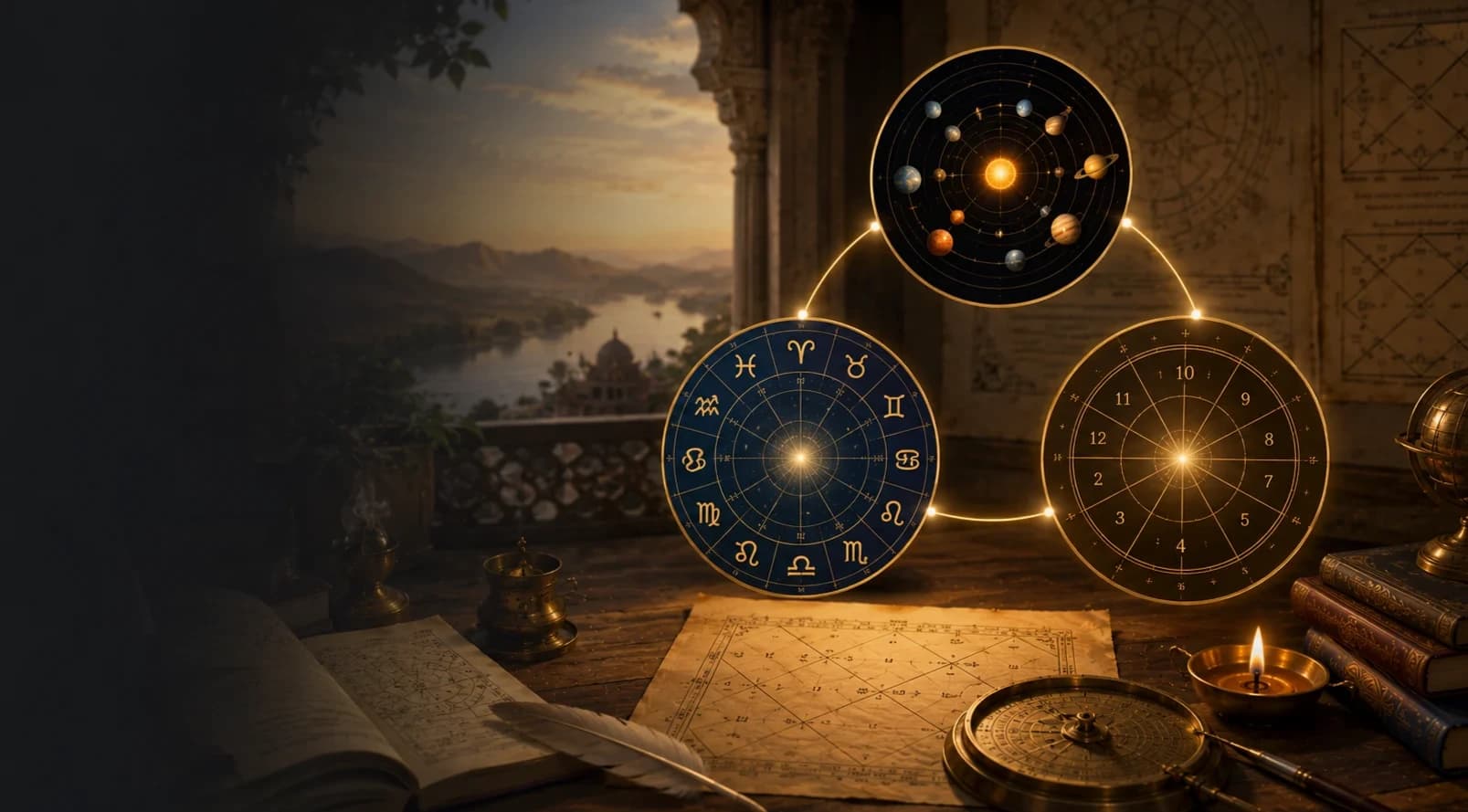
The Three Main Building Blocks: Grahas, Rashis, and Bhavas
For beginners, the easiest way to understand Jyotish is to start with three fundamental building blocks:
- Grahas – the nine planetary forces
- Rashis – the twelve zodiac signs
- Bhavas – the twelve houses of life
The planets are the actors. The signs are the style or environment in which those actors operate. The houses are the areas of life where those actors perform. This simple model helps make chart reading much more intuitive.
The Nine Grahas: What the Planets Represent
In Vedic Astrology, the nine grahas are Sun, Moon, Mars, Mercury, Jupiter, Venus, Saturn, Rahu, and Ketu. Rahu and Ketu are not physical planets in the modern astronomical sense; they are the lunar nodes, but they are treated as powerful grahas in Jyotish because of their karmic and psychological significance.
Each graha has natural significations:
- Sun (Surya): soul, self-respect, vitality, authority, father, leadership
- Moon (Chandra): mind, emotions, mother, nourishment, sensitivity, adaptability
- Mars (Mangal): courage, energy, conflict, property, initiative, siblings
- Mercury (Budha): intellect, communication, calculation, speech, trade, wit
- Jupiter (Guru): wisdom, ethics, children, faith, prosperity, counsel
- Venus (Shukra): love, beauty, pleasure, marriage, art, luxury, harmony
- Saturn (Shani): karma, discipline, delay, endurance, labour, reality, time
- Rahu: desire, obsession, amplification, foreignness, ambition, unconventionality
- Ketu: detachment, past-life residue, spirituality, cutting away, moksha
These meanings are called the planet’s natural significations, but their actual results depend greatly on the houses they rule, the signs they occupy, the aspects they receive, and the Dasha period in which they become active.
The Twelve Rashis: The Zodiac Signs in Jyotish
The twelve signs in Vedic Astrology are Mesha (Aries), Vrishabha (Taurus), Mithuna (Gemini), Karka (Cancer), Simha (Leo), Kanya (Virgo), Tula (Libra), Vrishchika (Scorpio), Dhanu (Sagittarius), Makara (Capricorn), Kumbha (Aquarius), and Meena (Pisces).
Each sign has a nature, element, temperament, and planetary ruler. For example, Aries is fiery, initiating, and ruled by Mars; Taurus is earthy, stable, and ruled by Venus; Cancer is nurturing and ruled by the Moon. When a planet sits in a sign, the sign colours the way that planet expresses itself. Mars in Aries behaves differently from Mars in Cancer. Mercury in Virgo behaves differently from Mercury in Pisces.
This is one of the reasons real chart reading requires context. A planet’s nature and a sign’s nature interact. A benefic planet in a difficult sign may struggle. A malefic planet in a sign of strength may become highly productive. Jyotish is always asking not just “what is the planet?” but “how strong is it, where is it, and what is it trying to do in this chart?”
The Twelve Houses: The Map of Life
The houses, or bhavas, are among the most practical parts of astrology because they describe concrete areas of life. In a simplified sense:
- 1st House: self, body, identity, overall direction
- 2nd House: speech, food, wealth, family of origin
- 3rd House: courage, communication, siblings, skills
- 4th House: home, mother, emotional foundation, property
- 5th House: intelligence, children, creativity, romance, past merit
- 6th House: health, service, enemies, debts, discipline
- 7th House: marriage, partnerships, contracts, public dealings
- 8th House: longevity, transformation, secrets, occult matters, sudden changes
- 9th House: dharma, higher learning, father, grace, fortune
- 10th House: career, status, action, reputation, public life
- 11th House: gains, networks, income, aspirations, fulfilment
- 12th House: losses, retreat, foreign lands, sleep, liberation, isolation
House meaning is foundational. But even more important is the concept of the house lord. Every house is ruled by the planet that owns the sign placed there. That house lord carries the affairs of that house into the house where it sits. This is a key principle of real interpretation.
Why the Ascendant (Lagna) Is So Important
If there is one point in the chart every beginner should understand first, it is the Ascendant, or Lagna. The Lagna is the sign rising on the eastern horizon at the moment of birth. It becomes the first house of the chart and determines the entire house structure from there.
This makes Lagna central to chart reading. It sets the physical and psychological orientation of the person. It determines which planets become functionally beneficial or challenging by house rulership. It influences health, vitality, temperament, and the overall framework of life. Two people with the same Moon sign or Sun sign can still live very different lives if their Ascendants differ, because the same planets will rule different houses for them.
For example, Saturn may be highly beneficial for one Ascendant and more difficult for another. Venus may become a yoga-producing planet in one chart and a more mixed influence in another. This is why Jyotish must be personal. The Ascendant individualizes the chart.
The Moon Sign and Why It Matters So Much
In popular astrology, the Sun sign gets most attention. In Vedic Astrology, the Moon is often even more psychologically revealing. The Moon reflects the mind, emotions, receptivity, everyday comfort, and the inner experience of life. It also plays a major role in timing systems and compatibility judgments.
Many classic chart assessments begin from the Moon sign as well as the Ascendant. Major transits such as Sade Sati are read relative to the Moon. Compatibility systems like Guna Milan use Moon-based logic. The running Dasha is also linked to the Moon’s nakshatra at birth. So if you ignore the Moon in Jyotish, you miss a huge part of the living chart.
The Nakshatras: The Lunar Mansions
One of the most distinctive features of Vedic Astrology is the use of the 27 Nakshatras, or lunar mansions. These are subtle divisions of the zodiac that add enormous interpretive richness. Every planet is placed not only in a sign and house but also in a nakshatra. Nakshatras give texture, symbolism, temperament, and karmic nuance that sign placements alone cannot provide.
For example, two people may both have the Moon in Taurus, but if one Moon is in Rohini and the other is in Krittika, their mental and emotional expression can be very different. The nakshatra brings mythic, psychological, and spiritual detail into the reading.
Nakshatras are also central to timing because the birth nakshatra of the Moon determines where the Vimshottari Dasha sequence begins. For beginners, it is enough to understand that nakshatras are one of the reasons Jyotish can feel so precise and layered.
Planetary Strength: Why Placement Is Never Enough
One of the most common beginner mistakes is to assume that a planet means the same thing in every chart. In reality, planetary strength matters enormously. A strong Jupiter can bless a chart with wisdom, faith, and prosperity. A weak Jupiter may struggle to deliver those same results. A strong Saturn can create discipline, endurance, and authority; a distressed Saturn may manifest as fear, delay, or burden.
Jyotish evaluates strength through many lenses, including:
- own sign placement
- exaltation and debilitation
- house placement
- aspects from benefics or malefics
- combustion
- retrogression
- Shadbala and other technical measures
This is why simplistic statements such as “Saturn in the 10th is bad” or “Venus in the 7th guarantees happy marriage” are unreliable. In real Jyotish, the answer is always contextual.
Yogas: Planetary Combinations That Change the Story
Another major feature of Vedic Astrology is the concept of Yogas, which are meaningful planetary combinations. Some yogas create wealth, status, intelligence, courage, spirituality, artistic refinement, or unusual success. Others indicate challenges, instability, emotional difficulty, or karmic pressure.
But even here, mature interpretation matters. The existence of a yoga in a chart does not mean it will fully manifest at all times. The yoga must be supported by planetary strength and activated by the right Dasha periods. This is another reason timing matters so much in Jyotish. A promise in the chart may be real, but it often unfolds when the appropriate period begins.
The Dasha System: Why Timing Is the Heart of Predictive Jyotish
If the birth chart is the map, the Dasha system is the clock. In practical prediction, this is one of the most powerful parts of Vedic Astrology. The chart may show many possibilities, but the Dasha tells us which themes are active now.
The most widely used timing system is Vimshottari Dasha, a 120-year cycle divided among the nine grahas. Each person begins at a different point in the cycle depending on the Moon’s nakshatra at birth. As major periods (Mahadashas) and sub-periods (Antardashas) change, different planets take the lead in shaping events, priorities, opportunities, and challenges.
This is why a person can say, “My life changed completely after age 28,” or “Everything shifted when a certain period began.” From the Jyotish perspective, those shifts often correspond to planetary timing changes. Dasha helps explain not only what is in the chart, but when it is likely to become visible.
How a Vedic Astrologer Actually Reads a Chart
A proper reading usually does not begin with a random placement. A skilled astrologer generally moves through a sequence such as:
- Assess the Ascendant and Ascendant lord
- Assess the Moon and mental-emotional condition
- Study the condition of key houses such as the 1st, 4th, 7th, 9th, and 10th
- Evaluate house lords and their placements
- Check planetary dignity, aspects, conjunctions, and yogas
- Use divisional charts where relevant
- Read current Dasha and major transits
This is holistic reading. It avoids the trap of judging life from one isolated factor. It also explains why computer-generated reports can feel shallow when they list placements without synthesis. The art of Jyotish lies in combining principles intelligently.
What Vedic Astrology Can Help You Understand
Used well, Jyotish can help illuminate many areas of life:
- personality and natural temperament
- career direction and vocational fit
- relationship patterns and marriage timing
- financial tendencies and effort patterns
- spiritual inclinations and inner struggles
- health sensitivities and lifestyle caution zones
- major life phases and turning points
What it should not be used for is obsessive dependency. Astrology is most useful when it supports wiser living, not when it replaces responsibility, common sense, medical advice, or personal growth.
Common Misconceptions Beginners Have
Beginners often assume Vedic Astrology is only about prediction. In truth, prediction is only one branch of its use. Others assume that one difficult placement ruins a chart. That is also false. Every chart contains mixed karma. Another misconception is that if two people share the same Sun sign or Moon sign, their lives will be similar. Without the full chart, that conclusion is much too simplistic.
Some also think that remedies are magic shortcuts. Traditional remedies do have an important place in Jyotish, but they work best when prescribed intelligently and combined with ethical living, discipline, and self-awareness. Remedies are not substitutes for maturity.
How to Begin Learning Jyotish Properly
If you are new to Vedic Astrology, the best learning path is simple:
- learn the 12 houses first
- learn the nine grahas and their natural significations
- learn the 12 rashis and their rulers
- understand the importance of Lagna and Moon
- study how house lords behave in different houses
- begin exploring nakshatras and Dasha gradually
It is tempting to jump straight into advanced yogas, divisional charts, or compatibility rules. But without a strong foundation, advanced material becomes confusing. The strongest readers are always the ones who respect the basics.
Final Thoughts: Why Vedic Astrology Still Matters Today
Even in a modern world filled with data, speed, and constant distraction, Vedic Astrology remains deeply relevant because it addresses questions that technology alone cannot answer: Who am I? What patterns shape my life? Why do certain lessons keep repeating? What is this period trying to teach me? What kind of life is truly aligned for me?
Jyotish does not ask you to become superstitious. It asks you to become observant. It invites you to see life as meaningful rather than random. It teaches that time has quality, not just quantity. It reminds us that destiny is not a single event but a pattern that can be read, understood, and lived with greater awareness.
If you are beginning your journey into Vedic Astrology, start with humility and curiosity. Learn the grammar of the chart. Study the houses, planets, signs, and timing systems. Most importantly, remember that the chart is not there to frighten you. It is there to bring light.
A good Jyotish reading should leave you clearer, steadier, and more honest with yourself than before. That is the real purpose of this ancient science.
Frequently asked questions
What are the basic parts of Jyotish?
The main building blocks include Grahas, Rashis, Bhavas, Nakshatras, aspects, combinations, Dashas, and transits.
Does Jyotish guarantee future events?
No. Jyotish is used to interpret patterns and timing themes, not to guarantee outcomes.
Jyotish basics and related reading
- The three pillars: planets, signs, and houses
- The 12 houses in a birth chart
- The nine Grahas explained
- What is the Ascendant or Lagna?
- Understanding the structure of a birth chart before exploring timing, compatibility, or reports.
- A Vedic birth chart with planetary positions, houses, signs, and interpretive sections.
Astrology guidance is interpretive, not deterministic. Outcomes also depend on choices, circumstances, and context.
Last updated:
Editorial insight
The biggest mistake beginners make is thinking Vedic Astrology is a list of placements to memorise. Jyotish is a living system. A chart must be read as an interconnected whole — the Ascendant, the condition of house lords, the strength of planets, the nakshatras, and the timing of Dashas all matter together.
- My Destiny Path Editorial Team
Real-Life Case Study
A 29-year-old client came for guidance because he felt his life had “gone off track” despite strong academic success. On the surface, his chart looked promising: a well-placed Jupiter and a powerful 10th house. But a closer reading showed a sensitive Moon under pressure and a running Dasha that was activating 12th-house themes of retreat, foreign movement, and inner uncertainty. His real problem was not lack of potential. It was timing. Once he understood that this phase was more about redirection than visible achievement, he stopped judging himself so harshly. Within the next year, he relocated abroad for research work that fit his chart far better than the corporate path he had been forcing. Jyotish did not magically “fix” his life. It helped him understand the season he was in and act with greater alignment.
Key terms in this article
- Dasha
- A planetary period used in Vedic astrology to understand life chapters and timing themes.
- Transit
- The current movement of planets and how those movements interact with a birth chart.
- Lagna
- The rising sign at birth, used as the starting point for house-based chart interpretation.
- Nakshatra
- A lunar mansion used by many Vedic timing and personality methods.
Explore related tools
Free Kundali
Generate your Vedic birth chart
Today's Panchang
Tithi, Nakshatra, Yoga & Muhurats
Kundali Matching
Check marriage compatibility
Western Natal Chart
Tropical birth chart · Placidus houses
Unlock Your Complete Destiny Report
40-page personalised PDF — Dasha predictions, Yogas, remedies & life guidance