

Quick Answer: What Are the 3 Pillars of Vedic Astrology?
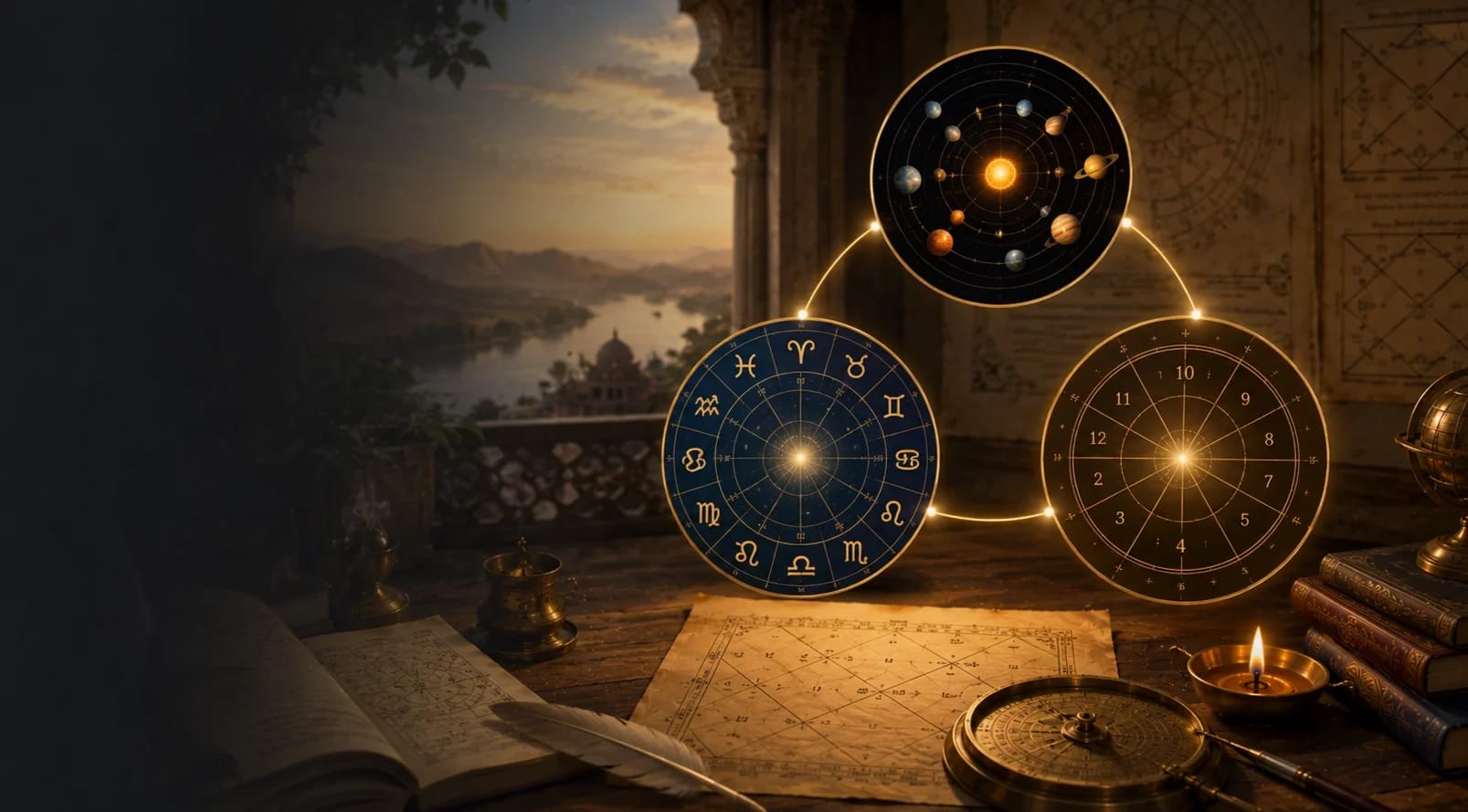
The three pillars of Vedic astrology are planets, signs, and houses. Planets show the active forces, signs show how those forces express themselves, and houses show the life areas where the results are experienced. A real Kundali reading combines all three.
Planets, Signs, and Houses Compared
Pillar Simple meaning Example question it answers
Planets / Grahas
The forces or significators in the chart
Which energy is active?
Signs / Rashis
The style or nature of expression
How does that energy behave?
Houses / Bhavas
The life area where results appear
Where in life does it show up?
How the Three Pillars Work Together
A planet by itself is not enough. Mars in Aries in the 10th house is read differently from Mars in Cancer in the 4th house because the planet, sign, and house all change the interpretation. This article focuses on that three-part reading method, while a broader Vedic astrology guide explains the full Jyotish system.
Frequently Asked Questions
Are planets more important than signs in Vedic astrology?
Planets are central, but signs and houses change how a planet acts and where its results appear. The three pillars should be read together.
What is the difference between a sign and a house?
A sign is a zodiac quality such as Aries or Taurus. A house is a life area such as career, marriage, wealth, or home.
Why does the same planet give different results in different charts?
The result changes because the planet's sign, house, dignity, aspects, conjunctions, and functional role vary from chart to chart.
Introduction: The Grammar of a Kundali
One of the main reasons beginners find Vedic Astrology overwhelming is that everything seems to appear at once. A chart contains planets, signs, houses, house lords, nakshatras, aspects, yogas, dashas, and more. For someone seeing a Kundali for the first time, it can feel as if there are too many moving parts to make sense of. That feeling is completely normal. But there is a simple way to make the system easier to understand: start with the three core pillars on which nearly all chart interpretation rests.
Those three pillars are Planets (Grahas), Signs (Rashis), and Houses (Bhavas). If you understand how these three work individually and how they combine, you already understand a large part of the grammar of Jyotish. Without them, chart reading becomes guesswork. With them, even a complex chart begins to feel structured and readable.
A useful way to think about these three pillars is this: the planet tells you what kind of force or energy is active. The sign tells you how that energy behaves or expresses itself. The house tells you where in life that energy shows up most strongly. Once you see the chart through that lens, the symbolism becomes much easier to follow.
For example, Mars always carries themes of action, courage, conflict, initiative, and force. But Mars in Aries behaves differently from Mars in Cancer. And Mars in the 10th house expresses differently from Mars in the 4th. The planet remains Mars, but the sign and house alter its style and field of manifestation. This simple idea is one of the most important keys to real astrology.
This article is designed for readers who want a clean, beginner-friendly but genuinely useful explanation of the three pillars of Vedic Astrology. We will define each one, understand how they interact, see why no single pillar can be read in isolation, and learn how astrologers begin combining them into meaningful interpretation.
Why These Three Are Called the Pillars of Vedic Astrology
There are many layers in Jyotish, but almost all chart interpretation begins with the relationship between grahas, rashis, and bhavas. These are the foundational components that create the chart’s working structure. If you skip them and jump directly into advanced yogas, divisional charts, or complicated predictive rules, the system may feel impressive, but it will not feel stable. You will be trying to read paragraphs before learning the alphabet.
The reason these are called pillars is simple: they hold everything else up. Yogas are formed through planetary combinations. House results depend on planets and signs. Dashas activate planets that are placed in signs and houses. Nakshatras refine the expression of planets already placed in signs and houses. Even remedies are often recommended on the basis of planetary condition within this same structural framework.
In other words, whether you are studying relationship astrology, career, wealth, health, spiritual tendencies, or timing, you keep coming back to the same three questions:
- Which planet is involved?
- In which sign is it placed?
- In which house is it operating?
That is why learning these three pillars is not “basic” in the sense of trivial. It is basic in the sense of foundational. These principles remain relevant even for advanced astrologers.
Pillar One: Planets (Grahas)
In Vedic Astrology, the planets are called Grahas. The Sanskrit word graha does not only mean planet in an astronomical sense. It also carries the meaning of “that which seizes” or “that which influences.” This is important, because in Jyotish the grahas are not treated only as objects floating in space. They are treated as active forces that shape experience, timing, psychology, karma, and life emphasis.
The nine grahas used in Vedic Astrology are:
- Sun (Surya)
- Moon (Chandra)
- Mars (Mangal)
- Mercury (Budha)
- Jupiter (Guru)
- Venus (Shukra)
- Saturn (Shani)
- Rahu
- Ketu
Rahu and Ketu are not physical planets in the modern astronomical sense. They are the lunar nodes. But in astrology they function as extremely important karmic points and are treated as grahas because of their predictive and symbolic power.
Each graha has a natural field of meaning. For example:
- Sun signifies vitality, authority, dignity, father, leadership, and self-radiance.
- Moon signifies mind, emotions, mother, nourishment, receptivity, and mental stability.
- Mars signifies courage, action, force, competition, conflict, and initiative.
- Mercury signifies intellect, speech, trade, analysis, adaptability, and communication.
- Jupiter signifies wisdom, ethics, blessings, children, faith, growth, and guidance.
- Venus signifies love, harmony, pleasure, art, relationships, beauty, and comforts.
- Saturn signifies karma, discipline, endurance, delay, responsibility, suffering, and maturity.
- Rahu signifies desire, ambition, obsession, amplification, disruption, foreign influence, and unconventional movement.
- Ketu signifies detachment, past karma, spiritual insight, separation, sharpness, and inner withdrawal.
But here is the first major lesson: a graha never acts alone in interpretation. A planet’s natural meaning is important, but it is not the final meaning. The sign and house modify how that planet behaves and where it gives results.
What Grahas Actually Do in a Chart
If signs are environments and houses are life areas, then grahas are the active agents. They bring motion, events, tendencies, and karmic energy into the chart. In practical reading, they often tell us what is psychologically central, where energy accumulates, what kinds of lessons are emphasized, and how certain life fields get activated in different periods.
For example, if Saturn is strong in a chart, it may bring endurance, long-term discipline, responsibility, and substantial results after effort. If Saturn is weak or heavily burdened, it may manifest as fear, delay, isolation, or psychological heaviness. The planet is still Saturn, but its condition shapes the quality of the result.
This is why astrologers do not stop at saying “Mars means anger” or “Jupiter means luck.” Real interpretation asks: How strong is the planet? Is it in its own sign? Is it exalted or debilitated? Is it receiving benefic aspects? Is it combust? Is it ruling important houses? Is it active in Dasha?
So while planets are the first pillar, they become truly meaningful only when connected with the other two pillars.
Pillar Two: Signs (Rashis)
The second pillar is the Rashi, or zodiac sign. In Vedic Astrology, there are twelve signs:
- Aries (Mesha)
- Taurus (Vrishabha)
- Gemini (Mithuna)
- Cancer (Karka)
- Leo (Simha)
- Virgo (Kanya)
- Libra (Tula)
- Scorpio (Vrishchika)
- Sagittarius (Dhanu)
- Capricorn (Makara)
- Aquarius (Kumbha)
- Pisces (Meena)
Each sign has a nature, a ruler, an element, a temperament, and a style of functioning. Signs do not create events by themselves in the way planets do. Instead, they shape the manner in which the planetary energy is expressed.
This is why we can say the sign shows the quality, mood, or style of a planet’s expression. Mars in Aries behaves in a direct, fiery, forceful, self-starting way. Mars in Cancer behaves through a much more emotional, reactive, and complicated channel. Mercury in Gemini may become fast, verbal, flexible, and curious. Mercury in Virgo may become precise, analytical, and detail-oriented. The graha is still the same, but the rashi changes the language through which that graha speaks.
What Rashis Add to Interpretation
Rashis add texture, environment, and behavioral style. They show how a planet thinks, reacts, expresses, and organizes itself. This makes them essential for interpretation. If you know the planet but not the sign, you know the raw energy but not the tone of that energy.
Each sign also has elemental qualities. Fire signs tend to move through action, inspiration, courage, and vision. Earth signs tend to move through stability, materiality, patience, and practical structure. Air signs tend to move through ideas, relationships, movement, and communication. Water signs tend to move through feeling, memory, nourishment, depth, and intuition.
Signs also have modalities and deeper symbolic themes. Some initiate. Some stabilize. Some adapt. Some are royal, some humble, some commercial, some emotional, some philosophical, some secretive. These themes matter because they colour the planet’s behavior.
So if a chart shows a strong Venus, that is only the beginning. A Venus in Taurus differs from Venus in Virgo. A Moon in Cancer differs from Moon in Capricorn. A Saturn in Aquarius differs from Saturn in Leo. Rashis transform the planet from a concept into a style of manifestation.
Pillar Three: Houses (Bhavas)
The third pillar is the Bhava, or house. If the planet tells us what energy is active, and the sign tells us how it behaves, the house tells us where in life that energy is likely to show up most strongly.
The twelve houses correspond broadly to twelve life fields:
- 1st House – self, body, personality, overall life direction
- 2nd House – speech, family, food, accumulated wealth
- 3rd House – courage, effort, communication, siblings, skills
- 4th House – home, mother, emotional foundations, property, inner comfort
- 5th House – intelligence, creativity, romance, children, merit
- 6th House – service, illness, conflict, debts, discipline, resistance
- 7th House – marriage, partnership, agreements, the public-facing other
- 8th House – transformation, vulnerability, crisis, hidden matters, longevity, occult depth
- 9th House – dharma, blessings, father, teachers, fortune, higher wisdom
- 10th House – action, karma, profession, reputation, public life
- 11th House – gains, fulfilment, networks, aspirations, social support
- 12th House – loss, retreat, sleep, foreign lands, renunciation, liberation
Houses are where astrology becomes highly practical. They translate planetary symbolism into actual life themes. They tell us whether a planetary energy is likely to become prominent in career, relationship, health, family, finances, or spiritual life.
Why Houses Matter So Much
Many beginners memorize planet meanings and sign meanings but do not yet understand how important the houses are. But the house is often what makes astrology feel concrete. If Jupiter is wisdom and blessing, the house tells us where those blessings may be most visible. If Mars is force and drive, the house tells us where that drive is being applied. If Saturn is discipline and karmic pressure, the house tells us which field of life is demanding maturity.
For example:
- Venus in the 10th may bring artistic public presence, grace in profession, or work related to beauty or relationships.
- Venus in the 4th may bring a love of comfort, refined domestic life, attachment to emotional harmony, or pleasure through home and property.
- Mars in the 3rd may produce courage and skill-based effort.
- Mars in the 7th may bring strong-willed relationship dynamics.
So the house tells us where the energy lives in practical terms. Without that, interpretation floats in abstraction.
How the Three Pillars Work Together
Now we can put the model together:
- Planet = what energy is active
- Sign = how it expresses
- House = where it acts
Let us take one example. Suppose Mercury is in Virgo in the 10th house.
- Mercury tells us the energy involves intellect, speech, analysis, learning, and communication.
- Virgo tells us that Mercury expresses in a careful, detail-oriented, precise, discriminating way.
- The 10th house tells us this plays out in career, public role, duty, action, and visible work.
So even without going deeper yet, we can already imagine a person whose work may involve analysis, communication, writing, accounting, research, editing, systems thinking, or precision-based service.
Now imagine Moon in Cancer in the 4th house:
- Moon = mind, emotion, nourishment, inner security
- Cancer = nurturing, sensitive, protective, receptive
- 4th house = home, mother, emotional roots, private life
That immediately creates a different kind of picture—one centered on emotional depth, domestic sensitivity, inner belonging, and the importance of private stability.
This is the basic interpretive logic of astrology. Once you understand the three pillars, charts stop looking random.
Why No Single Pillar Can Be Read Alone
One of the biggest beginner mistakes is isolating one pillar and treating it as the entire truth. Someone memorizes that Saturn means delay and then assumes every Saturn placement must be negative. Someone memorizes that Libra means balance and assumes every planet in Libra behaves harmoniously. Someone memorizes that the 8th house is difficult and assumes everything there must be disastrous.
That is not how Jyotish works.
A planet’s natural meaning matters, but its sign and house matter too. A sign’s symbolic quality matters, but the planet occupying it matters too. A house’s life-field matters, but the ruling planet and occupant matter too. And beyond all of this, house lords, aspects, yogas, dignity, and Dashas refine the picture further.
This is why astrology rewards patience. Real interpretation is not about quick slogans. It is about seeing relationships correctly.
House Lords: Where the Three Pillars Become Personal
The idea of house lords is where the three pillars become even more specific. Every house begins with a sign. The ruler of that sign becomes the lord of the house. So the planet that rules a sign now takes responsibility for the life area represented by the house.
For example, if Taurus falls in the 10th house, Venus becomes the ruler of the 10th. That means profession, public action, and outer karma are strongly linked to Venusian themes. If Venus is placed in the 5th, then 10th-house matters may connect with creativity, children, intelligence, performance, advising, education, or speculative expression.
This is one reason Lagna is so important. Lagna determines the whole house structure, and therefore determines which planets become house lords. So while planets, signs, and houses are the three pillars, they become truly chart-specific through Lagna-based rulership.
A Simple Analogy for Beginners
Here is a beginner-friendly analogy that often helps:
- The planet is the actor.
- The sign is the costume, mood, and style of acting.
- The house is the stage or life setting.
So if Jupiter is the actor, Sagittarius is the costume, and the 9th house is the stage, then the scene will look philosophical, teaching-oriented, ethical, and spiritually expansive. If the same Jupiter is in Capricorn in the 6th house, the scene becomes more disciplined, effort-heavy, duty-bound, and structured around service and problem-solving.
The actor is the same. But the style and stage have changed. So the story changes too.
Common Beginner Confusions About the Three Pillars
Beginners often run into a few predictable confusions:
- thinking signs and houses mean the same thing
- thinking a planet acts the same in every chart
- memorizing sign keywords without seeing the planet involved
- ignoring house rulership
- trying to interpret one placement without context
One especially common mistake is confusing a sign with a house. For example, someone may think Aries is always the same as the 1st house, Taurus is always the same as the 2nd, and so on. While there are natural analogies, this is not how actual chart reading works. In a real Kundali, any sign can occupy a different house depending on Lagna. This is why Lagna-based structure matters so much.
How to Start Studying the Three Pillars Properly
If you want to learn these foundations well, a practical approach is:
- learn the natural meanings of the nine grahas
- learn the elemental and symbolic nature of the twelve rashis
- learn the life meanings of the twelve bhavas
- practice combining one planet, one sign, and one house together
- then gradually add house lords, aspects, and strength
This is much better than trying to memorize hundreds of interpretations separately. Once your mind understands the underlying grammar, interpretation becomes far more natural.
Why These Three Pillars Matter Even in Advanced Astrology
Even advanced Jyotish never leaves these pillars behind. Divisional charts, yogas, Dashas, transits, remedies, and compatibility all still rest on the same logic. Which graha is involved? In what sign? In what house? Under what rulership conditions? With what strength? Activated in what period?
That means if your foundations are strong, your later learning becomes much easier. And if your foundations are weak, advanced concepts will remain fragile no matter how many terms you memorize.
Final Thoughts: Start Here and the Chart Will Begin to Speak
Vedic Astrology becomes much less intimidating when you stop trying to learn everything at once and instead begin with its true foundations. Grahas, Rashis, and Bhavas are not just beginner topics. They are the underlying grammar of chart interpretation.
Planets show the active forces. Signs show the style of expression. Houses show the field of manifestation. Once you learn to combine these three, the chart becomes readable in a real way.
That is why these are called the three pillars of Vedic Astrology. They hold the system together. And if you learn them well, your Kundali will stop looking like a puzzle of symbols and start becoming what it really is: a meaningful map of life.
Editorial insight
The biggest leap in astrology learning happens when a student stops memorizing disconnected meanings and starts thinking structurally. Planet, sign, and house together form the basic sentence of chart interpretation. Without that sentence, the Kundali stays fragmented. With it, the chart begins to speak clearly.
- My Destiny Path Editorial Team
Real-Life Case Study
A student of astrology once felt frustrated because every chart looked like a mass of unrelated details. She knew that Jupiter meant wisdom, Taurus meant stability, and the 10th house meant career, but she still could not “read” a chart. The breakthrough came when she learned to combine the three pillars instead of treating them separately. When she began asking, “What planet is this? In what sign? In what house?” the chart suddenly became understandable. Jupiter in Taurus in the 10th was no longer three separate notes — it became a coherent statement about steady growth, ethical visibility, and a grounded public role. That was the point at which astrology changed for her from memorization into interpretation.
Key terms in this article
- Dasha
- A planetary period used in Vedic astrology to understand life chapters and timing themes.
- Transit
- The current movement of planets and how those movements interact with a birth chart.
- Lagna
- The rising sign at birth, used as the starting point for house-based chart interpretation.
- Nakshatra
- A lunar mansion used by many Vedic timing and personality methods.
Explore related tools
Free Kundali
Generate your Vedic birth chart
Today's Panchang
Tithi, Nakshatra, Yoga & Muhurats
Kundali Matching
Check marriage compatibility
Western Natal Chart
Tropical birth chart · Placidus houses
Unlock Your Complete Destiny Report
40-page personalised PDF — Dasha predictions, Yogas, remedies & life guidance