

Quick Answer: What Is Panchang?
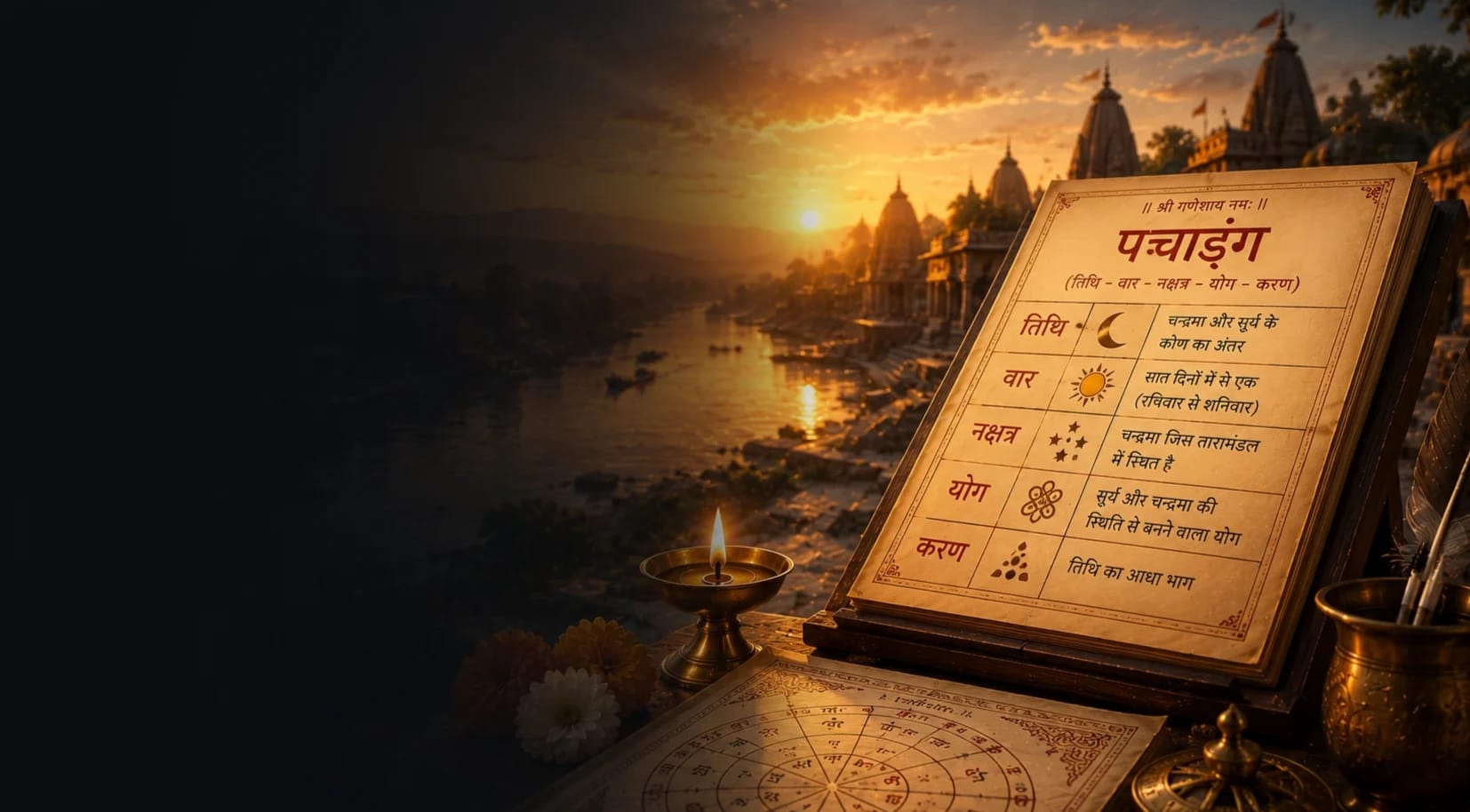
Panchang is a Hindu calendar system used to understand daily timing quality. The word means five limbs: Tithi, Nakshatra, Yoga, Karana, and weekday. Together, these help assess auspicious time windows, festivals, fasts, Muhurat, and daily spiritual observances.
The Five Parts of Panchang
Panchang part Simple meaning Why it matters
Tithi
Lunar day
Used for festivals, fasting, rituals, and Muhurat quality
Nakshatra
Moon's lunar mansion
Shows the day's emotional and activity quality
Yoga
Sun-Moon combination
Adds another layer of daily auspiciousness
Karana
Half of a Tithi
Used for practical action timing and ritual selection
Vaar
Weekday
Connects the day with a ruling planet and activity tone
How to Read Panchang Simply
Start with the date and location, because Panchang timings change by place. Then check the Tithi and Nakshatra for the main daily quality, review Rahu Kaal and other avoided periods, and use Muhurat rules for important activities. For major decisions, Panchang should be combined with practical planning and chart-specific guidance.
Frequently Asked Questions
Is Panchang the same everywhere?
No. Panchang timings depend on location, sunrise, and local timezone, so the same date can have different timing details in different cities.
What are the five limbs of Panchang?
The five limbs are Tithi, Nakshatra, Yoga, Karana, and Vaar, which means weekday.
Can Panchang tell the best time for every activity?
Panchang helps shortlist favorable and unfavorable windows, but important activities may also need purpose-specific Muhurat rules and personal chart context.
Why So Many People Hear About Panchang but Never Really Learn How to Read It
Many people grow up hearing that an event should be planned “according to Panchang.” A family may check Panchang before fixing a wedding date, choosing a housewarming time, starting a new business, naming a child, or observing an important fast or festival. Priests refer to it, elders respect it, and calendars often print parts of it. Yet for all its visibility, Panchang remains confusing to many ordinary readers.
People may know that Panchang is “some kind of Hindu calendar,” but they often do not know what its actual parts mean. They may hear words like Tithi, Nakshatra, Rahu Kaal, Yoga, and Karana, but these terms can sound technical, distant, or intimidating. As a result, Panchang is either followed mechanically or ignored completely.
This is unfortunate, because Panchang is not meant to be mysterious for the sake of mystery. At its best, it is a traditional way of understanding the quality of time. It helps people see that not every day is read in the same way, and not every moment carries the same traditional significance. It gives structure to ritual timing, festival observance, and the selection of Muhurat.
The good news is that Panchang becomes much easier once you understand its basic logic. You do not need to be a priest or advanced astrologer to understand the foundation. You simply need to know what the five main components are, what they describe, and how they work together.
This guide explains Panchang in simple language. We will look at what Panchang means, why it matters, what its five limbs are, how to read it at a beginner level, how it connects with Muhurat, and how it can be used wisely without turning it into fear or confusion.
What the Word Panchang Actually Means
The word Panchang comes from two Sanskrit roots: Pancha, meaning five, and Anga, meaning limbs or parts. So Panchang literally means the five limbs.
These five limbs are the five core time-factors used in the traditional Hindu calendar system:
- Tithi
- Vara
- Nakshatra
- Yoga
- Karana
When people say “check the Panchang,” they usually mean: look at these traditional time indicators and understand what kind of day or moment is being described.
This is an important point. Panchang is not just a calendar of dates. It is a calendar of qualified time. It tells you more than the number of the day. It tells you how that day is traditionally understood through lunar and solar relationships.
Panchang Is More Than a Date Calendar
Modern calendars usually tell us the date, weekday, month, and maybe a holiday. Panchang goes further. It describes the quality of time through traditional astronomical and astrological measures.
This is why Panchang is not the same thing as a simple wall calendar. A wall calendar might tell you that it is Tuesday, the 8th of a month. Panchang may additionally tell you:
- which lunar day is active
- which Nakshatra the Moon is in
- which Yoga is operating
- which Karana is present
- whether the day is favorable for certain rituals or actions
In other words, Panchang provides a richer traditional map of time. This is why it becomes so important for festivals, fasts, rituals, and Muhurat selection. It helps answer not only “what date is it?” but also “what kind of day is this in traditional timing?”
Why Panchang Matters in Hindu Tradition
In Hindu tradition, time is not treated as spiritually empty. Time is observed through rhythm, season, lunar movement, solar movement, and ritual significance. Panchang is one of the main tools used to understand that rhythm.
It matters because it helps determine:
- festival dates
- vrata and fasting observances
- ritual timings
- auspicious and less suitable periods
- Muhurat for major life events
- traditional daily timing awareness
Without Panchang, many traditional observances cannot be timed properly. For example, an important festival may not be observed simply by civil date, but by the relevant Tithi. A ceremony may not be planned merely by convenience, but by the combination of Panchang factors.
This is why Panchang is not only an astrological reference. It is also a cultural, ritual, and spiritual calendar.
The Five Parts of Panchang at a Glance
Before going deeper, it helps to understand the five parts in the simplest possible way:
- Tithi – the lunar day
- Vara – the weekday
- Nakshatra – the lunar constellation
- Yoga – a specific Sun-Moon combination
- Karana – half of a Tithi
If you remember just this much, you already have the framework. Everything else becomes easier from here.
Tithi: The Lunar Day
Tithi is one of the most important elements of Panchang. It is not the same as a civil date. A civil date changes according to the midnight-based calendar we use in daily life. Tithi is based on the angular relationship between the Sun and the Moon.
There are thirty Tithis in a lunar month, divided into the waxing half and the waning half. Different Tithis are traditionally understood to have different qualities, and many rituals and festivals depend on the correct Tithi rather than the civil date alone.
This is why a festival may sometimes appear on a date that surprises people who are only looking at the standard calendar. Panchang follows Tithi logic, not only civil dating.
At a beginner level, you do not need to calculate Tithi yourself. What matters is understanding that Tithi tells you what lunar day is operating, and this often carries ritual and timing significance.
Vara: The Weekday
Vara simply means the weekday. This is the part most people already recognize, because weekdays are familiar: Sunday, Monday, Tuesday, and so on.
But in Panchang, weekdays are not treated as neutral labels. Each weekday is traditionally associated with a planetary ruler and certain qualities. This is why some days are considered more supportive for particular actions or worship patterns than others.
For instance, certain weekdays are preferred for the worship of specific deities, some for certain vows, and some are given more importance in relation to particular life activities.
So Vara is easy to identify, but it is still meaningful within Panchang because it adds one more layer to the traditional reading of time.
Nakshatra: The Moon’s Constellation
Nakshatra refers to the lunar mansion or constellation through which the Moon is moving. This is another major part of Panchang and one of the most important factors in Muhurat.
There are twenty-seven Nakshatras commonly used in traditional astrology. Each is associated with a particular symbolic nature, and this nature is considered when judging the suitability of a time.
In simple terms, Nakshatra tells you where the Moon is in the traditional star framework. Since the Moon is strongly linked with mind, receptivity, and life rhythm in traditional thought, the active Nakshatra becomes highly significant for rituals, observances, and important beginnings.
A beginner does not need to master all twenty-seven Nakshatras immediately. It is enough to know that Nakshatra is one of the key ways Panchang describes the character of the moment.
Yoga: A Special Sun-Moon Combination
Yoga in Panchang is not the same as physical yoga practice. Here, Yoga refers to a specific calculated combination based on the positions of the Sun and Moon. This combination is given a traditional interpretive meaning.
Some Yogas are considered more favorable, some more mixed, and some are treated with caution depending on the activity involved. For a beginner, Yoga may initially seem abstract, because it is not as familiar as weekday or Tithi. But it is still one of the five core limbs of Panchang and therefore important in traditional time reading.
At a simple level, think of Yoga as one more layer that helps describe the nature of the moment. It contributes to the larger picture rather than standing alone.
Karana: Half of a Tithi
Karana is half of a Tithi. It may sound minor, but it is a meaningful factor in Panchang and Muhurat.
Different Karanas are traditionally associated with different effects, and some are more suitable than others for particular types of activities. In certain cases, Karana is especially considered in choosing the timing of important events.
For a beginner, the simplest understanding is this: Karana is another time-quality marker, smaller than Tithi but still relevant. It helps refine the judgment of the day or moment.
How the Five Parts Work Together
Panchang becomes easier to understand once you stop thinking of its five parts as separate isolated facts. They work together.
A single day may be described by:
- a particular Tithi
- a particular weekday
- a particular Nakshatra
- a specific Yoga
- a specific Karana
Together, these give a richer traditional picture of the time. This is why Panchang is so important in Muhurat. Muhurat is not usually chosen from one factor alone. It is selected by seeing how multiple Panchang factors combine.
So when a priest or astrologer checks Panchang for a ceremony, they are often looking at the overall harmony of these timing elements rather than one isolated label.
How to Read a Panchang Simply as a Beginner
If you are new to Panchang, do not start by trying to interpret everything at once. Start with a simple reading method:
- Look at the Tithi.
- Check the weekday.
- See which Nakshatra is active.
- Notice the listed Yoga and Karana.
- If relevant, also note any daily caution periods or special observances listed alongside the Panchang.
At first, you may not know how to interpret every factor fully. That is fine. Reading Panchang simply begins with knowing what you are looking at. Interpretation can deepen with study over time.
A beginner-friendly goal is not mastery on day one. It is familiarity.
Why Panchang Is Central to Muhurat
If Muhurat is the art of choosing a favorable time for an important action, then Panchang is one of the main tools used to make that judgment.
This is because Muhurat usually depends on questions like:
- Which Tithi is active?
- Which Nakshatra is operating?
- What is the weekday?
- Is the Yoga supportive?
- Is the Karana suitable?
- Are there any periods to avoid?
So if someone wants to understand Muhurat, learning Panchang is almost unavoidable. Panchang provides the timing language from which Muhurat is derived.
This is why a person may hear that a date is not enough. Traditional timing often needs the Panchang details behind the date.
Panchang Is Not Meant to Create Fear
One of the biggest problems in modern usage is that Panchang is sometimes presented in a fear-heavy way. People are told certain periods are bad, certain timings are dangerous, or one mistake in timing will ruin everything. That is not a healthy way to teach traditional time wisdom.
Panchang is best used as a system of awareness and discrimination, not anxiety. It helps people understand time more carefully. It does not require them to become frightened of living.
Used wisely, Panchang can help people:
- honor important timings
- plan rituals more accurately
- understand festival observance better
- approach Muhurat with clarity
Used poorly, it can become a source of unnecessary panic. The tradition itself is deeper than that.
Does Every Daily Task Need Panchang Checking?
This is a very practical question. The balanced answer is: no, not every small task needs detailed Panchang analysis.
Panchang becomes most important when:
- a ritual or festival is being observed
- a major life event is being planned
- a formal Muhurat is required
- traditional timing matters to the family or purpose involved
Ordinary daily life should not become paralyzed by timing anxiety. Panchang is a guide for meaningful timing, not a burden for every ordinary step.
This is where proportion matters. Respect for Panchang is good. Fearful overuse is not.
Common Beginner Mistakes When Looking at Panchang
New readers often make a few predictable mistakes:
- thinking Panchang is just another word for calendar
- trying to interpret every detail immediately without understanding the basics
- focusing only on one factor and ignoring the rest
- becoming frightened by caution periods without context
- assuming Panchang alone determines the whole outcome of an event
These mistakes can make Panchang seem harder or more intimidating than it really is. The best way forward is steady learning, not panic.
What a Beginner Should Focus on First
If you are completely new to Panchang, focus on these first principles:
- Panchang means the five limbs of traditional time-reading.
- Those five limbs are Tithi, Vara, Nakshatra, Yoga, and Karana.
- Panchang describes the quality of time, not just the date.
- It is important in ritual timing, festivals, and Muhurat.
- It should be used with understanding, not fear.
This alone gives a very strong beginner foundation.
Final Thoughts on What Panchang Is
So what is Panchang? In the simplest sense, it is the traditional Hindu calendar system that describes time through five key factors: Tithi, Vara, Nakshatra, Yoga, and Karana.
It matters because it helps people understand the quality of the day, observe rituals properly, identify important timing, and choose Muhurat with more clarity. It is not only about dates. It is about reading time in a more traditional and meaningful way.
If you want the shortest takeaway, remember this: Panchang is not just a calendar you look at. It is a traditional way of understanding what kind of time you are standing in.
That is the simplest way to begin reading it.
Editorial insight
Panchang should be understood as a traditional language of time. It does not merely tell us what day it is; it tells us how that day is being read through the lenses of lunar movement, weekday, and other sacred timing factors.
- My Destiny Path Editorial Team
Real-Life Case Study
A family preparing for a naming ceremony thought Panchang was simply a calendar that would tell them a convenient date. When they began to understand that Panchang includes Tithi, weekday, Nakshatra, Yoga, and Karana, they also understood why two dates that looked equally ordinary on a civil calendar were not read the same way in traditional timing. This shifted their view completely. Panchang stopped feeling like a mysterious religious formality and began to feel like a structured way of choosing time with more care. That is often what happens when Panchang is explained simply: confusion reduces, and respect becomes more natural.
Key terms in this article
- Nakshatra
- A lunar mansion used by many Vedic timing and personality methods.
- Muhurat
- A selected time window traditionally used for beginning important activities.
- Panchang
- A Hindu calendar framework using Tithi, Nakshatra, Yoga, Karana, and weekday quality.
Explore related tools
Today's Panchang
Tithi, Nakshatra, Yoga & Muhurats
Shubh Muhurat
Find auspicious timings for important events
Rahu Kaal
Today's inauspicious time periods
Choghadiya
Auspicious muhurat for the day
Unlock Your Complete Destiny Report
40-page personalised PDF — Dasha predictions, Yogas, remedies & life guidance