

Why So Many People Hear the Word Muhurat but Still Feel Confused
Many people grow up hearing the word Muhurat during important family occasions. It may come up while fixing a wedding date, planning a housewarming, buying a vehicle, naming a child, opening a business, or starting construction. Elders say, “We should check the Muhurat first.” Priests ask for birth details. Someone looks at the Panchang. A date is suggested, then a time window is chosen. For many families, all of this is familiar. Yet even after seeing it so often, a large number of people still do not really know what Muhurat means.
Some assume Muhurat simply means “a lucky time.” Others think it is a rigid religious rule that must be followed exactly or disaster will follow. Some people treat it with deep respect, while others dismiss it because they have only seen it explained in fearful or mechanical ways.
This confusion is understandable. Muhurat is often mentioned in practical life, but not always explained clearly. People are told when to follow it, but not always why. They hear that certain times are auspicious and others should be avoided, but they are not taught how this judgment is made or what role it is actually supposed to play.
The truth is that Muhurat is neither a random superstition nor a magical shortcut. At its best, it is a traditional way of choosing a supportive time for an important action. It is based on the idea that time has quality, and that certain moments may be more harmonious for certain kinds of beginnings than others.
This beginner’s guide is meant to explain Muhurat simply and thoughtfully. We will look at what Muhurat means, why it matters, how it is chosen, what factors are used, when it is most important, when people should be practical, and how to use it respectfully without becoming fearful or rigid.
What the Word Muhurat Actually Means
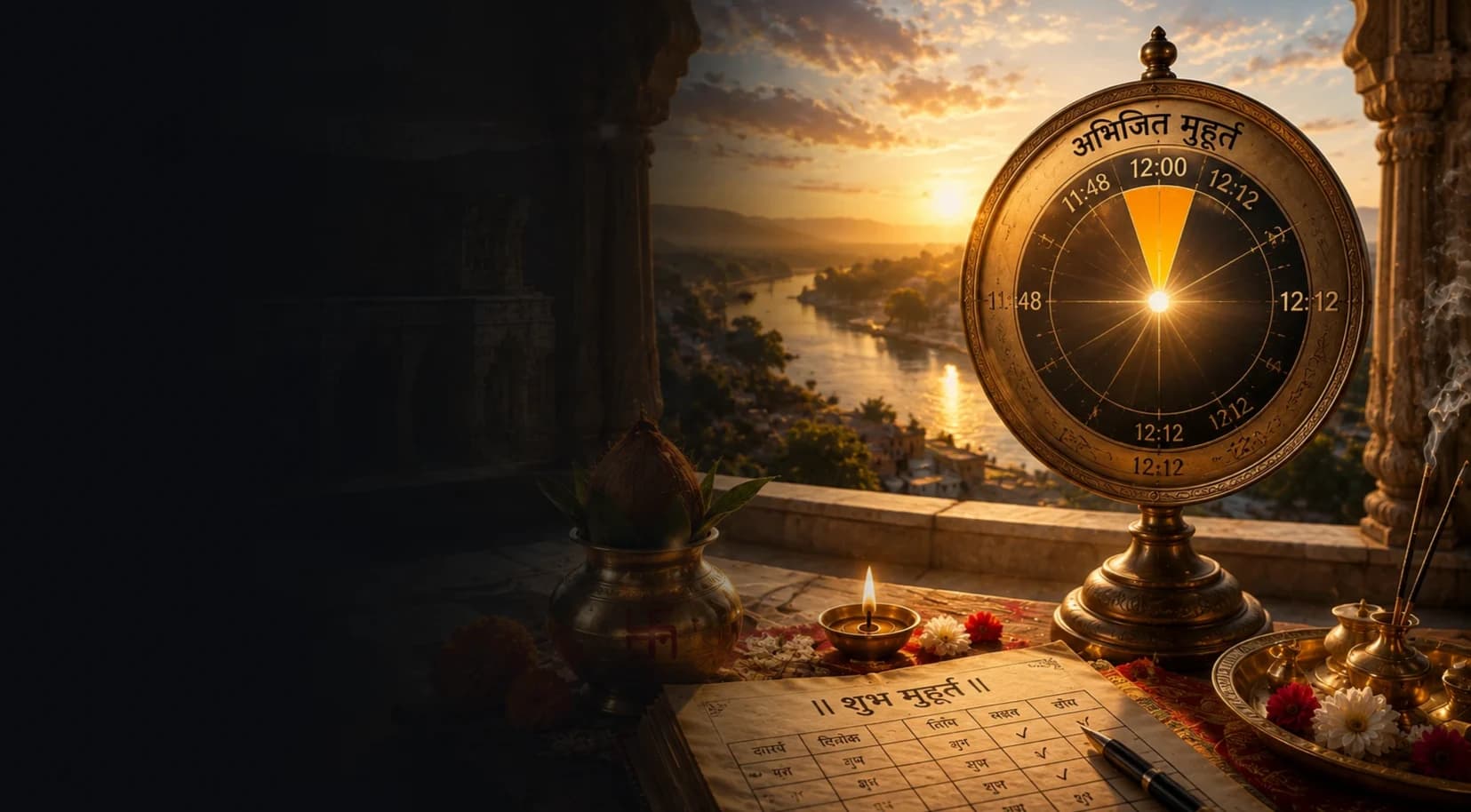
In the broadest sense, Muhurat means a chosen or favorable time for beginning an important activity. In traditional Hindu time-keeping, the word also has a more technical meaning connected with a division of time, but in common spiritual and household use, when people say “Muhurat,” they usually mean an auspicious time window selected for a specific purpose.
So if someone asks, “What is the Muhurat for marriage?” or “What is the Muhurat for Griha Pravesh?” they are really asking: What is the most supportive time to begin this event?
This is an important point. Muhurat is not just about a calendar date. It is about the quality of time chosen for a particular action.
In traditional thought, not every moment is treated as identical. Just as seasons differ, lunar days differ, weekdays differ, and planetary influences differ, certain combinations are considered more aligned with certain activities. Muhurat tries to choose a time when the larger timing factors are reasonably supportive.
This does not mean that a good Muhurat guarantees a perfect result. Nor does it mean that a less-than-ideal Muhurat destroys everything. It means that the beginning is being aligned, as far as possible, with a time believed to support the nature of the event.
The Core Idea Behind Muhurat Is That Time Has Quality
To understand Muhurat properly, it helps to understand the deeper idea behind it: time is not viewed as empty or neutral in the same way at every moment.
Traditional Indian thought often treats time as living, rhythmic, and qualified. Certain days feel better for rest, some for discipline, some for worship, some for beginnings, some for correction, and some for caution. Muhurat emerges from this larger understanding that actions do not happen in abstraction. They happen inside time, and time itself has patterns.
This is not a strange idea if you think about daily life. Even outside astrology or ritual, people already behave as though timing matters. They prefer to begin serious work when the mind is clear. They wait for a calm moment before discussing sensitive matters. They choose season, mood, readiness, and timing before important decisions. Muhurat takes this natural human instinct and places it within a sacred and traditional framework.
In simple terms, Muhurat asks: If this beginning matters, can we choose a time that is more supportive than random?
That is the heart of the practice.
Why Muhurat Matters in Hindu Tradition
In Hindu tradition, beginnings are taken seriously. Marriage is not just a social event. Entering a new home is not just a practical shift. Naming a child is not just a label. Starting a business is not only commerce. Important beginnings are often seen as sacred transitions, and Muhurat is one way of honoring that seriousness.
This is why Muhurat is often used for events such as:
- marriage
- engagement
- Griha Pravesh
- Naamkaran
- vehicle purchase
- new business opening
- Bhumi Pujan
- house construction beginnings
- major spiritual observances
The tradition does not say every tiny action in life must wait for a perfect Muhurat. Rather, it gives special importance to moments that mark the start of a meaningful new phase. The logic is simple: when a beginning carries emotional, social, karmic, or spiritual significance, it is worth starting carefully.
Muhurat therefore reflects reverence for beginnings. It is not merely a timing trick. It is a way of saying, “This matters, so let us begin with thoughtfulness.”
What Makes a Time a Shubh Muhurat?
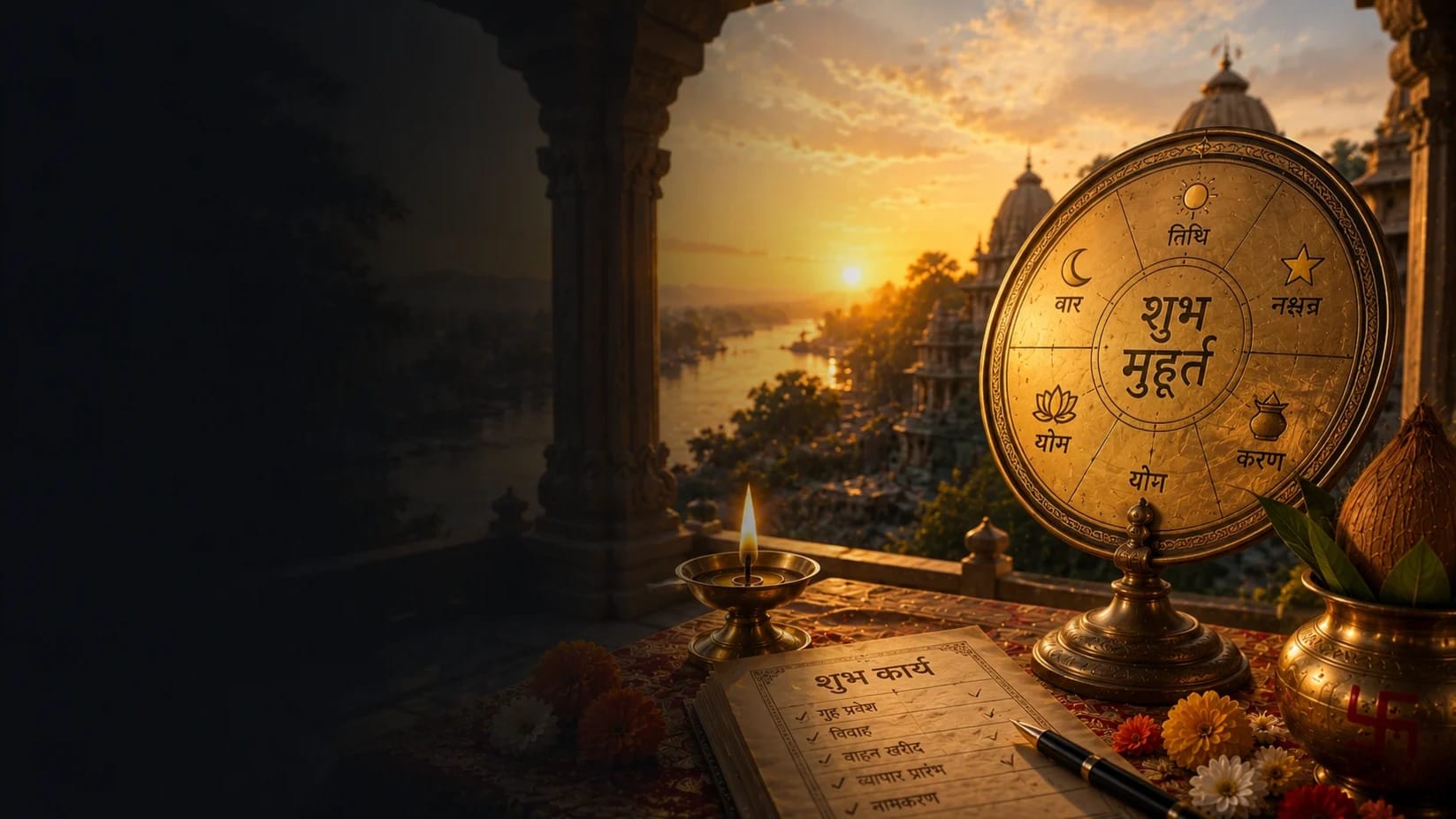
A Shubh Muhurat means an auspicious or favorable time. But what makes it favorable? The answer is not usually one single factor. Muhurat is generally chosen by looking at a combination of timing elements and seeing whether they support the nature of the event.
In traditional practice, the selected time may be judged through factors such as:
- Tithi
- Vara or weekday
- Nakshatra
- Yoga
- Karana
- the rising sign or Lagna at that time
- avoidance of certain difficult periods
- sometimes the charts of the individuals involved, depending on the event
This is why Muhurat is not simply “pick a lucky hour.” It is a structured judgment about whether the chosen time aligns reasonably well with the kind of action being undertaken.
For example, the Muhurat for marriage is not chosen exactly the same way as the Muhurat for travel, and the Muhurat for a business opening may not be identical in logic to a naming ceremony. The event matters, and the timing is chosen in relation to the event.
The Five Parts of Panchang Play a Major Role
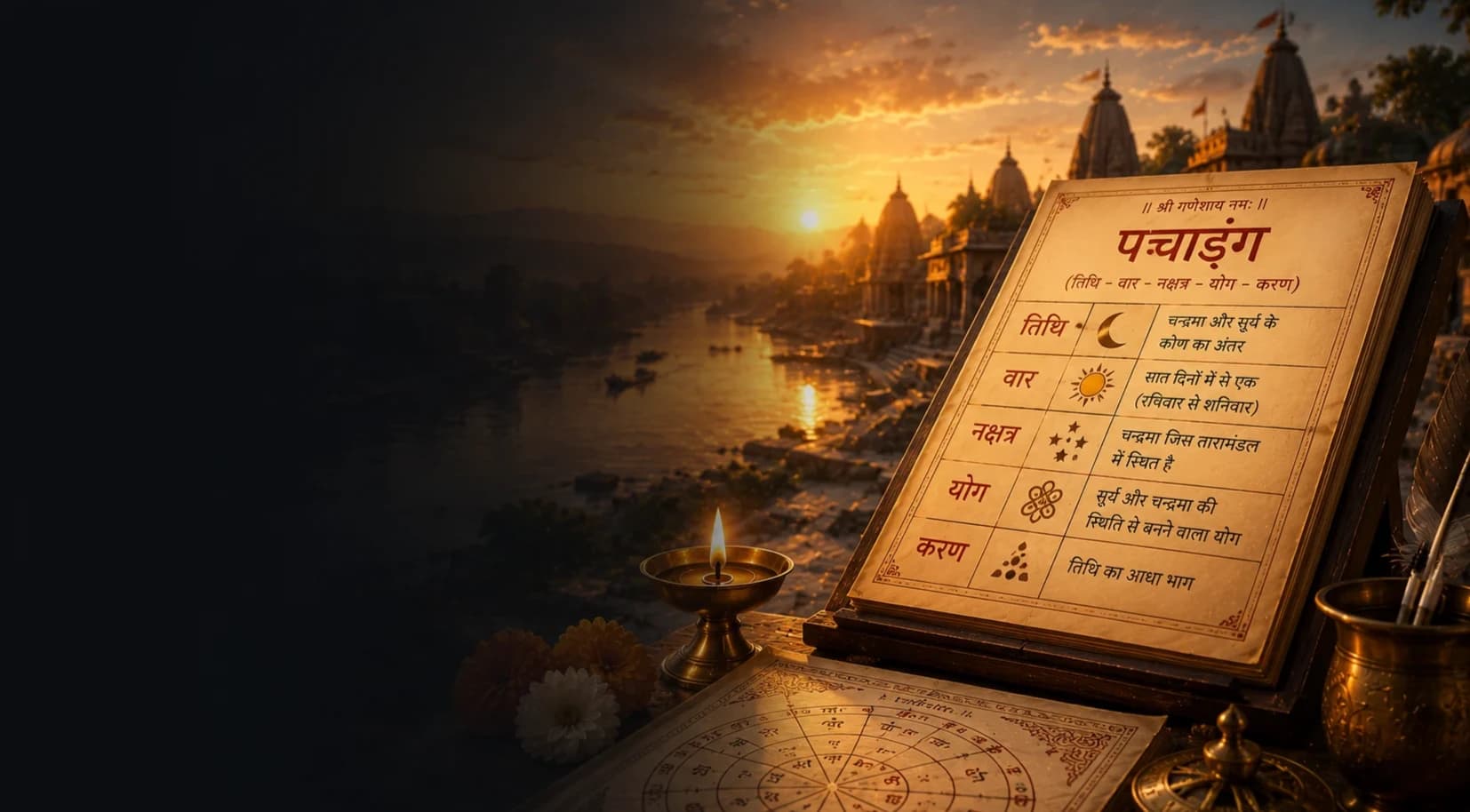
If you want to understand Muhurat, you must also understand that it is usually connected with the Panchang. Panchang literally means “five limbs,” and these five limbs are:
- Tithi
- Vara
- Nakshatra
- Yoga
- Karana
These are the core calendar factors that help describe the quality of time in traditional Hindu astrology and ritual timing.
A simple beginner’s way to understand them is this:
- Tithi describes the lunar day.
- Vara refers to the weekday.
- Nakshatra refers to the lunar constellation active at that time.
- Yoga is a specific astronomical combination with interpretive meaning.
- Karana is half of a Tithi and is also used for timing judgments.
A Muhurat is often selected by studying how these five factors come together. This is why Panchang is so central to Muhurat practice. Without Panchang, Muhurat cannot be properly understood.
Tithi: Why the Lunar Day Matters
Tithi is one of the most important parts of Muhurat. It is the lunar day, based on the angular relationship between the Sun and Moon. Different Tithis are believed to carry different qualities, and some are considered more suitable for certain activities than others.
In practical Muhurat work, some Tithis are preferred for auspicious beginnings, while others may be avoided for certain kinds of events. For example, some Tithis are considered better for celebration, some for worship, some for discipline, and some less suitable for major ceremonies.
A beginner does not need to memorize the entire system immediately. What matters first is understanding that Muhurat is not chosen randomly. The lunar day itself is treated as meaningful.
Nakshatra: Why the Moon Star Matters in Muhurat
Nakshatra is another major component of Muhurat. It refers to the lunar mansion or constellation through which the Moon is passing. In traditional astrology, Nakshatras carry distinct symbolic qualities, and these qualities are taken seriously when choosing a time.
Some Nakshatras are considered especially supportive for marriage, some for travel, some for education, some for spiritual practice, and some are treated with caution depending on the action.
Because the Moon is strongly linked with mind, rhythm, receptivity, and life movement in traditional thought, the active Nakshatra at the time of an event is treated as a major indicator of suitability.
This is one reason Muhurat is often more subtle than beginners expect. It is not enough to ask, “Is this date free?” Traditional timing asks, “What is the quality of the Moon’s placement and surrounding calendar factors at this moment?”
Weekday, Yoga, and Karana Also Matter
Along with Tithi and Nakshatra, the remaining Panchang elements also contribute to Muhurat judgment.
Vara means weekday. Different weekdays are associated with different planetary rulers and traditional qualities. This can influence whether a day is seen as more or less supportive for a specific event.
Yoga is a calculated combination based on the positions of the Sun and Moon, and it is interpreted according to traditional rules. Some Yogas are considered favorable, while others may not be preferred for certain undertakings.
Karana is half of a Tithi and also has interpretive significance in choosing time. Certain Karanas are preferred for stable beginnings, while others may be avoided depending on the nature of the action.
For a beginner, the important understanding is this: Muhurat is built from multiple timing layers. It is not a one-factor system.
Muhurat Is Not the Same for Every Event
One of the biggest beginner misunderstandings is assuming that there is one universal definition of a “good time” for everything. That is not how Muhurat works.
The best Muhurat depends on what kind of activity is being started.
For example:
- a marriage Muhurat is chosen differently from a business Muhurat
- a Griha Pravesh Muhurat is not identical in logic to a travel Muhurat
- a naming ceremony does not require the exact same timing logic as a property registration
This is because the symbolic intention of the event matters. Marriage involves relationship, union, and long-term household life. Housewarming relates to dwelling, stability, and domestic peace. Business beginnings relate to commerce, livelihood, and material movement. Each event is assessed according to its own nature.
This also explains why serious Muhurat calculation often requires more than just looking at one date in a calendar. The purpose of the event shapes the timing selection.
Why Some Time Periods Are Avoided
In Muhurat practice, choosing a favorable time is only one side of the process. The other side is avoiding certain periods that are traditionally seen as unsuitable.
This may include caution around factors such as:
- Rahu Kaal in daily timing traditions
- certain difficult Tithis for specific ceremonies
- certain Nakshatras depending on the event
- specific combinations judged unsuitable by tradition
- problematic time windows within a given day
This does not mean every “avoided” period is dangerous in a dramatic sense. It means the tradition believes those periods are less supportive for certain beginnings, especially when a more suitable time is available.
Used wisely, this is not about fear. It is about discretion.
Does Every Single Task Need a Muhurat?
This is one of the most important questions for modern readers. The honest answer is: no.
Not every action in life requires a formally chosen Muhurat. If people try to apply strict ritual timing to every small daily activity, life becomes rigid and anxious. That is not healthy, and it is not how tradition is best understood.
Muhurat matters most when the beginning is:
- symbolically important
- socially significant
- spiritually meaningful
- difficult to repeat
- connected with a major life transition
For ordinary daily functioning, many people instead use lighter timing awareness, such as checking the general suitability of the day or avoiding obviously inauspicious windows if convenient. Life is meant to be lived, not frozen under timing anxiety.
This is why wise teachers often emphasize proportion. Muhurat is guidance for important beginnings, not a system for making daily living fearful.
Muhurat Is Guidance, Not Guarantee
Another important thing beginners should understand is that Muhurat does not guarantee outcomes.
A good Muhurat does not remove the need for effort, maturity, discipline, communication, or wisdom. A marriage chosen in a fine Muhurat still requires respect and compatibility. A business started in a good Muhurat still needs planning and management. A house entered in a favorable Muhurat still requires care, peace, and right living.
In the same way, a less-than-perfect Muhurat does not automatically doom an event. The quality of action, intention, preparation, and human conduct still matters enormously.
This is why the healthiest understanding is: Muhurat supports the beginning; it does not replace the work that follows.
This one insight prevents both blind worship and total dismissal.
What Beginners Should Focus on First
If you are completely new to Muhurat, do not begin by trying to memorize every rule. Begin by understanding the main principles:
- Muhurat means a favorable time chosen for an important beginning.
- It is usually selected through Panchang factors.
- Different events require different timing logic.
- Some periods are chosen, and some are avoided.
- Muhurat is important, but it is not everything.
- Its purpose is support, not fear.
Once this foundation is clear, deeper study becomes much easier and much healthier.
Common Beginner Mistakes About Muhurat
Beginners often fall into a few common misunderstandings:
- thinking Muhurat means only “lucky time” in a vague sense
- assuming one rule applies to all events
- becoming frightened by every avoided time period
- believing a perfect Muhurat can replace preparation or responsibility
- thinking a slightly imperfect Muhurat ruins everything
- using Muhurat as a source of anxiety rather than timing wisdom
These mistakes can distort the whole subject. Muhurat should help people begin wisely, not trap them in superstition.
How to Use Muhurat Wisely in Modern Life
In modern life, people often need both practicality and tradition. This is possible, but it requires a balanced attitude.
A wise way to use Muhurat today is:
- respect it for major beginnings
- use Panchang-based timing with understanding, not blind fear
- be practical when circumstances are limited
- avoid obsession over perfect timing for every tiny action
- remember that human conduct still matters more than timing alone
This approach preserves both reverence and sanity. It allows Muhurat to remain a sacred aid instead of turning it into a source of household tension.
Final Thoughts on What Muhurat Is
So what is Muhurat? At its simplest, Muhurat is the traditional practice of choosing a supportive time for an important beginning. It reflects the belief that time carries quality, and that wise beginnings deserve thoughtful timing.
It is closely tied to the Panchang, especially Tithi, Vara, Nakshatra, Yoga, and Karana. It is used most often for important life events, not every tiny task. And it is meant to offer guidance, not fear; support, not superstition; reverence, not rigidity.
If you want the shortest possible takeaway, remember this: Muhurat is not about becoming afraid of time. It is about honoring important beginnings by choosing time more consciously.
That is the best place for a beginner to begin.
Editorial insight
Muhurat is best understood as a sacred discipline of thoughtful beginnings. Its purpose is not to frighten people into passivity, but to align important actions with a time that tradition regards as more supportive and harmonious.
- My Destiny Path Editorial Team
Real-Life Case Study
A family planning a housewarming ceremony became anxious because they had heard many conflicting opinions about which day and time would be acceptable. One relative insisted only one exact hour would work, while another dismissed Muhurat entirely. When the situation was explained more calmly, the family understood that Muhurat was not a tool for panic, but a way of choosing a reasonably supportive time for a meaningful beginning. Once they learned that the timing would be chosen through Panchang factors and that the purpose was reverence rather than fear, the entire process felt clearer and more peaceful. This is often what a proper understanding of Muhurat does: it reduces confusion and brings respectful order to important beginnings.
Key terms in this article
- Lagna
- The rising sign at birth, used as the starting point for house-based chart interpretation.
- Nakshatra
- A lunar mansion used by many Vedic timing and personality methods.
- House
- A life area in the birth chart, such as marriage, career, wealth, home, or health.
- Muhurat
- A selected time window traditionally used for beginning important activities.
Explore related tools
Today's Panchang
Tithi, Nakshatra, Yoga & Muhurats
Shubh Muhurat
Find auspicious timings for important events
Rahu Kaal
Today's inauspicious time periods
Choghadiya
Auspicious muhurat for the day
Unlock Your Complete Destiny Report
40-page personalised PDF — Dasha predictions, Yogas, remedies & life guidance