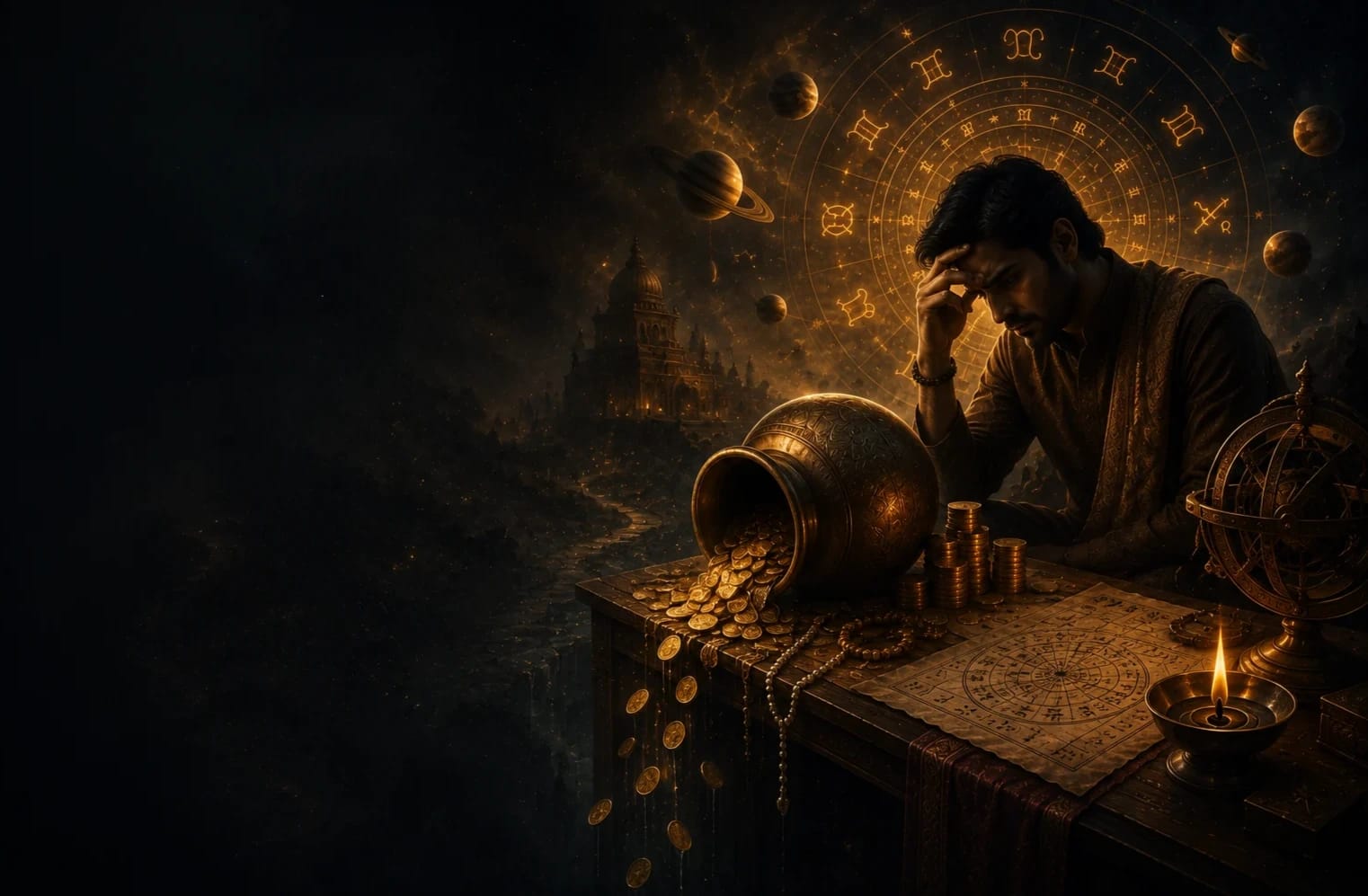


Why So Many People Say Money Comes but Never Stays
One of the most common money frustrations people describe is this: “I do earn, but money never stays in my hand.” For some, this means salary comes and disappears into expenses before the month settles. For others, it means income rises but savings do not. Some people repeatedly face sudden spending, family pressure, debt cycles, medical costs, impulsive buying, poor planning, or unstable cash flow. From the outside, it may look like they are earning enough. Yet inside their life, the feeling remains the same — money slips away too quickly.
This is a very real concern, and it is one of the places where astrology can offer useful insight if handled properly. Astrology should not be used here to create fear or fatalism. It should not tell a person that they are “doomed” to struggle financially. Rather, it should help answer a more practical question: What kind of financial pattern is operating here, and what does the chart suggest about why retention is weak?
In astrology, money staying in hand is not judged only by income. Earning and retaining are not the same thing. A person may have decent earning ability and still have weak saving ability. Another may attract money but lose it through uncontrolled desires. Another may earn well but face repeated duties, family burdens, debt, or sudden drains. Another may be financially talented but lack discipline. Another may go through a difficult period where expenses are temporarily stronger than gains.
This is why the question is not just “Will I earn?” It is also “Can I hold, manage, preserve, and stabilize what I earn?”
This guide explains how astrology looks at the problem of money not staying in hand. We will look at the houses that matter, the planetary patterns that often contribute, the difference between earning and retaining, the role of expenses and debt, and why some charts show leakage rather than accumulation.
Earning Money and Holding Money Are Two Different Things
This is the first and most important principle. In astrology, income and retention are not the same question. A chart may support earning without supporting saving. It may support gain without supporting stability. It may show multiple income channels but weak financial discipline. It may show good opportunities but repeated outflow.
This is why people sometimes get confused. They may have a good eleventh house and still complain that money does not remain. Or they may have strong professional promise and still live with constant cash stress. The reason is simple: income comes from one set of dynamics, but retention depends on several other factors as well.
A complete financial reading therefore asks several separate questions:
- How does money come?
- How stable is the earning pattern?
- Can the person save?
- Is there repeated leakage?
- Are expenses functional, emotional, karmic, or impulsive?
- Is money being lost through duty, desire, debt, confusion, or instability?
Once this difference is understood, the chart becomes much easier to read accurately.
The Second House Is One of the Most Important Houses for Money Retention
The second house is one of the first houses astrologers examine when asking why money does not stay in hand. This house is linked with accumulated wealth, stored resources, financial foundation, family assets, speech, values, and the ability to hold what one has earned.
If income is like water entering a vessel, the second house helps show the quality of the vessel itself. Can it hold? Does it preserve? Is there stability in the way money is handled? Is the financial foundation disciplined and structured, or loose and vulnerable?
A damaged or unstable second house, its afflicted lord, or difficult influences on this area may indicate challenges in saving, inconsistency in financial holding, family-related financial pressure, poor value management, or a tendency for earnings to disperse instead of consolidating.
This does not automatically mean lifelong poverty. It means the chart may need stronger financial structure, planning, and conscious handling in order for money to remain.
The Eleventh House Shows Gains but Not Always Retention
The eleventh house is the house of gains, incoming results, material fulfillment, networks, and achievement of desires. It often helps show how money comes in, how gains expand, and whether a person has access to profitable circles, opportunities, or income channels.
But this is exactly where many people misunderstand astrology. A strong eleventh house can show good inflow, but that does not guarantee that the money will stay. Gains can be high while savings remain low.
This is why a person may earn more than expected and still feel financially unstable. If the second house is weak, or the twelfth house is excessively strong, or the chart shows impulsive outflow, desire-driven spending, debt, obligations, or lack of planning, then gains may not accumulate.
So the eleventh house answers part of the money question — but not all of it.
The Twelfth House Often Shows Where Money Leaks Out
The twelfth house is one of the most important places to study when money seems to disappear. It is associated with expenditure, loss, letting go, withdrawal, hidden drains, sleep, foreign spending, spiritual giving, isolation, and all kinds of outflow.
This does not mean the twelfth house is “bad.” Some twelfth-house spending is meaningful, necessary, charitable, or spiritually valuable. But when a person says money never stays, astrologers almost always examine the twelfth house carefully.
A very active twelfth house may indicate:
- constant expenses
- poor expense control
- unseen drains
- lifestyle leakage
- money leaving through emotional relief or escapism
- financial outflow toward travel, comfort, isolation, or loss
If this house is heavily activated without enough balancing support from retention factors, the person may feel that money keeps slipping away no matter how much they try to improve things.
The Sixth House Can Show Debt, Loans, and Financial Pressure
The sixth house is deeply connected with debt, repayment, financial stress through obligation, conflict-related spending, competition, and the burdens of practical life. When money does not stay in hand, the sixth house often becomes relevant because sometimes the issue is not overspending for pleasure — it is financial pressure through responsibility.
A person may be paying:
- old debt
- loan installments
- medical bills
- legal obligations
- family burdens
- constant problem-solving expenses
In such charts, money disappears not because the person is careless, but because life repeatedly demands repair, management, settlement, or service.
This distinction matters. Astrology should not blame a person for “bad money handling” when the actual chart shows heavy duty-bound expenditure.
The Eighth House Can Bring Sudden Financial Shocks or Unpredictable Expenses
The eighth house is often associated with sudden events, hidden matters, instability, crisis, inheritance, shared assets, transformation, and unexpected disruptions. In financial matters, it can sometimes indicate periods where money does not stay because life brings sudden interruptions, emergencies, or sharp turns.
This may appear as:
- sudden repairs
- family emergencies
- unexpected financial reversals
- unstable shared money situations
- insurance, inheritance, or tax complications
- repeated unpredictable expenses
When the eighth house is strongly involved in the money story, the person may feel that financial planning keeps getting disturbed by factors beyond ordinary routine control. The issue is less about daily discipline and more about irregular disruption.
The Condition of the Second Lord Often Tells a Big Part of the Story
In Vedic astrology, it is never enough to look only at the house. The lord of the second house often tells a major part of the money-retention story.
If the second lord is strong, supported, and well placed, the person may have better ability to organize, preserve, and consolidate wealth — even if income is not spectacular. If the second lord is weak, afflicted, combust, trapped in difficult houses, or heavily pressured by unstable combinations, the person may find it harder to hold what they earn.
The second lord can show:
- how money is managed
- whether saving becomes natural or difficult
- whether financial choices support stability
- whether wealth is preserved or scattered
Many financial questions become clearer the moment the second lord is judged properly.
The Eleventh Lord May Show Income While the Twelfth Lord Shows Outflow Patterns
The condition of the eleventh lord helps show gains, while the twelfth lord often reveals the pattern of expenses, losses, or outflow. When these are compared carefully, a clearer financial picture emerges.
A strong eleventh lord with a difficult twelfth lord may show good earning but unstable retention. A damaged eleventh lord and aggressive twelfth pattern may show financial struggle from both sides. A balanced eleventh and moderate twelfth can support both gains and manageability.
Astrology becomes more useful here when it stops asking one vague question about “money” and instead asks multiple specific questions: income, retention, obligation, leakage, crisis, desire, and financial habits.
Venus Can Influence Lifestyle Spending, Comfort Seeking, and Pleasure-Based Outflow
Venus is not a money planet in a narrow sense, but it has a strong role in how a person relates to comfort, enjoyment, aesthetics, luxury, pleasure, and emotional sweetness. When money does not stay, Venus sometimes becomes relevant because spending is not always practical — sometimes it is about lifestyle, taste, attraction, or emotional soothing.
An imbalanced Venus may show:
- overspending on comfort
- beauty and appearance-related spending
- relationship-driven expenses
- luxury temptation
- using money to create emotional ease
This does not mean Venus is a “bad” planet. It means that financial leakage may sometimes come through the search for pleasure, softness, sweetness, or image-maintenance rather than direct financial weakness.
Jupiter Can Give Generosity but Sometimes Too Much Financial Looseness
Jupiter is often associated with blessings, wisdom, wealth potential, and expansion. But it can also, in some charts, create a certain kind of financial looseness when generosity, optimism, overtrust, or careless expansion becomes excessive.
A person under poorly managed Jupiter influence may:
- give too much
- assume money will always come again
- make large hopeful decisions without structure
- underestimate the importance of limits
In such cases, the issue is not lack of earning ability. It is lack of boundary around expansion and faith. This is why even apparently “good” planets can contribute to money not staying if their energy is not balanced.
Mercury Can Show Financial Intelligence or Financial Carelessness
Mercury is deeply connected with calculation, analysis, trade, practical reasoning, budgeting logic, and financial decision-making. A strong Mercury often helps a person think clearly about transactions, evaluate options, compare costs, and adjust intelligently.
A weak or disturbed Mercury, on the other hand, may contribute to:
- poor financial planning
- confused budgeting
- bad calculation
- short-term thinking
- inconsistent money decisions
Sometimes money does not stay simply because the earning potential is greater than the management intelligence. This is where Mercury becomes very important.
Rahu Can Create Constant Hunger, Image Spending, or More-and-More Thinking
Rahu often becomes relevant in charts where the person earns, spends, desires, upgrades, and still feels unsatisfied. Rahu is the planet of appetite, obsession, social comparison, ambition, and restless expansion.
When Rahu is involved in the money story, the problem may not be shortage alone. It may be insatiability. The person may feel that what they have is never enough. They may chase status, image, speed, lifestyle upgrades, or the feeling of being ahead. This can make money disappear quickly even when income is decent.
Rahu can also create impulsive decisions, speculative risks, or attraction toward glamorous but unstable financial behavior. In such charts, money does not stay because desire keeps outrunning containment.
Saturn Often Shows the Power of Financial Discipline and Retention
Saturn is one of the key planets when asking whether money can stay in hand. Saturn represents restraint, discipline, realism, austerity, patience, long-term thinking, and responsible structure. A healthy Saturn often helps build what many people lack: financial containment.
When Saturn functions well, a person may be cautious, measured, slower to spend, more aware of consequences, and capable of building over time. When Saturn is weak, feared, or psychologically distorted, the person may swing between scarcity fear and poor stability.
In many charts, money begins to stay not because income suddenly rises, but because Saturn-like discipline becomes stronger.
Sometimes Money Does Not Stay Because Family Duty Is Taking It
Not every financial leakage is selfish spending. In many charts, money does not stay because the person is carrying family obligations, household instability, elder care, sibling burdens, medical support, education costs, or repeated duty-based outflow.
This is why second-house, fourth-house, sixth-house, and even ninth-house patterns must sometimes be read together. A person may not be financially careless at all. They may simply be the one holding the family weight.
This matters deeply in interpretation. Astrology should help distinguish between:
- carelessness
- compulsion
- duty
- desire
- crisis
- mismanagement
Without this distinction, financial astrology becomes judgmental instead of helpful.
Timing Matters Because Money Leakage May Be Permanent or Period-Specific
Another important truth is that not every money problem is a lifelong condition. Sometimes a person goes through a period where expenses are unusually strong because of Dasha activation, difficult transits, family events, illness, relocation, business setup, debt clearing, or karmic obligation.
This means the question must also be asked: Is this a structural pattern, or is this a phase?
A difficult money period under a certain Dasha does not always mean permanent inability to retain wealth. Some people stabilize financially after a specific planetary period changes. Others only begin saving once debt cycles end. Others improve after emotional or lifestyle-based spending reduces.
Timing helps prevent unnecessary fear. Sometimes the chart does not say “You can never hold money.” It says “This period is draining, but not forever.”
Common Mistakes People Make When Reading Money Problems in Astrology
There are several common mistakes people make when trying to understand why money does not stay:
- looking only at income and not retention
- assuming a strong eleventh house solves everything
- ignoring the twelfth house
- ignoring debt and duty-based spending
- judging every expense as carelessness
- confusing wealth potential with present liquidity
- not checking whether the pattern is temporary or structural
- reducing everything to one “bad” planet
A careful reading avoids these shortcuts. Financial difficulty is often more layered than it first appears.
A Simple Beginner Checklist for Why Money May Not Stay
If you want a simple way to begin, check the following:
- What is the condition of the second house and its lord?
- What does the eleventh house show about gains?
- Is the twelfth house unusually active or stressed?
- Is the sixth house showing debt or obligation pressure?
- Is the eighth house contributing sudden expense or instability?
- Are Venus, Jupiter, Mercury, Rahu, or Saturn playing a major role?
- Does the person spend emotionally, impulsively, dutifully, or structurally?
- Is this pattern lifelong or linked to a current Dasha?
These questions already take the reading to a much more mature level.
What a Beginner Should Remember Most About Money Not Staying
If you are new to this subject, remember these points:
- Income and retention are not the same thing.
- A person may earn well and still struggle to save.
- The second, eleventh, twelfth, sixth, and eighth houses are especially important.
- Money loss may come from desire, carelessness, duty, debt, crisis, or timing.
- The goal of astrology is diagnosis and awareness, not shame or fear.
This level of clarity alone can make the subject much more useful.
Final Thoughts on Why Money Does Not Stay in Hand
So why does money not stay in hand? Astrology usually answers this by separating earning from retention, and then examining the houses and planets that govern savings, gains, expenses, debt, sudden disruptions, and financial behavior. The second house shows holding power. The eleventh shows gains. The twelfth shows outflow. The sixth may show debt or obligation. The eighth may show disruption. The relevant planets reveal whether the issue lies in desire, generosity, poor planning, crisis, or lack of discipline.
The most important thing to understand is that this question is not meant to produce fear. It is meant to produce clarity. Once the pattern is seen more accurately, practical correction becomes much easier.
If you want the shortest takeaway, remember this: money often does not stay in hand not because earning is absent, but because retention, discipline, timing, or outflow management is weaker than inflow.
That is the right place to begin the real conversation.
Editorial insight
Financial astrology becomes truly useful when it stops asking only, “Will money come?” and starts asking, “Will money stay, and if not, where is it going?” That shift alone makes the interpretation far more practical and honest.
- My Destiny Path Editorial Team
Real-Life Case Study
A woman once believed she had a “bad money chart” because despite earning consistently, she never built savings. A closer reading showed a different story. Her income pattern was actually reasonable, but a pressured second house, an active twelfth house, and repeated family-duty expenses were draining her resources. On top of that, a Venus-Rahu style of emotional relief spending made things worse during stressful periods. The problem was not that she could not earn. The problem was that her inflow was being defeated by obligation plus leakage. Once this was understood, her financial choices became more structured and the pattern began to improve. This is why astrology is most valuable when it helps separate emotional confusion from the actual pattern.
Key terms in this article
- Dasha
- A planetary period used in Vedic astrology to understand life chapters and timing themes.
- Transit
- The current movement of planets and how those movements interact with a birth chart.
- House
- A life area in the birth chart, such as marriage, career, wealth, home, or health.