

Quick Answer: What Are the 9 Grahas?
The 9 Grahas in Vedic astrology are Sun, Moon, Mars, Mercury, Jupiter, Venus, Saturn, Rahu, and Ketu. Graha means a planetary influence that shapes chart interpretation through signs, houses, aspects, conjunctions, dignity, and Dasha periods.
9 Grahas and Their Basic Meanings
Graha Common meaning Chart areas often reviewed
Sun / Surya
Soul, authority, vitality, father
Confidence, leadership, status
Moon / Chandra
Mind, emotions, mother, comfort
Mood, memory, emotional security
Mars / Mangal
Energy, courage, action, conflict
Drive, competition, property, siblings
Mercury / Budh
Speech, logic, commerce, learning
Communication, business, analysis
Jupiter / Guru
Wisdom, guidance, growth, children
Knowledge, faith, expansion, teachers
Venus / Shukra
Love, beauty, comfort, art
Relationships, luxury, harmony, creativity
Saturn / Shani
Discipline, delay, duty, endurance
Work, responsibility, karma, maturity
Rahu
Desire, obsession, foreign or unusual paths
Ambition, disruption, unconventional growth
Ketu
Detachment, past karma, spiritual insight
Release, intuition, isolation, moksha themes
Frequently Asked Questions
Are Rahu and Ketu planets?
Rahu and Ketu are not physical planets. They are lunar nodes, but Vedic astrology treats them as Grahas because their influence is important in chart reading.
Which Graha is strongest in a Kundali?
There is no universal strongest Graha. Strength depends on sign dignity, house placement, aspects, conjunctions, Shadbala, and the running Dasha.
Can one Graha decide everything?
No. A serious reading combines Grahas with signs, houses, Lagna, Moon, divisional charts, Dasha, and transits.
Why the 9 Grahas Are One of the First Things Every Astrology Reader Hears About
If you spend even a little time around Vedic astrology, one phrase appears again and again: the 9 Grahas. Whether someone is discussing a birth chart, a Mahadasha, a transit, a dosha, a remedy, or a life pattern, the Grahas keep appearing at the center of the discussion. This is because Vedic astrology is not only a system of signs and houses. It is also deeply a system of planetary intelligence.
When people first hear the word “Graha,” they often assume it simply means planet in the modern astronomical sense. That is only partly true. In Vedic astrology, Grahas are not understood merely as physical celestial bodies floating in space. They are also symbolic and karmic forces that shape how life is experienced. They indicate tendencies, drives, strengths, pressures, opportunities, desires, fears, lessons, and patterns of growth.
This is why anyone trying to understand Vedic astrology must eventually understand the Grahas. Without them, a Kundali becomes a static diagram. With them, the chart becomes alive.
For beginners, the topic may feel overwhelming. There are nine Grahas, each with many layers of meaning. The Sun is not just the Sun. The Moon is not just emotion. Saturn is not just delay. Rahu is not just fear. Each Graha has spiritual, psychological, karmic, and practical meanings. But once you understand the basic nature of each Graha, the whole language of Vedic astrology becomes much easier to follow.
This guide explains the 9 Grahas in clear beginner-friendly language. We will look at what the word Graha means, why these nine are so important, what each Graha represents in life, and how a reader should begin understanding them without fear or oversimplification.
What the Word Graha Actually Means
The word Graha is often translated as “planet,” but its deeper meaning is richer than that. In Sanskrit, the idea behind the word carries the sense of that which seizes, influences, or takes hold. This is a powerful clue to how Vedic astrology sees Grahas.
A Graha is not only a celestial reference point. It is also a force that “grasps” the field of life in some way. It influences the mind, behavior, circumstances, timing, inclinations, and karmic expression of a person.
This is why Grahas are treated as living principles in astrology. They are not just objects to be measured. They are carriers of meaning.
So when someone says a Graha is strong, weak, afflicted, exalted, retrograde, combust, or benefic in a particular chart, they are speaking about more than astronomy. They are speaking about how a certain life-force is functioning in the life of the native.
Why There Are 9 Grahas and Not Just Physical Planets
One of the first questions beginners ask is: if astrology is about planets, why does Vedic astrology count nine Grahas, including Rahu and Ketu, which are not physical planets in the usual modern sense?
The answer is simple: Vedic astrology is not limited to modern astronomical categories. It uses the nine Grahas because these nine are treated as the most important karmic and interpretive influences in the traditional system.
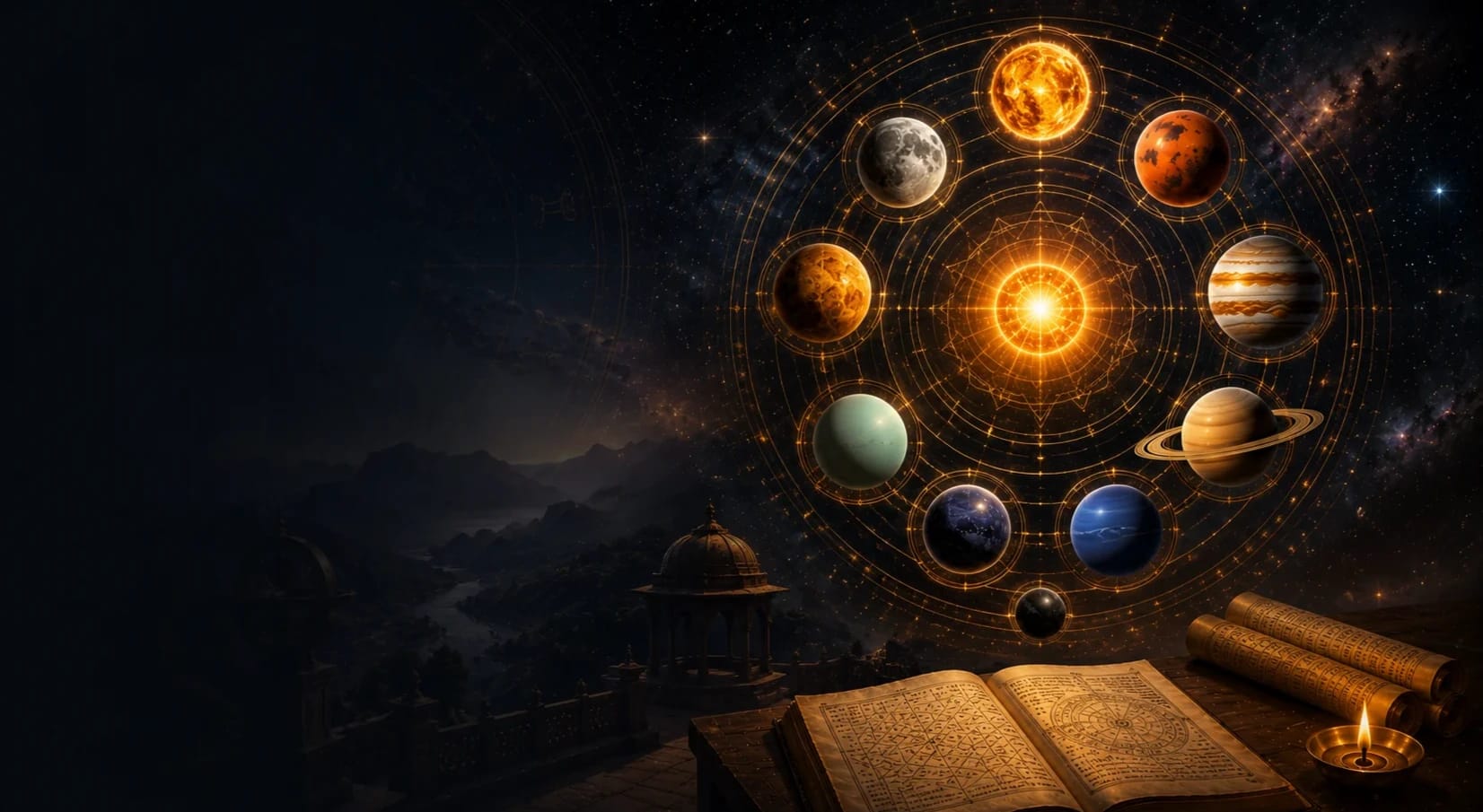
The 9 Grahas are:
- Sun
- Moon
- Mars
- Mercury
- Jupiter
- Venus
- Saturn
- Rahu
- Ketu
Rahu and Ketu are lunar nodes, not visible planets in the ordinary sense. But in Vedic astrology they are extremely important because they describe major karmic themes involving desire, attachment, obsession, separation, spiritualization, and unusual life experiences.
This is why the 9 Grahas are understood functionally, not only physically.
Why the Grahas Are So Important in a Kundali
The Grahas are central because they are the active forces moving through the chart. Signs give context. Houses show life areas. But Grahas are the ones that do things. They occupy houses, rule signs, cast aspects, combine with one another, run Dashas, transit through the zodiac, and trigger actual experiences in life.
This is why a chart cannot be understood properly by houses and signs alone. Two people may have the same house emphasis in broad terms, but their lives can unfold very differently depending on which Grahas are involved, how strong those Grahas are, where they sit, what they rule, and what kinds of relationships they form.
Grahas help answer questions like:
- What kind of mind does this person have?
- Where does confidence come from or weaken?
- How does the person act under pressure?
- What kind of relationship patterns repeat?
- Where does discipline come from?
- What kind of desires dominate life?
- Where is wisdom, confusion, love, ambition, fear, or detachment strongest?
In short, Grahas bring movement, personality, and karma into the chart.
The Sun in Vedic Astrology: Identity, Authority, and Inner Radiance
The Sun, or Surya, is one of the most important Grahas in Vedic astrology. It represents identity, self-respect, vitality, confidence, authority, leadership, purpose, and the inner sense of “I am.” It is often linked with father, status, dignity, and the power to stand in one’s own light.
When the Sun is functioning well, a person may show healthy confidence, clarity of direction, and natural authority. When it is weak or troubled, issues around recognition, self-worth, ego imbalance, or authority may become more visible.
The Sun is not simply about pride. At a deeper level, it shows the strength of the core self. It reveals how firmly a person stands in their own being.
The Moon in Vedic Astrology: Mind, Emotions, and Inner Security
The Moon, or Chandra, is the Graha most closely associated with the mind in Vedic astrology. It represents emotional life, sensitivity, perception, daily mood, memory, comfort, nourishment, receptivity, and the ability to feel safe inside oneself.
If the Sun shows the core identity, the Moon shows how that life is emotionally lived. It reveals what calms a person, what unsettles them, how they respond instinctively, and what kind of emotional rhythm supports them.
A strong Moon often supports steadiness, adaptability, empathy, and emotional intelligence. A disturbed Moon may bring inner restlessness, emotional inconsistency, oversensitivity, anxiety, or difficulty feeling grounded.
This is why the Moon is so central in chart interpretation. Many daily life patterns are Moon patterns before they are anything else.
Mars in Vedic Astrology: Action, Courage, and Raw Energy
Mars, or Mangal, represents action, force, initiative, courage, aggression, drive, protection, competition, and physical energy. It is the Graha of doing, confronting, pushing, fighting, and asserting.
Mars can be highly constructive when disciplined. It gives bravery, decisiveness, endurance, and the ability to take action under pressure. But when it becomes unbalanced, it may express as anger, rashness, impatience, conflict, injury-proneness, or combative behavior.
This is why Mars is not “bad.” It is intense. Whether that intensity becomes courage or destruction depends on the larger chart and the maturity of expression.
Mercury in Vedic Astrology: Intelligence, Speech, and Adaptability
Mercury, or Budha, governs intellect, speech, learning, analysis, communication, business skill, wit, adaptability, and practical thinking. It is the Graha of interpretation and exchange.
Where Mercury is strong, people may show cleverness, quick learning, verbal skill, humor, adaptability, and commercial intelligence. Where Mercury is weak or troubled, there may be confusion, inconsistency in communication, overthinking, misjudgment, or unstable reasoning.
Mercury is very important in modern life because so much of contemporary living depends on communication, data, trade, messaging, and mental agility.
Jupiter in Vedic Astrology: Wisdom, Growth, and Dharma
Jupiter, or Guru/Brihaspati, is the Graha of wisdom, expansion, faith, ethics, grace, teaching, blessings, counsel, and higher meaning. It is often called the great benefic in traditional astrology.
Jupiter shows where a person may grow through knowledge, guidance, principle, generosity, and perspective. It is linked with dharma, children, learning, spiritual direction, hope, and wholesome expansion.
A strong Jupiter can bring wisdom, optimism, sound judgment, spiritual inclination, and support from teachers or good counsel. A weakened Jupiter may show poor judgment, misplaced faith, confusion in values, or lack of ethical clarity.
Jupiter is one of the most nourishing Grahas when functioning well, because it helps life grow in the right direction rather than merely in a bigger direction.
Venus in Vedic Astrology: Love, Comfort, and Refinement
Venus, or Shukra, governs love, pleasure, beauty, harmony, sensual enjoyment, attraction, comfort, art, refinement, luxury, and relational sweetness. It is closely linked with relationship experience, aesthetics, enjoyment, and worldly enjoyments.
When Venus is balanced, it supports appreciation, affection, artistic sense, grace, relationship harmony, and healthy enjoyment of life. When troubled, it may lead to overindulgence, attachment to pleasure, unstable relationship patterns, vanity, or misdirected desire.
Venus is not only about romance. It also tells us how a person receives comfort, what they enjoy, how they form attraction, and how they relate to beauty and pleasure in the world.
Saturn in Vedic Astrology: Karma, Discipline, and Maturity
Saturn, or Shani, is one of the most misunderstood Grahas. It represents karma, discipline, endurance, pressure, labor, realism, structure, delay, fear, responsibility, and long-term maturation.
People often fear Saturn because it is associated with difficulty, slowness, and accountability. But Saturn is not merely a planet of punishment. It is also the Graha that teaches seriousness, patience, humility, perseverance, and grounded strength.
A strong Saturn may give discipline, resilience, realism, responsibility, and deep maturity. A troubled Saturn may bring fear, heaviness, delay, frustration, loneliness, or chronic pressure. Yet even then, Saturn often teaches through necessity what other Grahas may not teach at all.
Saturn’s lessons are rarely superficial. That is why its influence can feel heavy, but also deeply transformative.
Rahu in Vedic Astrology: Desire, Ambition, and Unfinished Hunger
Rahu is one of the lunar nodes and one of the most fascinating Grahas in Vedic astrology. It represents desire, obsession, worldly ambition, unconventionality, confusion, illusion, foreignness, hunger, amplification, and restless seeking.
Rahu tends to magnify whatever it touches. It often creates fascination, urgency, and dissatisfaction. It pushes a person toward experience, intensity, novelty, risk, and worldly involvement. In modern life, Rahu is especially relevant because many contemporary patterns — image obsession, ambition, speed, technology fixation, and social climbing — have a strong Rahu flavor.
Rahu can bring breakthrough, daring, unusual success, and boundary-crossing intelligence. But it can also bring illusion, anxiety, overreach, addictive desire, or obsession without contentment.
Rahu is powerful not because it is “evil,” but because it is hungry.
Ketu in Vedic Astrology: Detachment, Loss, and Spiritual Depth
Ketu, the other lunar node, is often understood as the counterpart to Rahu. Where Rahu moves toward craving and worldly hunger, Ketu tends toward detachment, separation, past-life residue, spiritualization, inwardness, and disinterest in external reward.
Ketu can create unusual insight, intuition, non-attachment, mystical depth, and freedom from superficiality. But it can also bring confusion, fragmentation, isolation, disconnection, lack of worldly motivation, or sudden experiences of severance.
Ketu is frequently misunderstood because people focus only on its difficult side. But Ketu is also the Graha that can break illusion, reduce ego fixation, and push consciousness toward deeper truth.
It is not always comfortable, but it is often spiritually significant.
Are the 9 Grahas Good or Bad?
Beginners often ask whether certain Grahas are good and others are bad. This question is understandable, but it is also too simple.
In Vedic astrology, some Grahas are traditionally classed as natural benefics and some as natural malefics. But even that is not the whole story. A Graha’s actual effect depends on many things:
- its sign placement
- its house placement
- its dignity
- its aspects
- its conjunctions
- its lordship in the chart
- the Dasha running
- the maturity and life context of the person
This is why Saturn is not always “bad,” and Jupiter is not always “easy.” Mars is not always destructive. Venus is not always beneficial in a simple sense. Rahu is not always ruinous, and Ketu is not always negative.
A wise reader learns to stop asking, “Which Graha is good?” and start asking, “How is this Graha functioning in this chart?”
How the Grahas Work Together in Real Life
Another important beginner insight is that the Grahas do not operate in isolation. Real life is not just Sun life, Moon life, or Saturn life. Human experience is shaped by combinations.
For example:
- Sun and Saturn may create tension between authority and pressure.
- Moon and Rahu may amplify emotional restlessness.
- Mercury and Jupiter may influence intellect in very different ways.
- Venus and Mars together may intensify attraction, desire, or passion.
- Ketu with the Moon may shift emotional life toward withdrawal or unusual sensitivity.
This is why Graha interpretation becomes deeper with study. Each Graha has its own meaning, but those meanings are modified by relationship, placement, strength, and timing.
The beginner should first learn the core nature of each Graha. That is the foundation. Nuance can come afterward.
What a Beginner Should Remember First About the 9 Grahas
If you are new to this subject, the most useful things to remember are these:
- The 9 Grahas are the main planetary forces used in Vedic astrology.
- They are not only astronomical markers but karmic and psychological influences.
- Each Graha represents a different kind of life energy.
- They become meaningful through sign, house, dignity, relationship, and timing.
- They should not be judged through fear or oversimplified good-versus-bad thinking.
With just this much understanding, you already have a strong beginning.
Final Thoughts on What the 9 Grahas Are
So what are the 9 Grahas in Vedic astrology? They are the nine principal planetary influences through which the tradition interprets personality, karma, timing, emotion, desire, discipline, intelligence, growth, pleasure, and spiritual movement.
They are the Sun, Moon, Mars, Mercury, Jupiter, Venus, Saturn, Rahu, and Ketu. Each represents a distinct force in life, and together they form one of the most essential foundations of chart interpretation.
If you want the shortest takeaway, remember this: the 9 Grahas are not just planets to be named — they are the core living forces through which a Kundali speaks.
That is why learning them is one of the best first steps for anyone entering Vedic astrology.
Frequently asked questions
Are Rahu and Ketu physical planets?
No. They are the lunar nodes, mathematical points used in chart and eclipse interpretation.
Is any Graha always good or always bad?
No. A Graha's expression depends on its chart role, placement, strength, relationships, and the question being studied.
Jyotish basics and related reading
- What is Vedic astrology?
- The three pillars: planets, signs, and houses
- The 12 houses in a birth chart
- What is the Ascendant or Lagna?
- Understanding the structure of a birth chart before exploring timing, compatibility, or reports.
- A Vedic birth chart with planetary positions, houses, signs, and interpretive sections.
Astrology guidance is interpretive, not deterministic. Outcomes also depend on choices, circumstances, and context.
Last updated:
Editorial insight
The Grahas should not be understood merely as bodies in the sky. In Vedic astrology, they are carriers of karma, temperament, desire, discipline, wisdom, and experience. To understand the Grahas is to begin understanding how a chart actually lives and breathes.
- My Destiny Path Editorial Team
Real-Life Case Study
A beginner once looked at a chart and assumed that houses and signs alone would explain everything important. But the chart felt flat and confusing until the Grahas were properly examined. Once the Sun was understood as the indicator of identity, the Moon as the mind, Saturn as karmic pressure, and Rahu as restless ambition, the chart suddenly became readable. The person’s emotional instability, career anxiety, need for recognition, and repeated attraction toward intense situations all began to make sense. This is often what happens when the 9 Grahas are learned properly: the chart stops being a diagram and starts becoming a living story.
Key terms in this article
- Dasha
- A planetary period used in Vedic astrology to understand life chapters and timing themes.
- Transit
- The current movement of planets and how those movements interact with a birth chart.
- Lagna
- The rising sign at birth, used as the starting point for house-based chart interpretation.
- House
- A life area in the birth chart, such as marriage, career, wealth, home, or health.
Explore related tools
Free Kundali
Generate your Vedic birth chart
Today's Panchang
Tithi, Nakshatra, Yoga & Muhurats
Kundali Matching
Check marriage compatibility
Western Natal Chart
Tropical birth chart · Placidus houses
Unlock Your Complete Destiny Report
40-page personalised PDF — Dasha predictions, Yogas, remedies & life guidance