

Why the Main Door Gets So Much Attention in Vastu
When people start learning Vastu Shastra, one of the first things they hear is that the main door matters a lot. This is why buyers often ask about entrance direction before buying a flat, families ask about the main gate before constructing a house, and consultants are frequently called just to comment on whether the entrance is “good” or “bad.” In many cases, the entire conversation about a property begins and ends with one question: Which direction does the main door face?
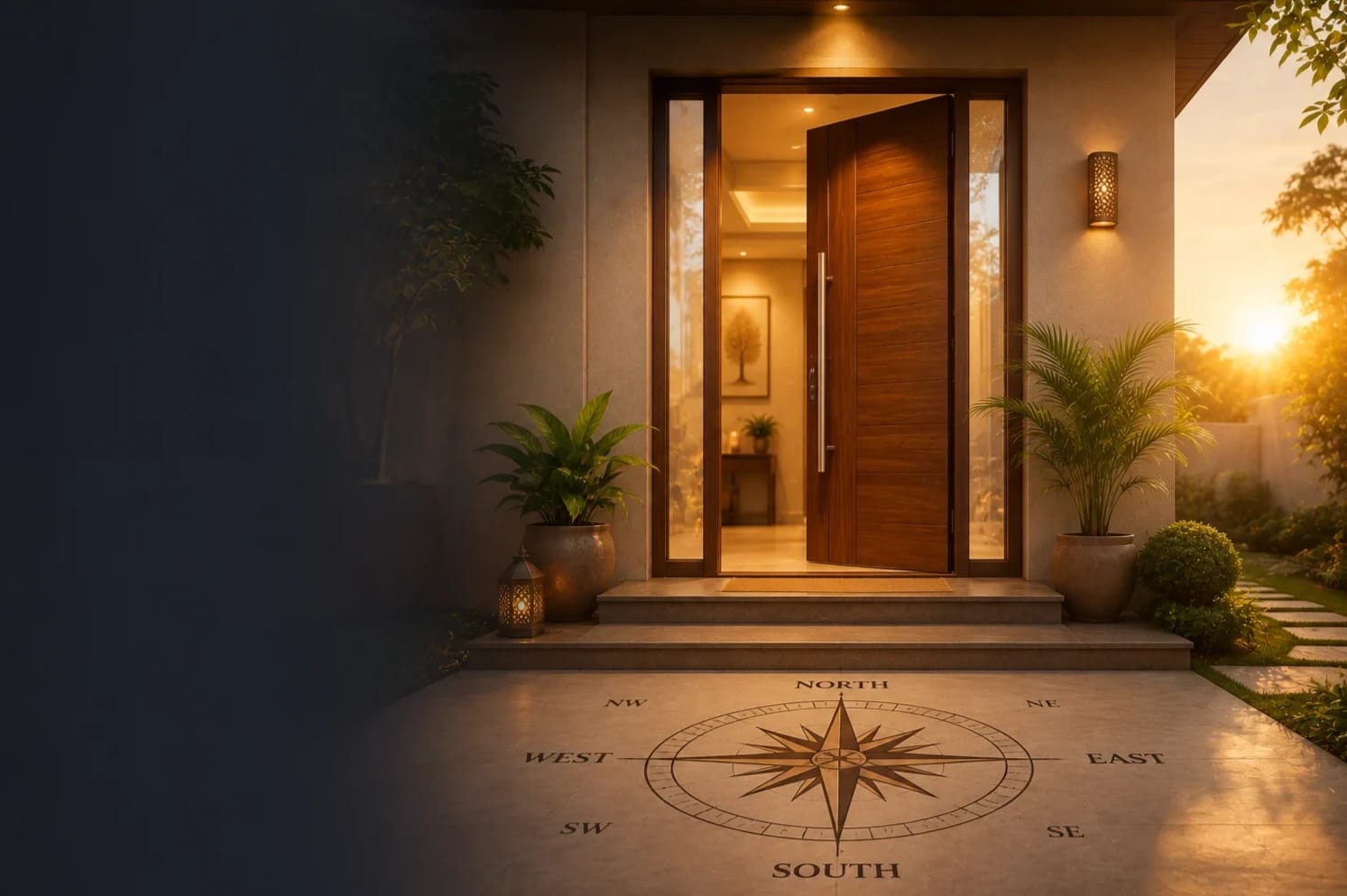
There is a reason the entrance receives so much attention. In both practical and symbolic terms, the main door is the point through which movement, people, activity, attention, sound, and daily flow enter the home. It is the transition point between outside and inside. In traditional Vastu thinking, that makes it extremely important. The entrance is not seen as just a door in a wall. It is treated as the home’s primary receiving point.
But this is also where confusion begins. Many people are told simplistic things like “east-facing is always best,” “south-facing is always bad,” or “one wrong entrance can ruin everything.” These kinds of statements create unnecessary fear. They may sound decisive, but they do not reflect the balanced way Vastu should be understood.
The truth is more nuanced. In Vastu, entrance direction matters, but direction alone is not the whole story. Placement within the direction matters. Cleanliness matters. openness matters. obstruction matters. proportion matters. Surrounding environment matters. The overall house layout matters. A reasonably placed entrance in a non-ideal direction may perform better than a poorly placed or blocked entrance in a supposedly ideal one.
This article is written to give beginners a calmer and more practical understanding of the main door in Vastu. We will look at why the entrance matters, how different directions are traditionally understood, which directions are generally considered more supportive, why south-facing entrances should not automatically be feared, what mistakes weaken an entrance, what matters for flats versus independent houses, and what practical remedies or improvements can be considered if the entrance is not ideal.
The goal is not to make you anxious about your home. The goal is to help you understand the logic behind the advice.
What the Main Door Represents in Vastu
In Vastu Shastra, the main door is often treated as the point through which the house receives movement, interaction, rhythm, and what traditional language may describe as incoming energy. Even if a person does not want to use subtle or spiritual language, the practical idea is still easy to understand: the entrance strongly affects first impressions, daily circulation, openness, and the psychological feel of a home.
Think about how much the entrance influences real life:
- It is where family members enter and leave every day.
- It shapes how guests experience the home.
- It contributes to light, ventilation, and visual openness near the entry zone.
- It affects how welcoming or cramped the house feels.
- It sets the tone for transition from outside pressure to inside comfort.
Traditional Vastu gives the main door symbolic importance because it is the home’s primary threshold. Thresholds are always important in human experience. They are not only physical points but psychological ones. A clean, well-positioned, well-kept entrance tends to feel more settled, inviting, and alive. A broken, dark, obstructed, noisy, or neglected entrance tends to feel uneasy or heavy.
This is why Vastu does not treat the entrance casually. But it is equally important to understand that the main door should be read with proportion. It is an important factor, not a magical switch that determines the entire quality of life.
Does Direction Alone Decide Whether a Main Door Is Good?
This is one of the most important beginner questions, and the honest answer is: no.
Direction matters, but direction alone does not decide everything. A person may hear that north or east entrances are favorable and then assume any north or east main door must be excellent. But if that entrance is cramped, dirty, blocked, damaged, badly proportioned, or awkwardly positioned, the result may still feel poor. Similarly, a south-facing entrance that is well maintained, properly placed, balanced in design, and supported by the rest of the home may not deserve the fear people often attach to it.
This is why experienced Vastu readers do not stop at the simple label of east-facing, west-facing, north-facing, or south-facing. They also consider:
- the exact placement of the door within that side
- whether the entrance opens clearly or faces obstruction
- cleanliness and visual order near the entry point
- the size and proportion of the door
- light and openness near the entrance
- the overall layout of the house or apartment
So if you are trying to understand the best main door direction as per Vastu, keep this principle in mind from the beginning: direction is important, but it is only one part of the entrance reading.
Which Main Door Directions Are Generally Considered Favorable?
In broad traditional Vastu understanding, east and north entrances are often treated as especially favorable. West can also be acceptable or good in many cases. South is the direction that creates the most fear in popular conversation, but this fear is often exaggerated and poorly explained.
A balanced beginner summary would be:
- East-facing main door – often considered very auspicious and supportive
- North-facing main door – often considered beneficial and positive
- West-facing main door – not automatically bad; can be good depending on placement and layout
- South-facing main door – should be judged carefully, but not blindly feared
This already helps remove a common misunderstanding: Vastu is not saying only one direction works and all others fail. It is offering preferences and cautions, not cartoonish absolutes.
To understand why these directional preferences exist, we need to look at each direction more carefully.
East-Facing Main Door in Vastu
East-facing entrances are often regarded very positively in Vastu. Traditionally, the east is associated with the rising sun, light, beginnings, clarity, visibility, and auspicious forward movement. Because sunlight from the east has symbolic and environmental significance, entrances aligned well with this direction are often seen as supportive.
In practical terms, people often experience east-facing entrances as psychologically pleasant because they are linked with morning light and a sense of freshness. In symbolic language, east is connected with growth, visibility, vitality, and a more uplifting beginning to the day.
That said, not every east-facing main door is automatically ideal. A few things still matter:
- Is the door well positioned on the eastern side?
- Is the entrance blocked by clutter or wall congestion?
- Is the doorway dark, neglected, broken, or cramped?
- Does the inside entry zone immediately feel heavy or chaotic?
If these issues are present, even an east-facing entrance may not feel as supportive as expected. So the right conclusion is not “east is always perfect,” but rather “east is traditionally favorable when the entrance is functionally and spatially healthy.”
North-Facing Main Door in Vastu
North-facing entrances are also widely considered favorable in Vastu. The north is often associated with flow, opportunity, movement, prosperity symbolism, and supportive incoming energy. In many traditional readings, north-facing entrances are viewed as beneficial, especially when they are clean, open, and well positioned.
In practical terms, a north-facing entrance may be appreciated for its sense of openness and for the symbolic idea of inviting smoother movement and opportunity into life. Many people specifically search for north-facing properties because they have heard these positive associations repeatedly.
But here too, maturity is needed. A north-facing entrance is not automatically excellent if the entry zone is poorly maintained or badly arranged. If there is constant clutter, darkness, broken framing, sharp obstruction, or a strong sense of compression, the practical experience of the entrance can still feel weak.
So north is generally considered supportive, yes—but like every direction in Vastu, it works best when the actual entrance condition also supports balance.
West-Facing Main Door in Vastu
West-facing entrances are one of the directions most often misunderstood. Many people assume west is automatically weak or undesirable because it is not as praised in popular conversation as east or north. But this is an oversimplification.
In many Vastu interpretations, west-facing entrances can be acceptable, workable, or even beneficial depending on exact placement, house plan, and how the entrance functions in reality. West is not a direction that should be dismissed casually.
Why does west get a mixed reputation? Because people often hear selective advice without context. In some layouts, west may not be as naturally preferred as east or north. But that does not mean west is bad by default. A properly placed, proportionate, clean, open west-facing main door can function quite well.
So if your house or flat has a west-facing entrance, the correct response is not fear. The correct response is assessment. Look at the actual entrance condition, placement, surrounding layout, and room balance before forming a conclusion.
South-Facing Main Door in Vastu: The Most Feared Direction
South-facing entrances are easily the most feared in popular Vastu discussion. Many people have heard blunt statements like “never buy a south-facing house” or “south entrance causes struggle.” These statements are part of why so much unnecessary panic exists around property decisions.
The more balanced truth is this: south-facing entrances require careful reading, but they are not automatically disastrous.
Why are they treated cautiously in traditional Vastu? Because the south is often associated with heavier, more intense, or more controlled directional qualities. In some settings, it is not considered as naturally open or gentle as east or north. This leads to more caution in entrance evaluation.
But caution is not the same as condemnation. Many south-facing homes function perfectly well in real life, especially when:
- the door is properly placed within the southern side
- the entry is clean, bright, and well maintained
- the internal layout is balanced
- the rest of the house supports healthy room distribution
- the entrance is not visually or structurally troubled
This is why mature Vastu readers do not declare all south-facing entrances “bad.” They judge them more carefully. That is a very different thing.
Placement Within the Direction Matters a Lot
This is a point beginners often miss: in Vastu, it is not enough to say that a door is on the east, west, north, or south side. The exact segment or zone within that side can matter significantly.
Traditional Vastu often divides each directional side into smaller sections and interprets those sections differently. This means one north-facing entrance may be considered much better placed than another north-facing entrance on the same wall, depending on where exactly it falls.
This is one reason why people get confused when they compare homes casually. Two properties may both be called “east-facing,” but the exact main door position, interior layout, and surrounding spatial balance may differ greatly.
So if you are evaluating your own home, do not stop at the label of the facing direction. Remember that direction gives the general category, but placement gives the finer meaning.
What Else Makes a Main Door Good Besides Direction?
A supportive main door is not created by direction alone. Several practical and symbolic conditions matter. These include:
- cleanliness – a neglected entrance weakens the psychological and symbolic quality of the entry point
- good lighting – a dark or oppressive entrance feels less inviting and more stagnant
- lack of obstruction – the area immediately around the entrance should not feel blocked or congested
- proper door condition – broken, noisy, damaged, or poorly fitted doors reduce the sense of order
- welcoming entry zone – the house should not feel hostile or cramped the moment one enters
- reasonable proportion – the door should feel appropriately sized and placed for the home
This is why a practical Vastu reading often overlaps with common-sense spatial design. An entrance that is open, maintained, balanced, and functionally welcoming tends to feel more supportive regardless of whether it is east, north, west, or south.
In other words, the quality of the entrance experience matters almost as much as the direction itself.
Common Main Door Mistakes People Make
When people ask about the best main door direction, they often forget that many entrance problems come not from direction but from poor maintenance and poor use. Some common mistakes include:
- keeping shoes, boxes, garbage, or random clutter piled at the door
- allowing the entrance to remain dark or unpleasant
- using a damaged or noisy main door for years without repair
- having sharp visual obstruction immediately outside the entrance
- keeping the entry zone dirty, cramped, or unwelcoming
- treating the entrance like a leftover utility corner instead of the home’s threshold
These are not small things. Even from a purely psychological and practical point of view, the entrance influences how the home is experienced. Vastu simply gives that insight a stronger framework.
So before worrying about whether your entrance is one direction or another, it is worth asking: Have I made the entrance itself healthy, clear, and dignified?
Main Door Vastu for Flats and Apartments
Modern readers often live in flats or apartments, where they cannot choose or redesign the plot freely. This raises a very practical question: if the building is already constructed, how much does entrance direction still matter?
The answer is that it still matters, but application must become realistic and adaptive.
In a flat, you usually cannot move the main door. So the wise approach is not to become hopeless if the entrance is not ideal. Instead, focus on what can still be improved:
- keep the entrance clean and bright
- reduce clutter near the doorway
- maintain the door in good condition
- create a welcoming internal entry feel
- support the home with better room-wise Vastu where possible
This is important because many urban families become unnecessarily anxious after hearing rigid Vastu rules. A flat is not the same as a custom-built independent house. Practical Vastu for apartments must respect real constraints.
Direction still matters, yes. But in a modern flat, it should be read with much more proportion than fear.
Should You Reject a House Only Because of Main Door Direction?
This is one of the most practical questions a buyer can ask, and the balanced answer is: usually, no — not without deeper assessment.
If a person rejects an otherwise excellent home only because someone casually said “south-facing is bad” or “west is not ideal,” they may be making a decision based on incomplete understanding.
A property should be judged more broadly:
- How is the main door actually placed?
- What is the overall layout of the home?
- How are kitchen, bedrooms, and toilets arranged?
- Does the home feel airy, usable, and balanced?
- Can practical corrections be made?
- Is the property otherwise strong in location, quality, and real-life suitability?
A truly wise Vastu approach never isolates one factor and turns it into total destiny. The main door is important, but it is still one part of a larger spatial picture.
What to Do If Your Main Door Is Not in an Ideal Direction
If your entrance is not in the direction you would have preferred, the first thing to do is not panic.
Instead, ask practical questions:
- Is the entrance clean and dignified?
- Is the door well maintained?
- Can lighting be improved?
- Can clutter be removed?
- Can the inside entry zone feel calmer and more balanced?
- Can the rest of the home be organized better according to function and direction?
In many real homes, these changes matter more than people realize. A less-than-ideal direction handled intelligently may feel better than an ideal direction handled carelessly.
Some traditions and consultants also recommend symbolic remedies, but even then, the first line of correction should usually be practical: cleanliness, order, maintenance, openness, and respectful use of the entrance zone.
The Healthiest Way to Think About Main Door Vastu
The healthiest Vastu mindset is neither blind faith nor total dismissal. It is proportion.
If you are learning about entrance direction, keep these truths together:
- Yes, direction matters.
- Yes, some directions are generally preferred.
- No, one imperfect direction does not automatically destroy a home.
- No, a favorable direction does not fix bad maintenance or bad design.
- Yes, the entrance should be treated with respect.
- Yes, practical improvements matter a lot.
This is the difference between thoughtful Vastu and fear-based Vastu. Thoughtful Vastu helps you improve the home. Fear-based Vastu makes you afraid of living in it.
Final Thoughts on the Best Main Door Direction as per Vastu
So what is the best main door direction as per Vastu? In broad traditional understanding, east and north are often considered especially favorable. West can also be acceptable or good depending on placement and layout. South should be judged with greater care, but it should not be blindly feared.
The deeper truth, however, is even more important: the best entrance is not created by direction alone. It also depends on exact placement, cleanliness, openness, maintenance, proportion, and the overall balance of the home.
If you want the shortest possible takeaway, remember this: choose a main door direction wisely if you have the choice, but never judge an entrance by direction alone. A well-kept, well-placed, unobstructed entrance is far more meaningful than fear-based labels.
That is the balanced Vastu way to understand the main door.
Editorial insight
In Vastu, the main door matters because it is the threshold through which the home receives movement, interaction, and symbolic flow. But a wise reading never stops at direction alone; it also asks whether the entrance is balanced, open, clean, and properly maintained.
- My Destiny Path Editorial Team
Real-Life Case Study
A family once rejected several good properties because they had heard that only one entrance direction was truly auspicious. Eventually they found a home they liked deeply, but the entrance direction made them anxious because relatives had warned them against it. When the property was studied more carefully, it became clear that the door was well placed, the entry area was open and bright, the internal layout was balanced, and the rest of the house functioned far better than several supposedly “better” options they had seen earlier. Instead of reacting to a label alone, they chose to understand the entrance in full context. That shift helped them make a calmer and more intelligent decision. This is often the real value of Vastu — not forcing fear, but encouraging better judgment about space.
Key terms in this article
- House
- A life area in the birth chart, such as marriage, career, wealth, home, or health.